
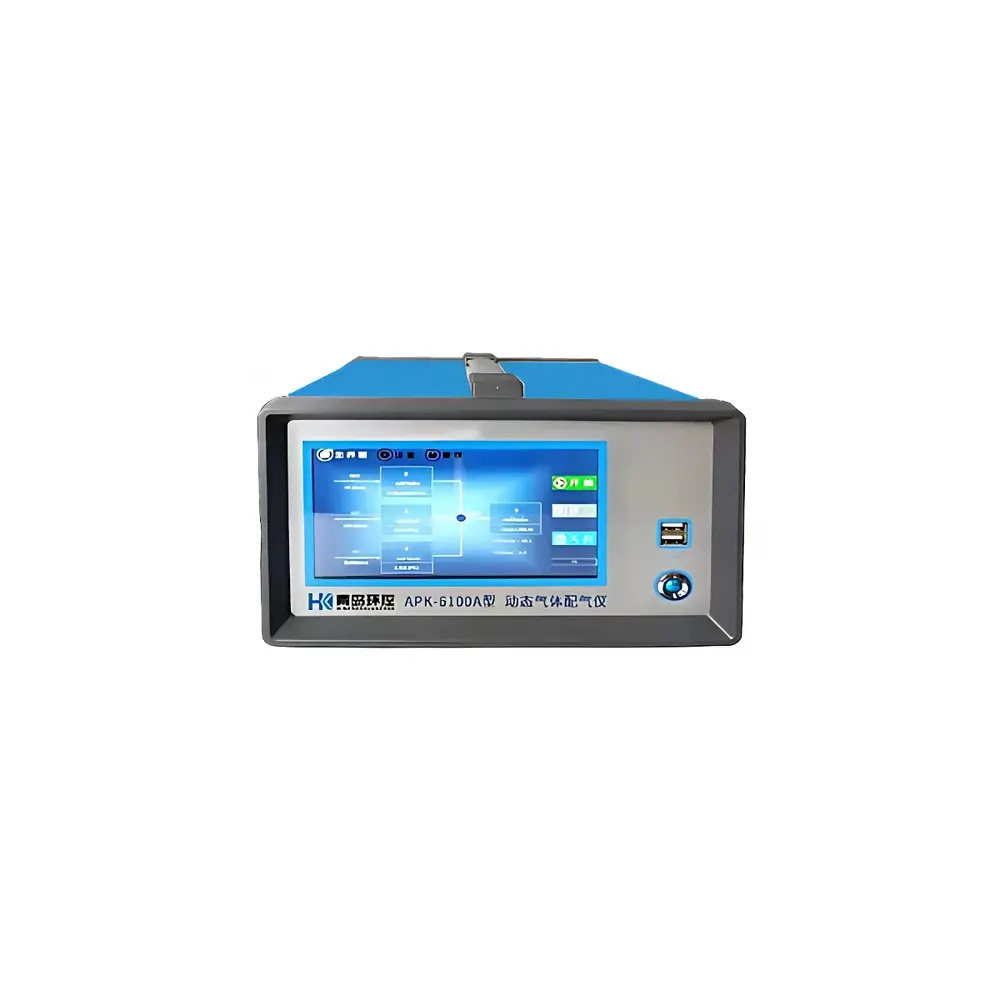
HUANKONG GHK-6100A Dynamic Gas Dilution System
| Brand | HUANKONG |
|---|---|
| Origin | Shandong, China |
| Manufacturer Type | OEM Manufacturer |
| Country of Origin | China |
| Model | GHK-6100A |
| Pricing | Upon Request |
| Flow Control Technology | Thermal Mass Flow Controllers (MFCs) |
| Compliance | GB/T 5275.7–2014 / ISO 6145-7:2009 |
| Referenced Methods | HJ 57–2017, HJ 1261–2022 |
| Material Construction | 316L Stainless Steel & PTFE Tubing |
| Temperature & Pressure Compensation | Integrated |
| Filtration | 5 µm Particulate Filter |
| Battery Runtime | ≥4 h (internal Li-ion) |
| Configurable Output Channels | Expandable per user specification |
Overview
The HUANKONG GHK-6100A Dynamic Gas Dilution System is an engineered solution for the precise, real-time generation of certified calibration gas mixtures in environmental monitoring, emissions testing, and laboratory QA/QC workflows. It operates on the principle of dynamic volumetric dilution—using calibrated thermal mass flow controllers (MFCs) to meter primary standard gases (e.g., SO₂, NOₓ, benzene, CO) and high-purity zero air or nitrogen into a controlled mixing manifold. By maintaining laminar, non-reactive flow paths and applying real-time temperature and pressure compensation, the system achieves traceable concentration accuracy across dilution ratios from 1:10 to 1:10,000. Designed specifically for compliance with GB/T 5275.7–2014 and its international counterpart ISO 6145-7:2009, the GHK-6100A supports traceable calibrations required under regulatory frameworks including China’s HJ 57–2017 (SO₂ by potentiometric electrolysis) and HJ 1261–2022 (BTEX analysis via gas-tight bag sampling and direct GC injection). Its architecture prioritizes metrological integrity over throughput speed—making it suitable for reference-grade calibration rather than process control applications.
Key Features
- Thermal mass flow controllers with ±0.8% reading accuracy and repeatability better than ±0.2% FS, certified to ISO 6145-7:2009 Annex C verification protocols
- Chemically inert fluidic path constructed from electropolished 316L stainless steel and virgin PTFE tubing to minimize adsorption, catalytic decomposition, and memory effects—critical for reactive species (e.g., NH₃, Cl₂, H₂S)
- Automated dilution algorithm: input source concentration, target output concentration, and desired total flow rate; system computes and regulates individual MFC setpoints without manual recalibration
- Onboard temperature (±0.2 °C) and absolute pressure (±0.1 kPa) sensors feed real-time corrections to MFC mass flow calculations, ensuring consistent volumetric dilution across ambient fluctuations (15–35 °C, 80–106 kPa)
- Programmable time-segmented output: up to 99 concentration steps per run, each with independent flow, dwell time, and ramp profiles—enabling automated multi-point calibration sequences
- Integrated 5 µm sintered stainless-steel particulate filter upstream of all MFCs to protect sensitive thermal sensors from dust, aerosols, and condensate ingress
- Field-replaceable internal Li-ion battery pack supporting ≥4 hours of continuous operation during mobile audits or off-grid site validation
Sample Compatibility & Compliance
The GHK-6100A accommodates single- or multi-component standard gases supplied in aluminum or stainless-steel lecture bottles (up to 20 MPa), including certified reference materials (CRMs) traceable to NIM (China) or NIST (USA). It is validated for use with common calibration standards: SO₂/N₂ (0.5–100 ppm), NO/NO₂/N₂ (0.1–50 ppm), benzene in air (0.05–5 ppm), and O₃ in oxygen (0.1–10 ppm). All wetted materials comply with ASTM F2218 (biocompatibility of polymer components) and USP Class VI requirements for extractables. The system meets the functional requirements of ISO/IEC 17025:2017 Clause 6.4.10 for calibration gas generators used in accredited laboratories. Full audit trails—including MFC setpoints, actual flows, T/P readings, and operator timestamps—are retained for GLP/GMP-aligned data integrity.
Software & Data Management
The GHK-6100A includes embedded firmware with USB-C and RS-232 interfaces for integration into LIMS or SCADA environments. A Windows-compatible configuration utility enables secure parameter upload/download, firmware updates, and calibration certificate import (in .csv or .xml format per ISO/IEC 17025 Appendix B). All operational logs are timestamped and digitally signed to satisfy FDA 21 CFR Part 11 requirements for electronic records and signatures. No cloud dependency: raw data remains local unless explicitly exported. Optional Ethernet module supports Modbus TCP for remote monitoring in central control rooms.
Applications
- Calibration of fixed and portable gas analyzers deployed in CEMS (Continuous Emission Monitoring Systems) per HJ 75–2017
- Verification of electrochemical, PID, and FTIR-based gas sensors used in occupational health and safety monitoring
- Preparation of multi-level calibration curves for EPA Method TO-15, HJ 1261–2022, and ISO 16017-1
- Dynamic challenge testing of air quality sensor networks under variable humidity and temperature conditions
- Reference gas generation for method validation studies conducted under CNAS-CL01:2018 (equivalent to ISO/IEC 17025)
FAQ
Does the GHK-6100A support automatic verification against primary standards?
Yes—the system accepts external gravimetric or manometric CRM certificates as reference inputs; its dilution algorithm cross-validates output concentrations against certified source values using uncertainty propagation per GUM (JCGM 100:2008).
Can it generate humidified calibration gases?
Not natively. Humidification requires external saturation modules (e.g., permeation tubes or Nafion dryers); the GHK-6100A maintains strict dry-gas handling to preserve MFC stability.
Is firmware upgrade capability available post-purchase?
Yes—field-upgradable via USB drive or serial interface; version history and release notes are provided with each update per IEC 62304 Class B software lifecycle requirements.
What documentation is supplied for regulatory audits?
Factory calibration reports (traceable to NIM), ISO 6145-7 conformance statement, material compliance certificates (RoHS, REACH), and full electrical safety test report (GB 4793.1–2019 / IEC 61010-1).







