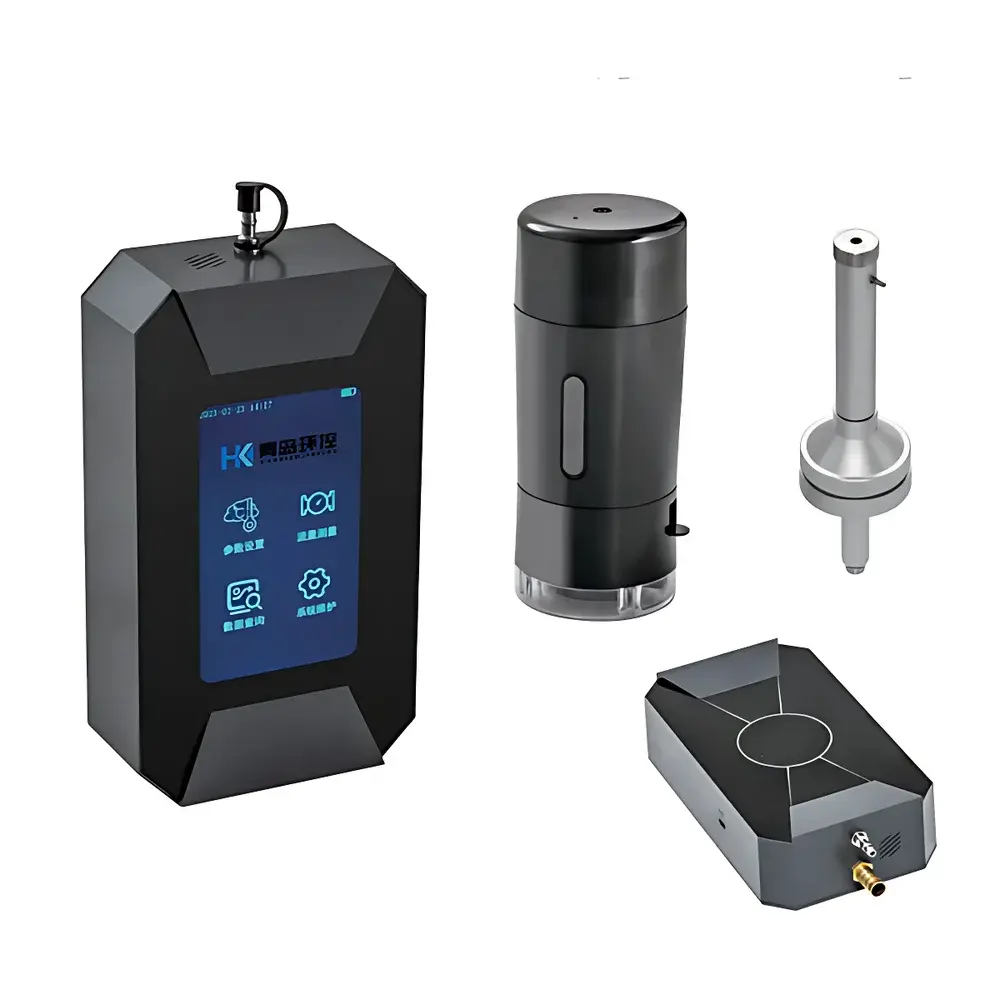
HUANKONG GHK-7000 Electronic Orifice & Soap Film Flow Calibrator
| Brand | HUANKONG |
|---|---|
| Origin | Shandong, China |
| Manufacturer Type | OEM/ODM Manufacturer |
| Regional Category | Domestic (China) |
| Model | GHK-7000 |
| Pricing | Upon Request |
| Flow Measurement Principle | Differential Pressure |
| Key Components | Orifice Module, Soap Film Module, Thermal Mass Flow Module, Microcontroller Unit, TFT Touch Display |
| Calibration Standards | JJG 586–2006, JJG 700–2016, JJF 2033–2023 |
| Operating Modes | Real-time flow display (actual, STP @ 273.15 K / 101.325 kPa, NTP @ 293.15 K / 101.325 kPa, RTP @ 298.15 K / 101.325 kPa) |
| Data Storage | 80 entries per range |
| Power Supply | Rechargeable Li-ion battery (>8 h runtime) |
| Interface | USB port (U-disk export supported), Optional Bluetooth thermal printer |
| Environmental Input | Manual barometric pressure & ambient temperature entry |
| Sensor Calibration | Digital calibration for flow, differential pressure, temperature, time, and battery voltage |
Overview
The HUANKONG GHK-7000 Electronic Orifice & Soap Film Flow Calibrator is a multi-modal, portable primary standard flow verification instrument engineered for metrological traceability in environmental monitoring, industrial hygiene, and analytical laboratory settings. It integrates three complementary flow measurement technologies—soap film volumetric displacement, orifice-based differential pressure (DP), and thermal mass flow sensing—within a single embedded microcontroller platform. Unlike secondary indicating devices, the GHK-7000 functions as a transfer standard capable of calibrating and verifying flow rates across a wide dynamic range (from sub-10 mL/min to >30 L/min), supporting compliance with national verification regulations including JJG 586–2006 (Soap Film Flowmeters), JJF 2033–2023 (Orifice Flowmeter Calibration), and JJG 700–2016 (Gas Chromatograph Flow Verification). Its design adheres to fundamental fluid mechanics principles: soap film operation relies on precise timing of meniscus transit through a calibrated glass tube (volumetric method); orifice mode applies ISO 5167-compliant DP equations using high-stability silicon piezoresistive sensors; and thermal mass mode employs constant-temperature anemometry for direct mass flow readout under varying gas composition and temperature conditions.
Key Features
- Tri-modal architecture: Interchangeable soap film tubes (5 ranges), orifice plates (7 ranges), and thermal mass flow sensors (3 ranges) share one unified control unit—eliminating cross-instrument variability and reducing lab footprint.
- TFT color touchscreen interface with intuitive icon-driven navigation, supporting multilingual prompts (English firmware available) and real-time graphical feedback during calibration sequences.
- Four standardized flow reporting modes: actual volumetric flow, and three reference conditions—STP (273.15 K, 101.325 kPa), NTP (293.15 K, 101.325 kPa), and RTP (298.15 K, 101.325 kPa)—all computed in real time using integrated temperature and pressure compensation algorithms.
- Digital calibration suite: On-device adjustment of soap film tube volume, orifice discharge coefficient, sensor zero/span, clock drift, and battery voltage offset—traceable via internal audit log.
- Embedded non-volatile memory stores up to 80 calibration records per flow module, each timestamped and tagged with operator ID, ambient conditions, and uncertainty estimates.
- USB host interface enables direct data export to FAT32-formatted USB drives; optional Bluetooth 5.0 module supports wireless pairing with certified thermal printers for GLP-compliant hardcopy generation.
- Manual environmental input override allows users to enter locally measured barometric pressure and dry-bulb temperature—critical for minimizing systematic error when ambient sensors exhibit drift or are exposed to radiant heating near sampling manifolds.
Sample Compatibility & Compliance
The GHK-7000 is validated for use with air, nitrogen, helium, carbon dioxide, and common VOC carrier gases (e.g., methane, propane, toluene vapor at <10% v/v) within operating temperature range 5–40 °C and relative humidity ≤80% RH (non-condensing). It meets mechanical and electrical safety requirements per GB 4793.1–2018 (equivalent to IEC 61010-1). All firmware and calibration logic comply with metrological traceability requirements outlined in JJF 1001–2011 (General Terms and Definitions of Metrology) and support audit-ready documentation for ISO/IEC 17025-accredited laboratories. While not FDA 21 CFR Part 11-certified out-of-box, its data export format (CSV with SHA-256 hash) and immutable audit trail enable integration into validated LIMS environments under client-defined SOPs.
Software & Data Management
Data acquisition and reporting are managed entirely onboard—no PC dependency required. Each calibration event generates a structured record containing raw sensor outputs (transit time, ΔP, temperature, voltage), compensated flow values, user-entered metadata (instrument ID, gas type, operator), and cryptographic integrity checksums. Exported CSV files conform to ASTM D6196–22 Annex A1 formatting for interoperability with commercial calibration management software (e.g., MET/TEAM, Qualer). Firmware updates are delivered via signed .bin files over USB; version history and change logs are retained in device memory for regulatory review.
Applications
- Periodic verification of low-flow samplers used in PM2.5/PM10 ambient air monitoring networks (EPA Method IO-3.2, ISO 7708).
- Field calibration of stack gas analyzers and continuous emission monitoring systems (CEMS) per EPA Performance Specification 2 and EN 15267.
- Validation of VOC canister and sorbent tube sampling pumps prior to GC-FID/ECD analysis (TO-17, ASTM D6196).
- Flow rate certification of gas chromatograph carrier lines, purge-and-trap systems, and headspace autosamplers.
- Verification of rotameters, variable-area meters, and digital mass flow controllers in HVAC commissioning and cleanroom validation.
FAQ
What gas types are supported for thermal mass flow calibration?
Nitrogen, air, helium, CO₂, and hydrocarbon vapors (methane, propane, benzene, toluene) up to 10% v/v in air—calibration coefficients are preloaded; custom gas matrices require factory configuration.
Does the GHK-7000 meet international calibration standards such as ISO/IEC 17025?
It serves as a verified transfer standard compliant with JJG/JJF national regulations; full ISO/IEC 17025 accreditation requires lab-specific uncertainty budgeting and documented metrological hierarchy—supported by provided calibration certificates and uncertainty statements.
Can the soap film module be used for wet-gas or aerosol-laden streams?
No—soap film operation requires particle-free, non-condensing, non-reactive gases; particulate or condensable vapors will disrupt meniscus formation and compromise volumetric accuracy.
Is firmware upgrade capability available post-purchase?
Yes—field-upgradable via USB with digitally signed firmware images; version history and patch notes are accessible in-system under Settings > System Info.
What is the typical measurement uncertainty for orifice mode at 10 L/min?
±1.2% of reading (k=2), derived from combined uncertainty components: DP sensor linearity (±0.5%), temperature compensation (±0.3%), orifice plate dimensional tolerance (±0.4%), and repeatability (±0.2%).