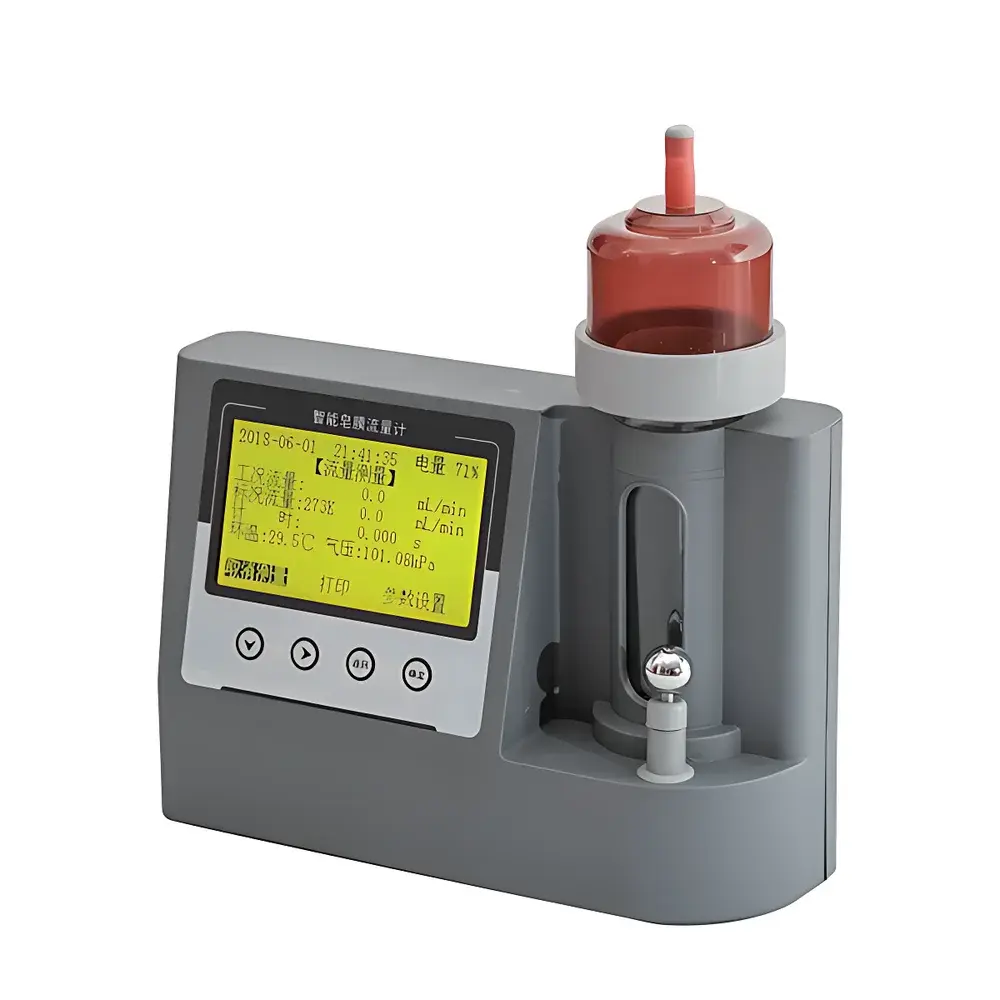
HUANKONG GHK-7100 Intelligent Electronic Soap Film Flowmeter
| Brand | HUANKONG |
|---|---|
| Origin | Shandong, China |
| Manufacturer Type | Manufacturer |
| Country of Origin | China |
| Model | GHK-7100 |
| Price | USD 1,150 (FOB) |
| Flow Measurement Principle | Differential Pressure (Soap Film Method) |
| Display | Large LCD with Chinese/English bilingual interface |
| Time Resolution | 0.001 s |
| Power Supply | AC/DC dual-mode |
| Operating Conditions Compensation | Automatic temperature (°C), pressure (kPa), and volume correction for standard conditions at 273.15 K / 101.325 kPa and 293.15 K / 101.325 kPa |
| Data Output | Optional thermal mini-printer support |
| Compliance | JJG 586–2006 Verification Regulation for Soap Film Flowmeters |
| Electromagnetic Compatibility | IEC 61326-1 compliant design |
Overview
The HUANKONG GHK-7100 Intelligent Electronic Soap Film Flowmeter is a precision volumetric flow calibration instrument engineered for traceable, low-flow gas measurement in laboratory, environmental monitoring, and industrial QA/QC applications. It operates on the well-established soap film displacement principle — a gravimetrically traceable primary method where a calibrated soap film traverses a vertically oriented glass tube of known internal cross-sectional area. The elapsed time for the film to pass between two optically detected reference marks is measured with microsecond-level timing resolution (0.001 s), enabling direct calculation of volumetric flow rate via Q = V/t. Unlike inferential devices such as thermal mass or turbine meters, the GHK-7100 delivers inherently high reproducibility (< ±0.5% reading) without requiring periodic recalibration against master standards — making it ideal for verifying and certifying flow rates in regulatory-compliant sampling systems.
Key Features
- High-resolution optical detection system using infrared photogates with sub-millisecond timing accuracy (±0.001 s)
- Dual-standard condition compensation: real-time conversion to standard volume at both 273.15 K / 101.325 kPa (STP) and 293.15 K / 101.325 kPa (NTP), per ISO 10780 and EPA Method 4
- Bilingual (English/Chinese) graphical LCD interface with intuitive menu navigation and context-sensitive prompts
- Integrated environmental sensors: digital temperature (±0.2 °C) and absolute pressure (±0.1 kPa) for dynamic flow correction
- Robust electromagnetic compatibility (EMC) architecture conforming to IEC 61326-1 for stable operation in electrically noisy field environments
- Modular mechanical design with precision-ground borosilicate glass measuring tubes and injection-molded polymer housing for long-term dimensional stability
- Onboard non-volatile memory storing up to 500 measurement records with timestamp, ambient T/P, and corrected flow values
Sample Compatibility & Compliance
The GHK-7100 is validated for use with clean, dry, non-corrosive gases including air, nitrogen, oxygen, carbon dioxide, and synthetic calibration mixtures. It supports flow ranges from 10 mL/min to 30 L/min, selectable via interchangeable glass tubes (not included; ordered separately per JJG 586–2006 Table 1). All configurations comply with national metrological verification requirements under JJG 586–2006, and its traceable measurement methodology satisfies ISO/IEC 17025 clause 6.5.2 for calibration equipment used in accredited laboratories. When deployed in GLP or GMP-regulated workflows — such as EPA-compliant stack testing or USP gas flow verification — the device supports audit-ready data logging when paired with optional printer output and manual record retention.
Software & Data Management
While the GHK-7100 operates autonomously without PC connectivity, its embedded firmware implements full audit-trail logic: each measurement event logs date/time, raw transit time, ambient temperature and pressure, user-applied correction factors, and final corrected flow value. All parameters are stored in write-protected memory with no editable fields, satisfying FDA 21 CFR Part 11 “electronic record” baseline requirements when combined with procedural controls. Optional thermal mini-printer (model PR-201) provides hard-copy output with header identification, operator ID field, and calibration certificate reference number — suitable for inclusion in QC batch records or third-party inspection reports.
Applications
- Calibration and verification of low-flow gas sampling instruments: personal dust samplers (NIOSH Method 0500), microbial impactors (ISO 14698), and portable VOC monitors
- Field validation of ambient air quality analyzers (e.g., O₃, NOₓ, SO₂) per EPA Performance Evaluation Protocols
- Flow rate certification for gas chromatography carrier gas delivery systems (helium, hydrogen, nitrogen)
- Verification of exhaust flow in laboratory fume hoods and cleanroom ventilation ducts
- Primary standard transfer in metrology labs performing inter-laboratory comparison studies under CIPM MRA frameworks
FAQ
What is the maximum allowable gas moisture content for reliable soap film formation?
The GHK-7100 requires gas relative humidity below 70 % RH to ensure consistent film integrity; desiccant drying or Nafion™ membrane conditioning is recommended for humid samples.
Can the GHK-7100 be used with corrosive gases such as chlorine or ammonia?
No — the glass tube and internal seals are not chemically resistant to halogens or alkaline vapors; only inert or mildly reactive gases are supported.
Is firmware upgrade capability available?
Firmware updates are performed via RS-232 serial interface using proprietary HUANKONG configuration utility; contact technical support for version-controlled release notes and update procedures.
Does the unit include NIST-traceable calibration documentation?
Each GHK-7100 ships with a factory calibration report referencing NIST SRM 2800 (soap film geometry verification) and NIST SP 250-94 (timebase calibration); full traceability statements are provided upon request.
How often should the soap solution be replaced during extended operation?
Typical soap solution (glycerin + sodium lauryl sulfate in deionized water) remains effective for ≥ 8 hours of continuous use; visual inspection for film breakage or residue buildup determines replacement frequency.