
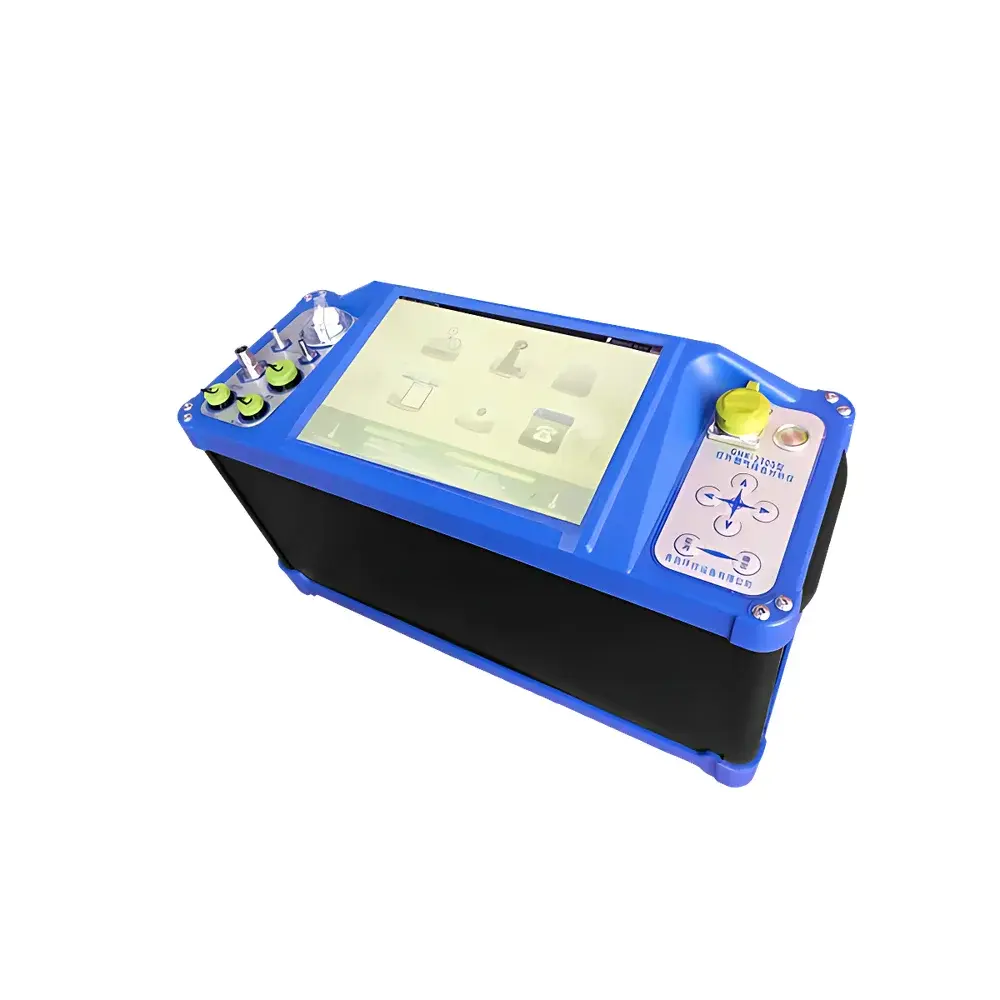
HUANKONG GHK2300 Infrared Multi-Gas Emission Analyzer for NOx, SO₂, CO₂, CO, H₂S, O₂, CH₄ and N₂O
| Brand | HUANKONG |
|---|---|
| Origin | Shandong, China |
| Manufacturer Type | Direct Manufacturer |
| Model | GHK2300 |
| Measurement Principle | Non-Dispersive Infrared (NDIR) Absorption |
| Gas Species | NOx (NO + NO₂), SO₂, CO₂, CO, H₂S, O₂, CH₄, N₂O |
| Sample Conditioning | Integrated dual-stage dew point suppression (semiconductor + membrane dryer), heated sampling probe with titanium alloy inner tube, automatic humidity cutoff protection |
| Display | High-brightness color touchscreen (touch + keypad interface) |
| Power Supply | DC 12–26 V / AC 80–260 V (with reverse polarity, overvoltage & overcurrent protection) |
| Battery | Rechargeable Li-ion, ≥4 h continuous operation (host + probe) |
| Data Storage | High-capacity internal memory (minute-level & average data), USB export supported |
| Connectivity | Bluetooth printer standard, optional IoT module for remote telemetry and cloud integration |
| Compliance | JJG968-2002, HJ/T397-2007, HJ629-2011, HJ692-2014, HJ870-2017, HJ/T44-1999, GB/T16157-1996 |
Overview
The HUANKONG GHK2300 Infrared Multi-Gas Emission Analyzer is an industrial-grade, portable stack emission monitoring system engineered for accurate, real-time quantification of gaseous pollutants in flue gas streams from stationary sources. It operates on the principle of non-dispersive infrared (NDIR) absorption spectroscopy — a well-established, reference-grade methodology standardized under multiple Chinese environmental regulatory protocols including HJ692-2014 (NOx), HJ629-2011 (SO2), and HJ870-2017 (CO2). Unlike single-gas analyzers, the GHK2300 simultaneously measures up to eight key constituents: nitrogen oxides (NO and NO2, reported as NOx), sulfur dioxide (SO2), carbon dioxide (CO2), carbon monoxide (CO), hydrogen sulfide (H2S), oxygen (O2), methane (CH4), and nitrous oxide (N2O). Its design targets compliance-driven applications in environmental inspection agencies, thermal power plants, cement kilns, waste incinerators, and industrial boiler operations where trace-level accuracy, long-term stability, and field robustness are mandatory.
Key Features
- Integrated tri-functional probe: Combines Pitot tube (rotatable for optimal alignment), heated gas sampling tube, and inline pre-conditioner — minimizing transport losses and enabling simultaneous velocity, temperature, and concentration measurements.
- Dual-stage moisture management: Semiconductor thermoelectric cooler paired with hydrophobic membrane dryer ensures ≤10% water-soluble gas loss (e.g., SO2, NH3) while maintaining dew point 15% v/v).
- Titanium alloy sampling tube: Corrosion-resistant, non-catalytic, low-adsorption inner conduit rated to 200 °C continuous duty; eliminates cross-contamination and preserves reactive species integrity during transit.
- Intelligent humidity safeguard: Built-in capacitive humidity sensor triggers automatic shutdown when stack moisture exceeds instrument tolerance — preventing optical window condensation and sensor drift.
- Four-in-one cable assembly: Consolidates thermocouple signal (smoke temperature), RS232/RS485 communication, DC power, and conditioned sample gas into a single armored cable with quick-connect fittings — reducing field setup time by >40%.
- EMC-hardened architecture: Meets IEC 61326-1 Class A immunity requirements; includes galvanic isolation, multi-layer PCB shielding, and ESD-protected front panel — validated for operation near VFDs, SCR systems, and electrostatic precipitators.
Sample Compatibility & Compliance
The GHK2300 is designed for direct insertion into ducts and stacks with diameters ≥150 mm and flue gas temperatures up to 200 °C. It accommodates particulate loadings ≤100 mg/m³ without filter clogging, thanks to its integrated cyclonic dust separator and self-cleaning optical path design. All measurement algorithms adhere to the linearity, zero/span stability, and interference rejection criteria specified in HJ/T397-2007 for field-deployed emission analyzers. The system supports audit-ready data logging per GLP-aligned practices: each stored record contains timestamp, GPS coordinates (when enabled), operator ID, calibration history, and raw spectral absorbance values. Full traceability is maintained through configurable audit trails compliant with ISO/IEC 17025 documentation requirements.
Software & Data Management
The embedded firmware provides dual-mode operation: standalone field mode (touchscreen GUI with intuitive workflow navigation) and PC-connected mode (via USB or Bluetooth) for advanced configuration and report generation. Internal memory stores ≥12 months of minute-averaged data (time-stamped, with QA/QC flags). Data export is supported via FAT32-formatted USB drives in CSV and PDF formats — compatible with national emission reporting platforms (e.g., China’s National Emission Permit Management Information Platform). Optional IoT firmware enables MQTT-based transmission to private or public cloud servers, supporting TLS 1.2 encryption and device authentication via X.509 certificates. Remote diagnostics, over-the-air updates, and alarm-triggered SMS/email notifications are configurable through the web-based fleet management portal.
Applications
- Regulatory stack testing per HJ/T397-2007 and local environmental bureau mandates
- CEMS performance verification and QA/QC auditing of continuous emission monitoring systems
- Combustion efficiency optimization in coal-fired and biomass boilers via O2/CO/CO2 balance analysis
- De-NOx system evaluation (SCR/SNCR) using differential NOx profiles across catalyst beds
- Greenhouse gas inventory support (CO2, CH4, N2O) aligned with IPCC Tier 2 methodologies
- Process troubleshooting in petrochemical cracking units and sulfur recovery trains (H2S, SO2, CO)
FAQ
Does the GHK2300 require daily calibration? Why or why not?
No. The analyzer employs dual-beam NDIR optics with sealed reference cells and temperature-compensated detectors, enabling stable baseline performance for ≥7 days between span checks. Zero calibration is recommended before each field deployment; span calibration is required every 72 hours for regulatory audits per HJ/T397-2007.
Can it measure NO and NO₂ separately, or only as total NOx?
The GHK2300 reports NOx as the sum of NO and NO₂ concentrations. It does not include chemiluminescence or catalytic conversion modules for speciated NO/NO₂ differentiation — consistent with HJ692-2014’s total NOx reporting requirement for stack compliance.
Is the built-in battery certified for air transport?
Yes. The lithium-ion pack complies with UN38.3 and IATA PI 965 Section II requirements, including thermal runaway mitigation and state-of-charge limitation to ≤30% for shipping.
What is the minimum detectable concentration for SO2 under field conditions?
At 1 Hz sampling rate and with dual-stage drying active, the practical limit of detection is 2 ppm (v/v) for SO2 — verified against NIST-traceable calibration gases and meeting HJ629-2011 sensitivity thresholds.
How is data integrity ensured during power interruption?
All measurements are written to non-volatile flash memory with atomic write operations. Power-loss recovery resumes logging from the last committed record without data corruption or timestamp gaps.
Related Products







