
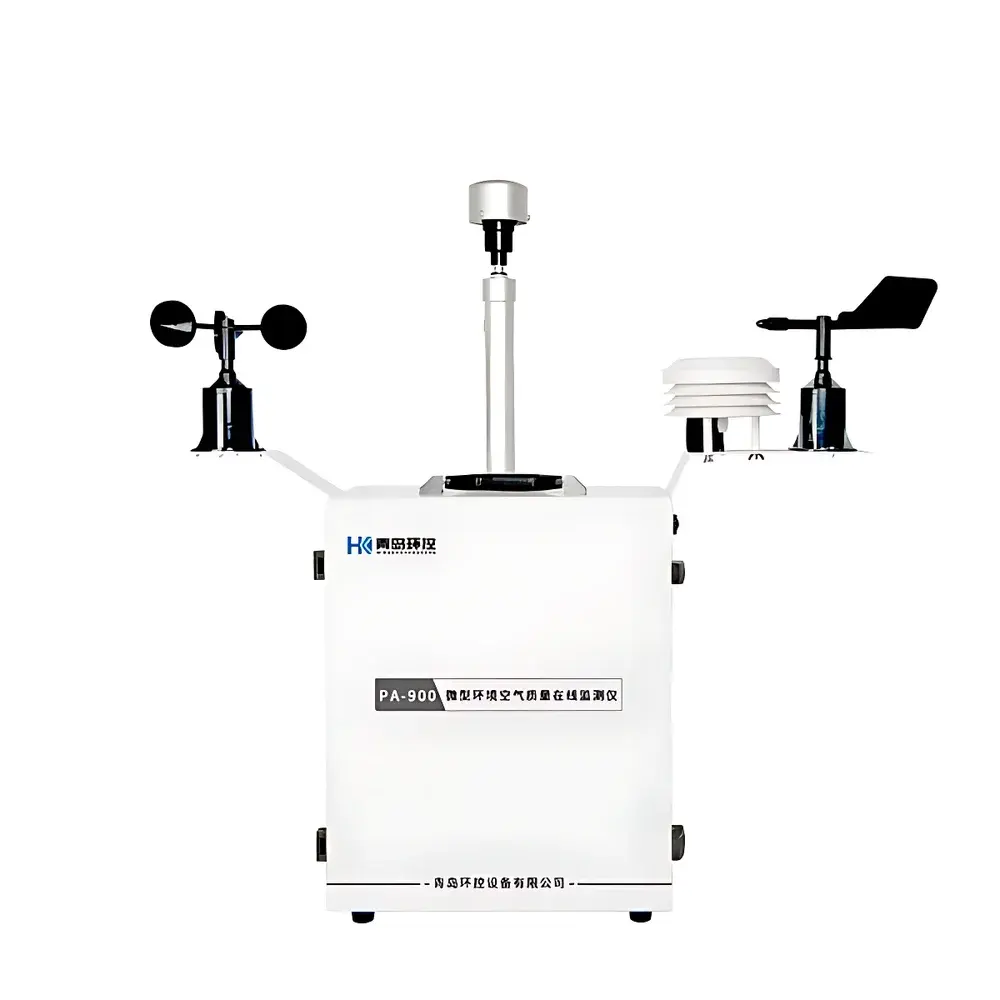
HUANKONG PA-900 Compact Ambient Air Quality Monitoring Station
| Brand | HUANKONG |
|---|---|
| Origin | Shandong, China |
| Manufacturer Type | OEM/ODM Manufacturer |
| Country of Origin | China |
| Model | PA-900 |
| Measurement Principle | Electrochemical & Optical Sensing (NDIR, UV-DOAS, PID) |
| Measured Parameters | TSP, PM₁₀, PM₂.₅, SO₂, NO₂, CO, O₃, CO₂, CH₄, N₂O, VOCs, BTEX (Benzene, Toluene, Ethylbenzene, Xylenes, Styrene, Cumene) |
| Environmental Compliance | GB 3095–2012, HJ 653–2013, HJ 633–2012 / HJ 212–2017, HJ 663–2013 |
| Power Supply | AC 220 V ±10% or Optional Solar + Battery Backup |
| Enclosure Rating | IP65 |
| Data Storage | Local Flash Memory (1-year continuous raw data at 1-min resolution) |
| Communication | Built-in 4G LTE Module, RS-485, Ethernet, MQTT/HTTP/Modbus TCP Support |
| Remote Management | OTA Firmware Updates, Web-based Platform Integration, Audit-Trail Enabled Configuration Logging |
Overview
The HUANKONG PA-900 Compact Ambient Air Quality Monitoring Station is an integrated, modular environmental monitoring system engineered for high-density deployment in urban grids, industrial parks, and enterprise boundary zones. It operates on a multi-sensor fusion architecture—combining electrochemical cells for reactive gases (SO₂, NO₂, CO, O₃), non-dispersive infrared (NDIR) optical modules for CO₂ and CH₄, tunable diode laser absorption spectroscopy (TDLAS) or UV differential optical absorption spectroscopy (UV-DOAS) for N₂O and ozone, and β-ray attenuation or laser scattering principles for particulate mass concentration (TSP, PM₁₀, PM₂.₅). Meteorological parameters—including temperature, relative humidity, wind speed, wind direction, and atmospheric pressure—are concurrently acquired via calibrated micro-sensors. Designed to meet the metrological rigor of Chinese national standards (GB 3095–2012, HJ 653–2013), the PA-900 delivers regulatory-grade data suitable for ambient air quality assessment, source attribution studies, and compliance reporting under municipal and provincial environmental protection bureaus.
Key Features
- Compact footprint (W × D × H: 520 × 420 × 850 mm) enabling rapid installation on lampposts, rooftops, or dedicated poles without civil works
- IP65-rated aluminum alloy enclosure with thermal management design for stable operation across –20 °C to +50 °C and 10–95% RH non-condensing environments
- Multi-tiered power resilience: primary AC 220 V input with optional solar panel + LiFePO₄ battery backup (72 h autonomy at full sensor load)
- Configurable sensor payload: base unit covers PM₂.₅/PM₁₀/TSP + meteorology; optional plug-in modules for greenhouse gases (CO₂, CH₄, N₂O), aromatic VOCs (BTEX), and noise (Class 2 sound level meter per IEC 61672)
- Real-time alarm logic with programmable thresholds, relay outputs, and MQTT-triggered notifications for integration into SCADA or EMS platforms
- Built-in 4G LTE Cat 4 module with dual-SIM failover, TLS 1.2 encrypted data transmission, and automatic NTP time synchronization
Sample Compatibility & Compliance
The PA-900 is validated for continuous unattended operation in ambient air matrices containing typical urban/industrial aerosol loadings (0–1000 µg/m³ PM₂.₅), trace gas concentrations (e.g., 0–500 ppb NO₂, 0–100 ppm CO), and volatile organic compounds (0.1–10 ppm benzene equivalent). Its sensor calibration protocols align with HJ 653–2013 requirements for zero/span verification frequency, drift tolerance (≤±5% FS/7 d), and inter-comparison performance against reference analyzers. All firmware and data handling routines support audit-ready logging per GLP-aligned workflows. Data packet structure conforms to HJ 212–2017 framing rules, including device ID, timestamp (UTC), measurement values, quality flags (QF), and checksum fields—ensuring seamless ingestion into provincial-level environmental information platforms.
Software & Data Management
Data acquisition occurs at 1-minute intervals, stored locally in industrial-grade flash memory with circular overwrite capability (retaining ≥1 year of raw sensor readings, meteorological vectors, and diagnostic logs). Field access is enabled via USB port for manual data export (CSV/JSON) or secure firmware updates. The optional HUANKONG Cloud Platform provides role-based web access: administrators configure sampling schedules, calibration events, and alarm rules; end users visualize time-series plots (instantaneous, 1-min avg, hourly/daily means), generate PDF reports compliant with HJ 663–2013 evaluation methodology, and trigger remote zero/span procedures. Platform audit trails record all configuration changes, user logins, and OTA update histories—supporting internal QA reviews and external regulatory inspections under ISO/IEC 17025 frameworks.
Applications
- Urban air quality grid monitoring: high-resolution mapping of pollution hotspots and dispersion modeling input
- Industrial fence-line monitoring: real-time tracking of fugitive emissions from chemical plants, refineries, and manufacturing facilities
- Greenhouse gas inventory support: long-term CO₂/CH₄/N₂O trend analysis aligned with national MRV (Measurement, Reporting, Verification) protocols
- VOCs source identification: BTEX speciation for odor complaint investigations and risk-based exposure assessments
- Smart city infrastructure: integration with traffic management systems, public health dashboards, and emergency response decision engines
- Academic and research deployments: low-cost node networks for atmospheric chemistry field campaigns and sensor validation studies
FAQ
Does the PA-900 comply with international calibration standards such as ISO 12039 or EN 14625?
The PA-900 adheres to Chinese national standards (GB/HJ series) and is designed for domestic regulatory acceptance. While not certified to EN or ISO gas analyzer standards, its sensor modules undergo factory calibration traceable to NIM (National Institute of Metrology, China) reference gases.
Can the system operate autonomously during extended power outages?
Yes—when equipped with the optional solar + battery kit, the PA-900 maintains full functionality for up to 72 hours without grid power, including active sampling, data logging, and 4G telemetry.
Is raw sensor output accessible for third-party algorithm development?
Yes—RS-485 Modbus RTU interface provides direct register-level access to unprocessed ADC counts, temperature-compensated voltage outputs, and diagnostic registers, facilitating custom signal processing and machine learning model training.
How frequently does the system require maintenance or recalibration?
Zero/span checks are recommended every 7 days for gaseous sensors and monthly for particulate channels per HJ 653–2013; filter replacements every 3 months in high-dust environments; full sensor replacement interval is 24 months under normal operating conditions.
Does the platform support FDA 21 CFR Part 11 or EU Annex 11 compliance features?
While not validated for pharmaceutical GxP environments, the cloud platform implements electronic signatures, role-based permissions, and immutable audit logs—providing foundational controls adaptable to regulated data integrity requirements with site-specific validation.
Related Products







