
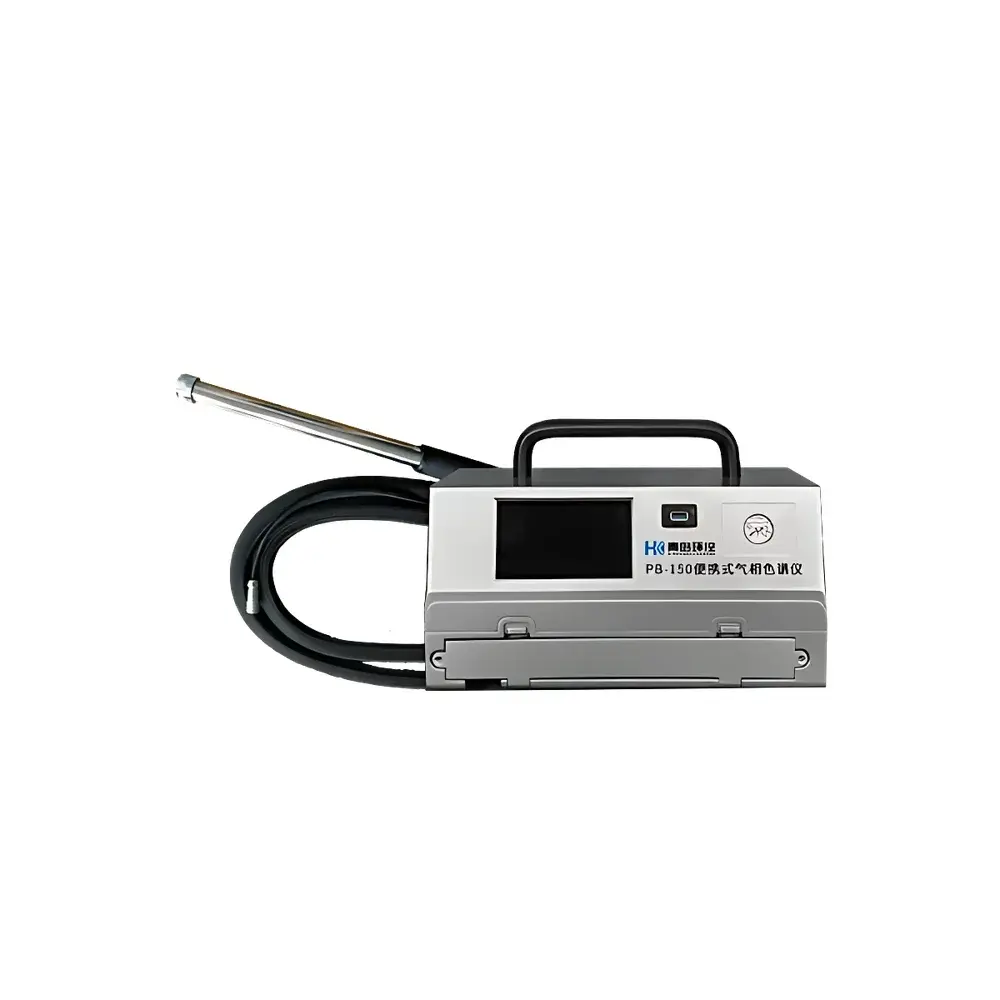
HUANKONG PB-150 Portable Gas Chromatograph for BTEX Analysis
| Brand | HUANKONG |
|---|---|
| Model | PB-150 |
| Origin | Shandong, China |
| Manufacturer Type | Direct Manufacturer |
| Country of Origin | China |
| Repeatability | ≤5% F.S. |
| Weight | ≤4.5 kg |
| Dimensions | 170 × 165 × 310 mm |
Overview
The HUANKONG PB-150 Portable Gas Chromatograph is a field-deployable analytical instrument engineered for rapid, on-site qualitative and quantitative determination of benzene, toluene, ethylbenzene, xylenes (BTEX), trichloroethylene, tetrachloroethylene, cumene, styrene, and naphthalene in ambient air, stack emissions, soil headspace, and water vapor-phase samples. It operates on the principle of gas chromatography (GC) with temperature-programmed separation and selective detection—leveraging micro-electromechanical systems (MEMS)-fabricated capillary columns and an integrated high-sensitivity detector. Unlike benchtop GC systems requiring laboratory infrastructure, the PB-150 integrates all critical subsystems—including carrier gas supply, heated sampling pathway, pressure-controlled injection, and real-time signal processing—into a single ruggedized enclosure. Its design targets compliance with field measurement requirements under EPA Method TO-15, ISO 16017-1, and ASTM D5762 for volatile organic compound (VOC) profiling in environmental and occupational health monitoring.
Key Features
- Integrated high-vacuum sampling pump enabling robust operation across variable pressure and humidity conditions, including low-flow stack sampling and passive ambient air draw.
- Detector system designed for immediate operational readiness: no pre-heating, flame ignition, or oven thermal equilibration required prior to analysis—reducing time-to-first-result to under 90 seconds.
- Fully heated sample introduction path (up to 180 °C) preventing condensation of semi-volatile analytes and minimizing adsorptive losses during transfer from probe to column.
- Onboard compressed carrier gas reservoir (helium or nitrogen-compatible) eliminating external gas cylinders and reducing background interference from ambient air infiltration.
- Multi-stage particulate filtration (pre-filter + sintered metal + hydrophobic membrane) protecting the MEMS column and detector from aerosol, moisture, and particulate fouling—extending service intervals beyond 500 field analyses.
- MEMS-based microfabricated chromatographic column with optimized stationary phase chemistry for BTEX resolution in sub-5-minute runtimes at ambient or elevated column temperatures.
- Bluetooth-enabled Android/iOS application interface supporting remote configuration, live chromatogram visualization, peak integration, calibration management, and export of .csv/.cdf data files.
Sample Compatibility & Compliance
The PB-150 accepts gaseous samples directly via heated stainless-steel probe or Tedlar® bag; headspace vapors from aqueous or solid matrices (e.g., soil cores) are introduced using a built-in thermal desorption module (optional accessory). It meets functional equivalency requirements for field screening per Chinese HJ 1012–2018 and supports data traceability aligned with GLP principles. All firmware logs include timestamped audit trails for method parameters, calibration events, and operator actions—facilitating internal QA/QC review and regulatory submission preparation. While not certified to UL/CE for intrinsic safety, the unit complies with IP54 ingress protection and operates within Class I, Division 2 hazardous area guidelines when used with appropriate sampling accessories.
Software & Data Management
The companion mobile application provides intuitive workflow control without dependency on PC hardware. Users configure method parameters—including injection volume, column ramp rates, detector gain, and integration thresholds—via guided menus. Real-time chromatograms display baseline-corrected signals with automated peak detection and retention time locking. Calibration curves support multi-point linear or quadratic regression with forced origin options. All raw and processed data are stored locally with SHA-256 hash integrity verification; encrypted export supports secure transfer to LIMS or cloud-based environmental data platforms. Audit logs record user ID, timestamp, parameter changes, and calibration verification results—meeting minimum documentation expectations under ISO/IEC 17025 Clause 7.7 and FDA 21 CFR Part 11 for electronic records (when paired with organizational authentication protocols).
Applications
- Regulatory compliance monitoring of fugitive emissions and stack effluents in petrochemical, paint manufacturing, and adhesive production facilities.
- Rapid assessment of BTEX contamination at industrial site boundaries, landfill perimeters, and remediation zones under ASTM D6792 protocols.
- Occupational exposure evaluation in confined spaces (e.g., tank interiors, spray booths) where fixed monitors lack spatial flexibility.
- Emergency response triage following chemical spills or storage tank breaches—providing actionable concentration data within minutes of arrival on-scene.
- Research-grade VOC profiling in urban air quality studies, especially where temporal resolution and geographic coverage outweigh absolute laboratory-grade uncertainty requirements.
FAQ
What carrier gases are compatible with the PB-150?
The instrument is configured for helium or nitrogen as primary carrier gases; hydrogen compatibility requires factory modification and adherence to local safety regulations.
Can the PB-150 quantify compounds beyond the listed BTEX group?
Yes—method development allows extension to other C6–C10 aromatics and chlorinated solvents; retention time libraries must be validated per application-specific matrix.
Is external power required during operation?
No—the unit operates exclusively on its internal rechargeable Li-ion battery (rated for ≥4 hours continuous analysis at 25 °C).
How is calibration performed in the field?
Calibration uses certified permeation tubes or dynamic dilution standards; the software guides users through multi-level bracketing and auto-validates linearity and sensitivity drift.
Does the PB-150 meet any international emission testing standards?
It satisfies technical performance criteria referenced in EN 14181 (QAL2/QAL3), EPA Method 25A for total hydrocarbons, and serves as a screening tool compliant with ISO 11843-7 for detection capability estimation.
Related Products





