
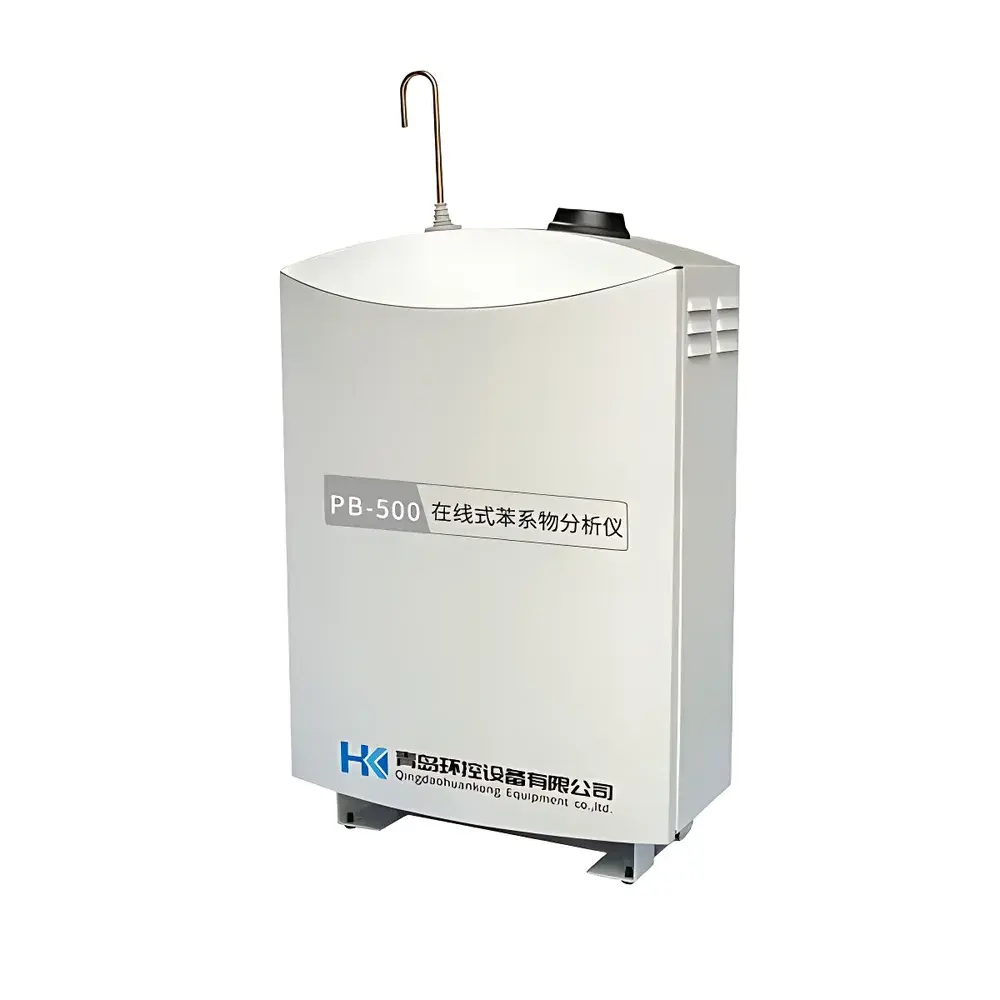
HUANKONG PB-500 Online Gas Chromatograph for Benzene-Series VOCs Analysis
| Brand | HUANKONG |
|---|---|
| Model | PB-500 |
| Type | Online Gas Chromatograph |
| Application | Ambient Air Monitoring of Aromatic Hydrocarbons (Benzene, Toluene, Ethylbenzene, Xylenes) |
| Detection Principle | Micro-preconcentration + Capillary GC Separation + PID Detection |
| Power Supply | 12 V DC |
| Maintenance Interval | Up to 12 months |
| Calibration Frequency | Monthly |
| Integrated Carrier Gas Generation | Yes |
| Compliance | Designed for ISO 16000-6, ASTM D5197, and EPA TO-15/TO-17 compliant monitoring workflows |
| Sample Compatibility | Ambient air, indoor air, industrial stack effluent (diluted), tunnel/garage air |
| Data Output | Analog 4–20 mA, RS-485, optional wireless LTE/LoRaWAN module |
Overview
The HUANKONG PB-500 Online Gas Chromatograph is a purpose-built, miniaturized analytical system engineered for continuous, unattended quantification of benzene-series volatile organic compounds (VOCs)—including benzene, toluene, ethylbenzene, and xylenes (BTEX)—in ambient, indoor, and industrial air matrices. Unlike conventional benchtop or portable GC systems, the PB-500 integrates micro-electro-mechanical systems (MEMS) preconcentration, microfluidic gas handling, and capillary column chromatography into a single robust architecture. It operates on the principle of thermal desorption coupled with temperature-programmed gas chromatographic separation, followed by photoionization detection (PID) with 10.6 eV lamp energy. The absence of external high-pressure carrier gas cylinders—enabled by an on-board, pressure-regulated zero-air generator—eliminates logistical constraints associated with gas supply, making the PB-500 uniquely suited for remote, long-term deployment in fixed-site networks or mobile monitoring platforms.
Key Features
- MEMS-based micro-preconcentrator: Selectively traps BTEX compounds at ambient temperature, then thermally desorbs them in a narrow pulse (< 100 ms) for sharp chromatographic peaks and enhanced sensitivity (sub-ppb LOD for benzene).
- Monolithic micro-GC separation module: Utilizes a surface-micromachined, low-thermal-mass fused-silica column (3 m × 0.25 mm ID, 1.0 µm film thickness) enabling rapid temperature ramping (up to 30 °C/s) and cycle times under 8 minutes.
- Integrated zero-air carrier gas generation: Electrochemical oxygen removal and catalytic hydrocarbon scrubbing produce ultra-pure, stable carrier flow (5–15 mL/min) without compressed gas cylinders or external air compressors.
- Low-power, wide-range operation: 12 V DC input supports solar-battery hybrid power configurations; operating temperature range: −20 °C to +50 °C (with optional thermostatic enclosure).
- Minimal maintenance design: Solid-state valves, no consumable traps or septa, and self-diagnostic firmware reduce scheduled interventions. One monthly calibration using certified permeation tube standards ensures traceability per ISO/IEC 17025 requirements.
- Embedded edge processing: Onboard ARM Cortex-M7 processor executes real-time peak integration, retention time alignment, and baseline correction prior to data export.
Sample Compatibility & Compliance
The PB-500 is validated for direct analysis of undiluted ambient air (flow rate: 200–500 mL/min), indoor air (including HVAC duct sampling), and diluted industrial emissions (up to 1:10 dilution ratio). It meets the physical and performance criteria outlined in ISO 16000-6 (indoor air VOC measurement), ASTM D5197 (ambient air benzene by GC-PID), and EPA Method TO-15 (canister-based VOC analysis—adapted for online mode via dynamic calibration). Its digital output architecture supports audit-ready data logging with timestamped metadata, meeting GLP/GMP-aligned record integrity standards. Optional 21 CFR Part 11-compliant software modules provide electronic signatures, user access control, and immutable audit trails for regulated environments.
Software & Data Management
The PB-500 ships with HUANKONG GC-Link™ firmware v3.2, supporting local configuration via web interface (HTTPS/TLS 1.2) and remote management through MQTT or Modbus TCP protocols. Raw chromatograms and processed concentration values (µg/m³ or ppb) are stored in standardized NetCDF-4 format with embedded CF conventions. The optional DataHub Edge Module adds LTE Cat-M1 or LoRaWAN connectivity, enabling secure transmission to cloud platforms (e.g., AWS IoT Core or Azure IoT Hub) with TLS 1.3 encryption. All firmware updates are cryptographically signed and verified before installation. Calibration logs, system health metrics (column temperature stability, PID lamp intensity decay, preconcentrator trap efficiency), and alarm events are retained for ≥18 months onboard.
Applications
- Fixed-site ambient air quality networks: Urban street-level monitoring, airport perimeter surveillance, railway station platforms, and underground parking structures.
- Industrial fence-line and stack monitoring: Real-time compliance tracking against local VOC emission limits (e.g., China’s GB 37822-2019, EU IED Annex VI).
- Indoor environmental quality (IEQ) assessment: Continuous BTEX profiling in healthcare facilities, schools, museums, and office buildings to support ventilation optimization per ASHRAE Standard 62.1.
- Emergency response and fugitive emission detection: Rapid deployment in chemical spill scenarios or leak investigations where portability and battery autonomy (>72 h) are critical.
- Research-grade exposure studies: High-temporal-resolution (1–5 min intervals) VOC dynamics mapping in microenvironments such as vehicle cabins or cleanrooms.
FAQ
Does the PB-500 require external carrier gas cylinders?
No. It generates purified zero air internally via electrochemical O₂ removal and catalytic hydrocarbon scrubbing, eliminating cylinder dependency.
What is the detection limit for benzene in ambient air?
The system achieves a method detection limit (MDL) of 0.12 µg/m³ (≈0.03 ppb) for benzene with 30-minute integrated sampling, per EPA MDL calculation protocol.
Can the PB-500 be integrated into existing SCADA or EMS platforms?
Yes. Native Modbus RTU/ASCII over RS-485 and analog 4–20 mA outputs enable seamless integration; optional OPC UA gateway available upon request.
Is field calibration possible without lab intervention?
Yes. Automated multi-point calibration using NIST-traceable permeation tubes is performed via touchscreen or remote command; results are logged with full uncertainty budgeting.
What cybersecurity measures are implemented?
Firmware signing, TLS 1.3 for all network communications, configurable password policies, role-based access control (RBAC), and disabled default credentials out-of-the-box.





