
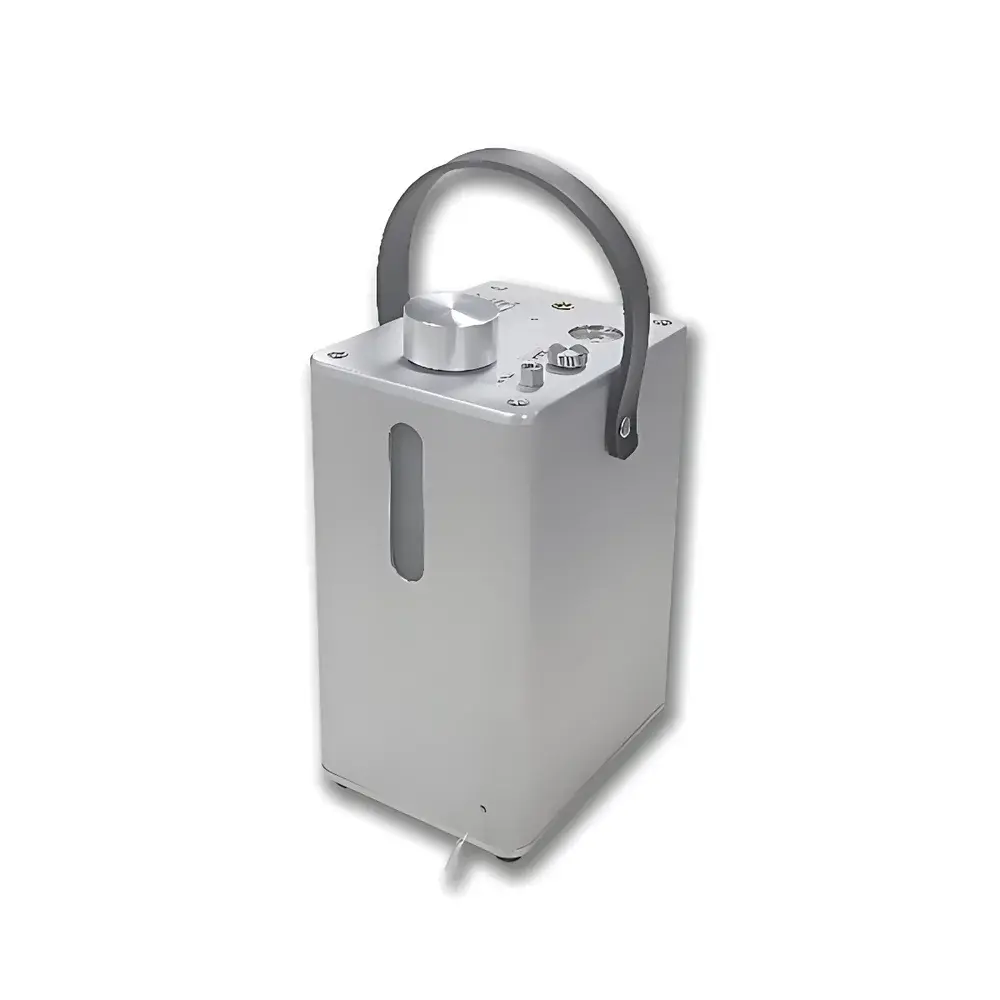
HUANKONG PF-300 Portable PEM Hydrogen Generator
| Brand | HUANKONG |
|---|---|
| Origin | Shandong, China |
| Manufacturer Type | Direct Manufacturer |
| Country of Origin | China |
| Model | PF-300 |
| Hydrogen Production Principle | Proton Exchange Membrane (PEM) Electrolysis of Deionized Water |
| Hydrogen Purity | ≥99.999% |
| Output Pressure | Up to 3 MPa |
| Flow Rate | Customizable |
| Power Consumption | ~100 W (typical at rated output) |
| Construction Materials | Titanium and 316L stainless steel pressure components |
| Safety Features | Automatic pressure cutoff, high-integrity metal-seal fittings (rated to 3 MPa), integrated high-pressure gas–liquid separator |
| Certifications | Compliant with GB/T 37562–2019 (Chinese standard for PEM hydrogen generators), designed per ISO 22734-1 for electrolytic hydrogen generation systems |
Overview
The HUANKONG PF-300 is a compact, portable proton exchange membrane (PEM) hydrogen generator engineered for on-site, low-flow, high-purity hydrogen supply in analytical and field-deployable applications—particularly as a dedicated hydrogen source for non-methane hydrocarbon (NMHC) analyzers, portable gas chromatographs (GC), and solid-state hydrogen storage refilling stations. Unlike alkaline or traditional electrolytic systems, the PF-300 employs solid polymer electrolyte (SPE) technology: deionized water is fed into a PEM electrolytic cell where a noble-metal catalyst (platinum-loaded Nafion™-type membrane) facilitates efficient electrochemical dissociation into high-purity H₂ and O₂. The membrane acts as both electrolyte and physical barrier, enabling intrinsic separation of gaseous products without liquid electrolyte circulation or caustic additives. This architecture eliminates corrosion risks, ensures zero hydrocarbon contamination, and delivers consistent 99.999% hydrogen purity—meeting ASTM D7165 (for GC carrier gas) and USP purity requirements for instrumental gas supply.
Key Features
- PEM-based electrolysis using ultra-pure deionized water—no KOH, no acids, no consumable electrolytes.
- Integrated titanium and 316L stainless steel pressure manifold rated to 3 MPa; fully compatible with Type III/IV composite hydrogen storage cylinders.
- Automatic pressure-regulated operation: real-time feedback control terminates electrolysis upon reaching user-set outlet pressure (default 3 MPa), preventing over-pressurization.
- High-efficiency gas–liquid separation via a stainless-steel high-pressure coalescing separator—zero desiccant or drying cartridges required; maintenance-free under continuous operation.
- DC-powered design (24 V nominal input) enables seamless integration with portable power banks, solar chargers, or vehicle electrical systems—ideal for mobile labs and remote NMHC monitoring.
- Onboard safety architecture includes redundant pressure transducers, thermal cut-off sensors, and leak-tight metal ferrule (VCR/VCO) fittings certified to ISO 15848-1 for fugitive emission control.
Sample Compatibility & Compliance
The PF-300 is validated for continuous operation with feed water resistivity ≥15 MΩ·cm (ASTM D1193 Type I). It produces hydrogen suitable for GC carrier gas (per ASTM D3612 Annex A1), FID fuel gas (per EPA Method 25A), and laboratory-scale metal hydride charging protocols. All wetted materials comply with FDA 21 CFR 177.2420 (food-contact polymers) and EU Regulation (EC) No. 1935/2004. The system’s firmware supports audit-ready event logging—including start/stop timestamps, pressure excursions, and fault codes—facilitating GLP/GMP-aligned documentation. While not CE-marked for EU general-purpose use, its mechanical and electrical design adheres to IEC 61000-6-2 (EMC immunity) and IEC 61000-6-4 (EMC emissions) standards.
Software & Data Management
The PF-300 operates in fully autonomous mode with no external software dependency. All operational parameters—including real-time pressure, cell voltage, coolant temperature, and cumulative operating hours—are displayed on a backlit OLED interface. Internal non-volatile memory stores the last 1,000 operational events with UTC timestamps. Optional RS-485 Modbus RTU output (configurable via DIP switch) enables integration into SCADA or LIMS environments for centralized monitoring, remote alarm triggering, and compliance reporting. Data export is supported via USB-C dump (CSV format), retaining full traceability for internal QA audits or regulatory review.
Applications
- Field-deployable hydrogen supply for portable NMHC analyzers (e.g., photoionization detectors, flame ionization detectors) requiring stable 99.999% H₂ fuel gas.
- On-demand refueling of small-format metal hydride or carbon nanotube-based hydrogen storage units used in UAVs, handheld sensors, and micro-fuel cells.
- Carrier and detector gas source for benchtop and transportable GC systems performing VOC speciation in ambient air or stack emissions testing.
- Calibration gas blending systems requiring ultra-high-purity hydrogen as a diluent or reaction gas in catalytic oxidation setups.
- Teaching laboratories demonstrating clean hydrogen production principles, PEM electrochemistry, and pressure-controlled gas generation dynamics.
FAQ
What feed water quality is required for optimal performance?
Deionized water with resistivity ≥15 MΩ·cm and total organic carbon (TOC) <5 ppb is mandatory. Use of lower-grade water risks membrane fouling and irreversible catalyst poisoning.
Can the PF-300 be operated continuously for >72 hours?
Yes—thermal management and pressure-cycling logic ensure stable long-duration output; however, periodic visual inspection of fittings and inlet filter is recommended every 500 operating hours.
Is the hydrogen output compatible with GC-FID systems requiring ultra-low moisture?
The integrated high-pressure gas–liquid separator achieves dew point ≤ –40 °C at 3 MPa; for sub-–60 °C requirements, an optional external Peltier-cooled trap (sold separately) may be added downstream.
Does the unit support remote start/stop via digital signal?
Yes—dry-contact closure input (24 V DC, isolated) is provided for external interlock integration, such as analyzer ready-signal synchronization.
What is the expected service life of the PEM stack under normal use?
Based on accelerated lifetime testing per ISO 22734-2, the core electrolyzer module maintains ≥95% initial efficiency after 8,000 hours of operation at 70% rated load.



