
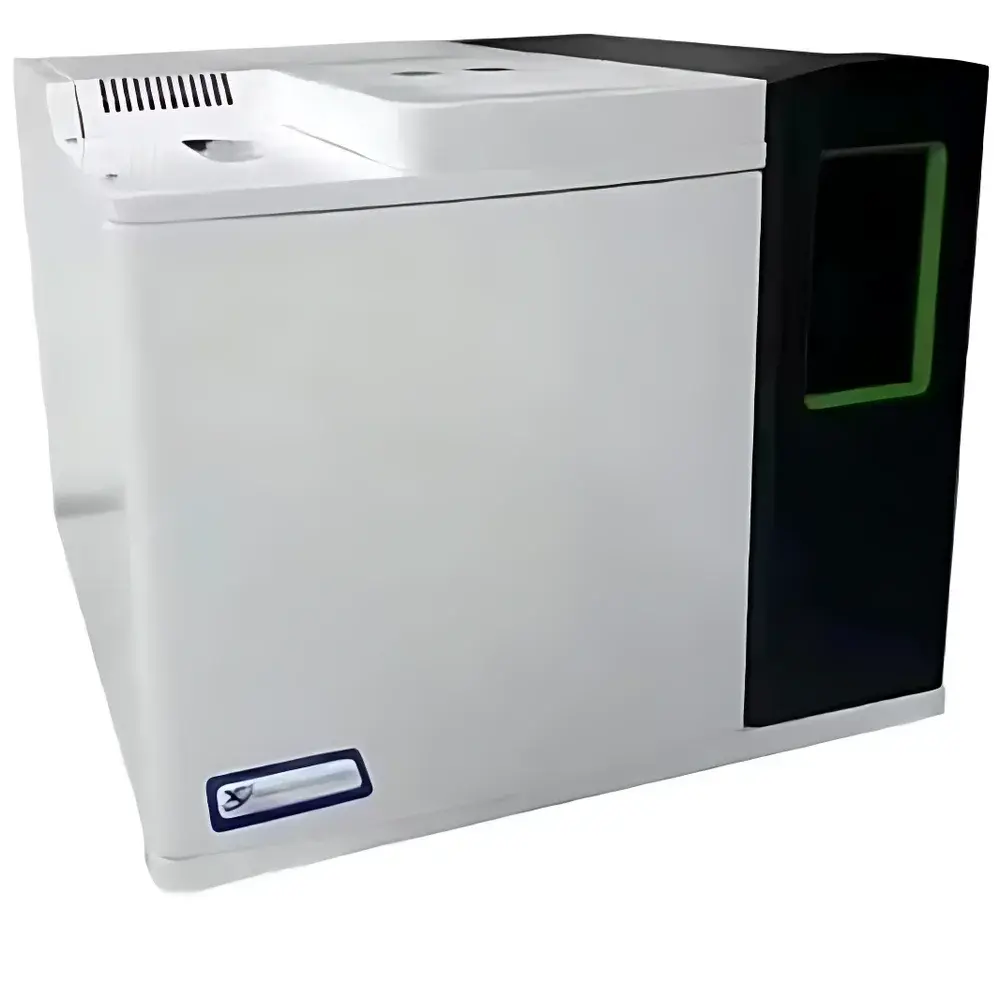
HuaShengPuXin GC6210 Dedicated Gas Chromatograph for Oxygenates, Aromatics, and Benzene/Toluene Analysis in Gasoline
| Brand | HuaShengPuXin (HSPX) |
|---|---|
| Origin | Beijing, China |
| Manufacturer Type | Direct Manufacturer |
| Instrument Type | Laboratory Gas Chromatograph |
| Application Field | Petroleum Refining & Fuel Quality Control |
| Temperature Control Range | Ambient to 400 °C |
| Oven Ramp Rate | 0.1–40 °C/min |
| Oven Cool-down Time | ~6 min (400 °C → 50 °C) |
| Carrier Gas Flow Range & Control | 0–1200 mL/min |
| Carrier Gas Pressure Range & Control | 0–0.6 MPa |
| Injector Maximum Operating Temperature | 400 °C |
| Injector Pressure Setting Range | 0–0.6 MPa |
| Injector Total Flow Setting Range | 0–1200 mL/min |
Overview
The HuaShengPuXin GC6210 Dedicated Gas Chromatograph is a purpose-built analytical system engineered for the precise, sequential quantification of oxygenated compounds (alcohols and ethers), benzene, toluene, and total aromatic hydrocarbons in automotive gasoline. It operates on the principle of high-resolution capillary gas chromatography coupled with flame ionization detection (FID), utilizing a dual-column configuration with automated valve switching to achieve selective group-type separation. The system is fully compliant with two critical Chinese national standards: SH/T 0663–1998 for oxygenates (including methanol, ethanol, MTBE, ETBE, TAME, and tert-butanol) and SH/T 0693–2000 for aromatic hydrocarbons (benzene, toluene, ethylbenzene, xylenes, and C9+ aromatics). Its architecture supports robust, reproducible analysis under routine laboratory conditions—meeting the method-defined retention time windows, peak resolution requirements (>1.5 between adjacent oxygenates), and calibration linearity (R² ≥ 0.999 over specified concentration ranges) required for regulatory compliance in fuel quality assurance.
Key Features
- Dual-column, multi-step valving architecture featuring a stainless-steel TCEP pre-column (0.56 m × 0.38 mm, 20% TCEP/Chromosorb P AW 80–100 mesh) and a fused-silica DB-1 WCOT analytical column (30 m × 0.32 mm × 3 µm, cross-linked methyl silicone)
- Imported 10-port automatic rotary valve enabling precise, timed heart-cut and backflush operations without manual intervention
- FID detector with optimized hydrogen/air flow control, baseline stability < 1 × 10⁻¹² A, and linear dynamic range > 107
- Temperature-programmable oven with ±0.1 °C isothermal stability and ramp reproducibility ≤ ±0.5 °C across 0.1–40 °C/min
- Independent, pressure-controlled injector modules supporting split/splitless injection with real-time flow monitoring and digital pressure feedback
- Integrated carrier gas management system compatible with high-purity nitrogen (≥99.999%), hydrogen (≥99.999%), and zero-air
Sample Compatibility & Compliance
The GC6210 is validated for undiluted or minimally diluted gasoline samples (ASTM D4057 sampling protocol), including reformulated gasoline (RFG), oxygenated blends (E10, E15), and low-sulfur premium grades. It accommodates internal standardization using 2-hexanone for aromatic analysis and glycol dimethyl ether (DME) for oxygenates—both traceable to NIST SRM equivalents. Method validation data confirm adherence to SH/T 0663–1998 and SH/T 0693–2000 repeatability criteria (RSD ≤ 2.0% for benzene; ≤ 3.5% for MTBE; ≤ 4.0% for C9+ aromatics). While designed for Chinese national standards, its chromatographic performance aligns with key elements of ASTM D3606 (benzene/toluene), ASTM D4815 (oxygenates), and ISO 20653:2020 (fuel hydrocarbon group-type analysis) frameworks—enabling cross-method correlation studies in international laboratories.
Software & Data Management
The system includes a dedicated chromatography data system (CDS) supporting full method development, sequence control, peak integration via valley-to-valley and tangent skim algorithms, and automated report generation per SH/T standard templates. Audit trails record all method edits, integration parameter changes, and calibration events with user ID and timestamp. Data files comply with ASTM E2524-18 metadata conventions and support export in .cdf, .csv, and .pdf formats. For regulated environments, optional 21 CFR Part 11-compliant software modules are available—including electronic signatures, role-based access control, and secure archive retention—facilitating GLP/GMP-aligned quality control workflows in refinery QC labs and third-party testing facilities.
Applications
- Quantitative determination of regulated oxygenates: methanol, ethanol, isopropanol, tert-butanol, MTBE, ETBE, TAME, DIPE, and cyclohexanol
- Regulatory-grade benzene and toluene measurement per national fuel specifications (e.g., GB 17930–2016)
- Total aromatic content profiling (BTEX + C8–C12 aromatics) for engine knock resistance assessment
- Batch release testing in petroleum refineries and blending terminals
- Third-party verification for fuel certification (CNAS-accredited labs)
- Method transfer and validation support for laboratories upgrading from packed-column GC systems
FAQ
Does the GC6210 meet ASTM or ISO equivalency requirements?
Yes—while certified to SH/T 0663 and SH/T 0693, its column selectivity, temperature programming fidelity, and FID sensitivity satisfy core technical prerequisites of ASTM D3606, D4815, and ISO 20653. Cross-validation studies are recommended for formal method equivalence claims.
Can the system analyze ethanol-blended gasoline (E10/E15) without column degradation?
Yes—the DB-1 WCOT column is chemically resistant to ethanol and other polar oxygenates when operated within specified temperature limits (≤280 °C for extended use); routine column conditioning protocols are included in the operator manual.
Is hardware-level compliance with 21 CFR Part 11 available?
The base system supports audit-trail-enabled software; full Part 11 compliance requires optional licensed firmware and administrative configuration—contact technical support for deployment documentation.
What maintenance intervals are recommended for routine operation?
FID jet cleaning every 200 injections; inlet liner replacement every 500 injections; column trimming (0.5–1 m) every 1,000 injections; annual oven seal and valve rotor inspection.
Are reference standards supplied with the instrument?
Calibration and verification standards (oxygenate mix, aromatic mix, internal standards) are provided as optional accessories—not bundled—but traceability certificates and handling protocols are included in the installation qualification (IQ) package.



