
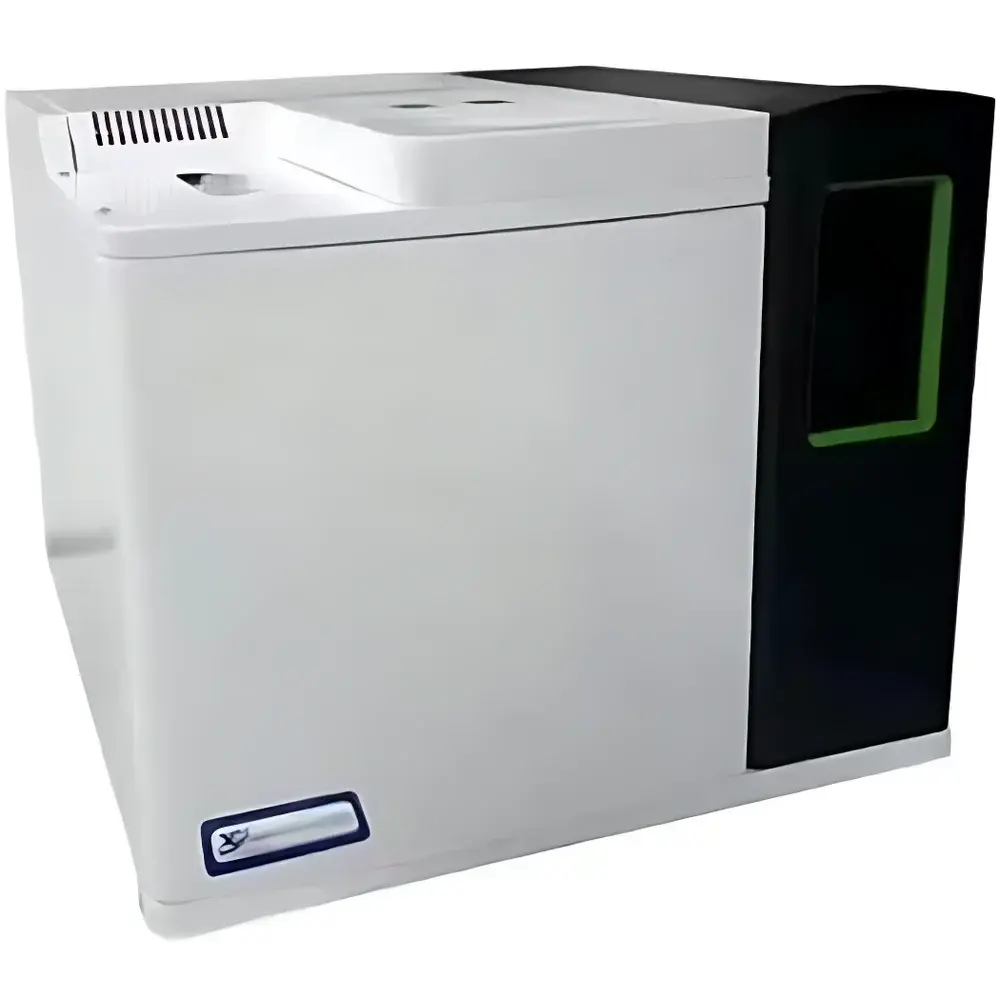
HuaShengPuXin GC6210 Transformer Oil-Specific Gas Chromatograph
| Brand | HuaShengPuXin (HSPX) |
|---|---|
| Origin | Beijing, China |
| Manufacturer Type | Direct Manufacturer |
| Instrument Category | Domestic Lab-Scale Gas Chromatograph |
| Model | GC6210 |
| Price Range | USD 4,200 – 7,000 |
| Oven Temperature Range | Ambient to 400 °C |
| Oven Ramp Rate | 0.1–40 °C/min |
| Oven Cool-Down Rate | 400 °C → 50 °C in ~6 min |
| Carrier Gas Flow Range & Control | 0–60 mL/min |
| Carrier Gas Pressure Range & Control | 0–0.6 MPa |
| Injector Maximum Operating Temperature | 400 °C |
| Injector Pressure Setting Range | 0–0.6 MPa |
| Injector Total Flow Setting Range | 0–1200 mL/min |
| Detection Limits (as per GB/T 17623) | H₂ ≤ 2 ppm, CO ≤ 5 ppm, CH₄ ≤ 0.1 ppm, CO₂ ≤ 5 ppm, C₂H₂ ≤ 0.1 ppm, C₂H₆ ≤ 0.1 ppm, C₂H₄ ≤ 0.1 ppm |
Overview
The HuaShengPuXin GC6210 Transformer Oil-Specific Gas Chromatograph is a dedicated analytical platform engineered for the precise quantification of dissolved gases in electrical insulating oils—primarily mineral-based transformer oils used in power transmission and distribution equipment. It operates on the principle of gas chromatography with flame ionization detection (FID) and thermal conductivity detection (TCD), configured in parallel or sequential mode to simultaneously resolve and quantify key fault-gas species: hydrogen (H₂), methane (CH₄), ethane (C₂H₆), ethylene (C₂H₄), acetylene (C₂H₂), carbon monoxide (CO), and carbon dioxide (CO₂). The system is optimized for direct injection of headspace gas extracted from oil samples via vacuum degassing or mechanical shaking methods, eliminating derivatization or pre-concentration steps. Its design adheres to the separation efficiency, retention time stability, and sensitivity requirements defined in GB/T 17623–2017 (“Guidelines for Dissolved Gas Analysis in Transformer Oil”) and aligns with IEC 60567 recommendations for diagnostic gas monitoring in high-voltage apparatus.
Key Features
- Optimized dual-detector configuration: TCD for high-sensitivity H₂ and CO detection; FID for hydrocarbon quantification (CH₄, C₂H₂, C₂H₄, C₂H₆) with linear dynamic range exceeding 10⁵
- Programmable oven with ultra-stable temperature control (±0.1 °C) across ambient to 400 °C, supporting complex multi-step temperature ramps for baseline resolution of co-eluting C₂ isomers
- Dedicated split/splitless injector with pressure-programmed operation and active septum purge, rated to 400 °C for consistent vaporization of high-boiling matrix components
- Integrated carrier gas control module with electronic pressure/flow regulation (EPC/EFC) ensuring reproducible retention times (<0.02 min RSD) across multi-day sequences
- Rugged stainless-steel pneumatic architecture compatible with helium, nitrogen, or hydrogen carrier gases—configured for optimal efficiency per ASTM D3612 Class B methodology
- Front-panel touchscreen interface with embedded method storage, real-time chromatogram display, and alarm-triggered event logging
Sample Compatibility & Compliance
The GC6210 is validated for use with insulating oils conforming to IEC 60296 and ASTM D3487 specifications. Sample introduction follows standardized degassing protocols (e.g., vacuum extraction per GB/T 7597 or mechanical agitation per DL/T 703). The instrument meets all hardware and performance criteria outlined in GB/T 17623–2017, including minimum detection limits (MDLs), repeatability (RSD ≤3% for all target analytes at 3× MDL), and retention time precision. Data acquisition and reporting support audit-ready workflows compliant with GLP principles; optional firmware upgrade enables 21 CFR Part 11–compliant electronic signatures and full audit trail functionality.
Software & Data Management
Chromatographic data acquisition and processing are performed using HSPX ChromaLink v3.2 software, a Windows-based platform supporting automated peak integration, calibration curve generation (linear and quadratic), and DGA fault diagnosis via Duval Triangle, Rogers Ratio, and IEC 60599 classification algorithms. Raw data (.chd) and processed reports (.pdf/.xlsx) are stored with immutable timestamps and user-access logs. Network deployment supports centralized instrument monitoring across lab networks, while optional LIMS integration (via ASTM E1394 or HL7-compliant API) enables seamless transfer of dissolved gas concentration results into enterprise asset management systems.
Applications
- Preventive maintenance screening of power transformers, reactors, and instrument transformers
- Root-cause analysis of partial discharge, thermal faults (>700 °C), and arcing events via C₂H₂/C₂H₄ ratio trending
- Commissioning verification of new or reconditioned units prior to energization
- Long-term oil health monitoring in GIS bushings, tap changers, and substation auxiliary equipment
- Supporting condition-based maintenance (CBM) programs aligned with IEEE C57.104 and CIGRÉ TB 596 frameworks
FAQ
What standards does the GC6210 comply with for transformer oil DGA?
It fulfills all instrumental performance requirements specified in GB/T 17623–2017 and supports methodologies referenced in IEC 60567, ASTM D3612, and IEEE C57.104.
Can the system analyze all seven key fault gases in a single run?
Yes—using a dual-column, dual-detector configuration with backflush capability, it achieves complete resolution of H₂, CO, CO₂, CH₄, C₂H₆, C₂H₄, and C₂H₂ within ≤25 minutes.
Is hydrogen carrier gas supported, and what safety provisions exist?
Hydrogen is fully supported as carrier gas; the system includes leak detection sensors, automatic shutdown on pressure anomaly, and certified gas line fittings meeting ISO 8573–1 Class 2 purity requirements.
How is data integrity ensured for regulatory reporting?
With optional 21 CFR Part 11 firmware, the system provides role-based access control, electronic signatures, and tamper-evident audit trails for all method changes, injections, and result approvals.
What maintenance intervals are recommended for routine operation?
Column conditioning every 200 injections; detector cleaning every 500 injections; annual calibration verification against certified gas standards traceable to NIM (China) or NIST (USA).







