
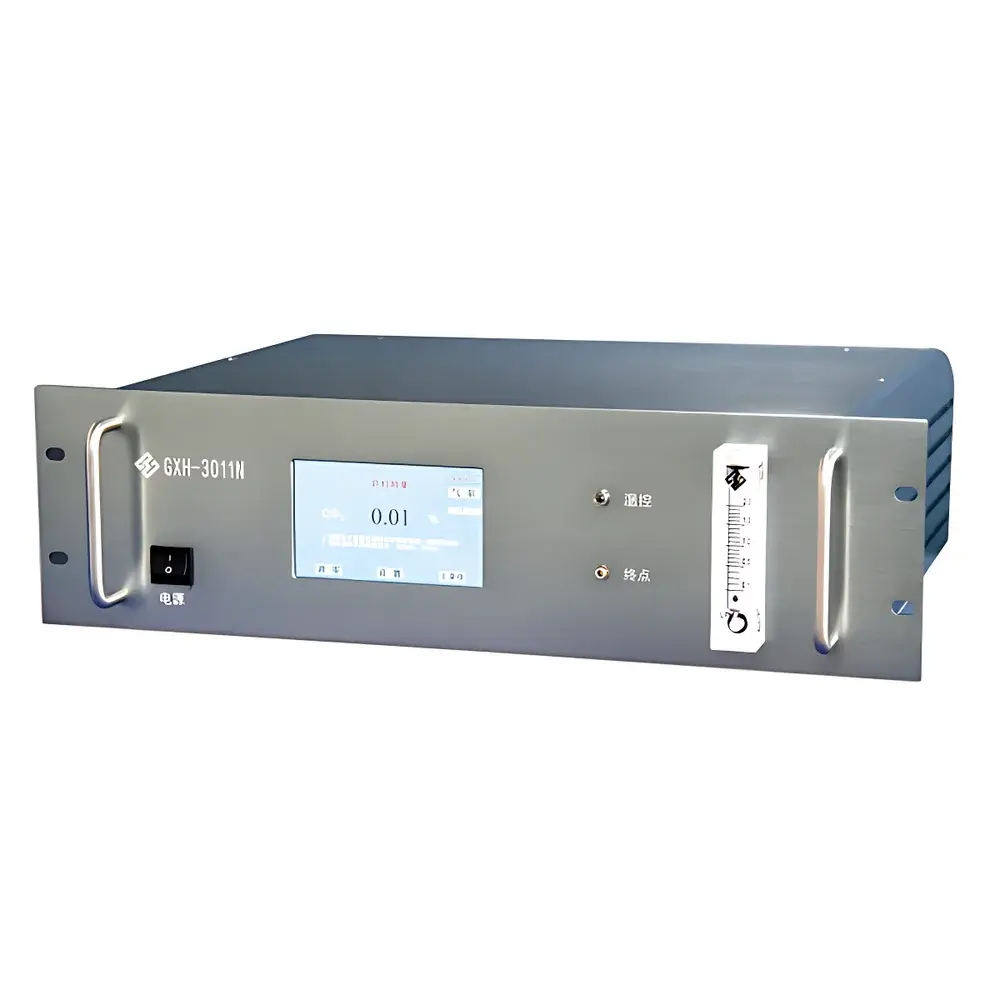
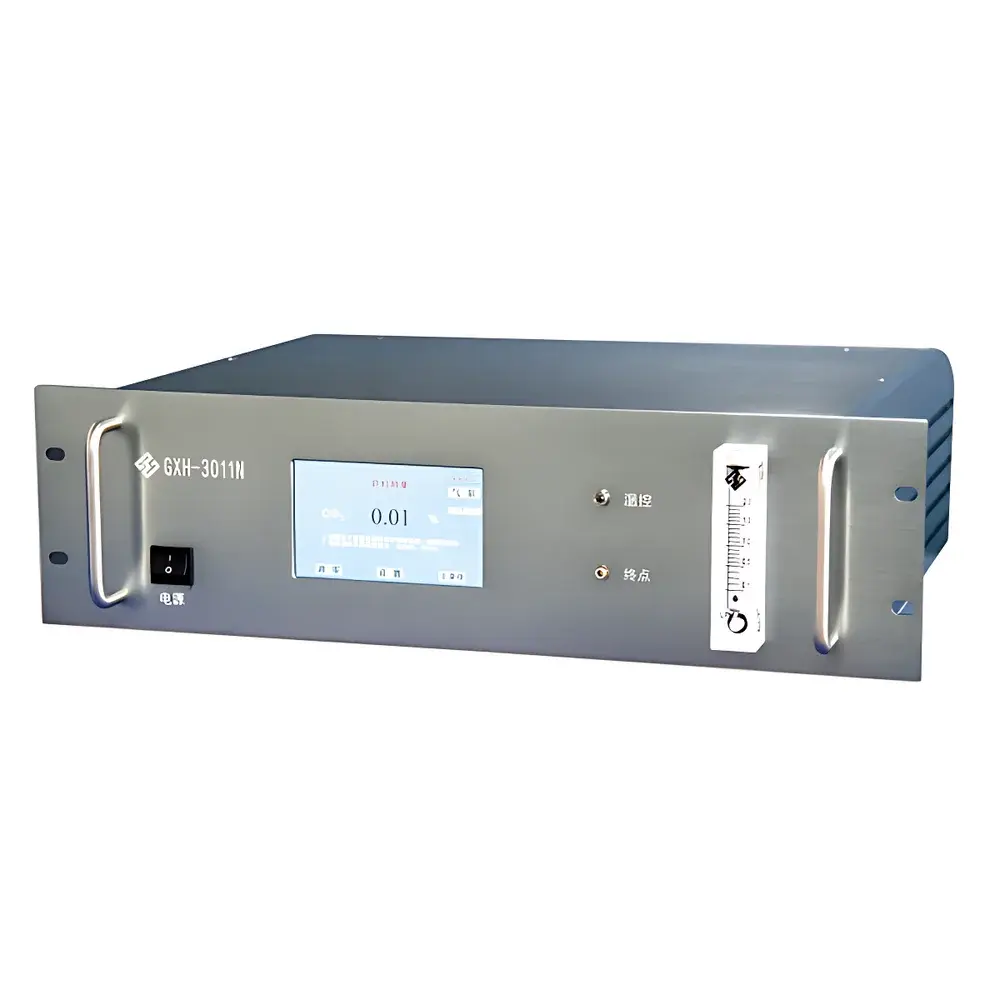
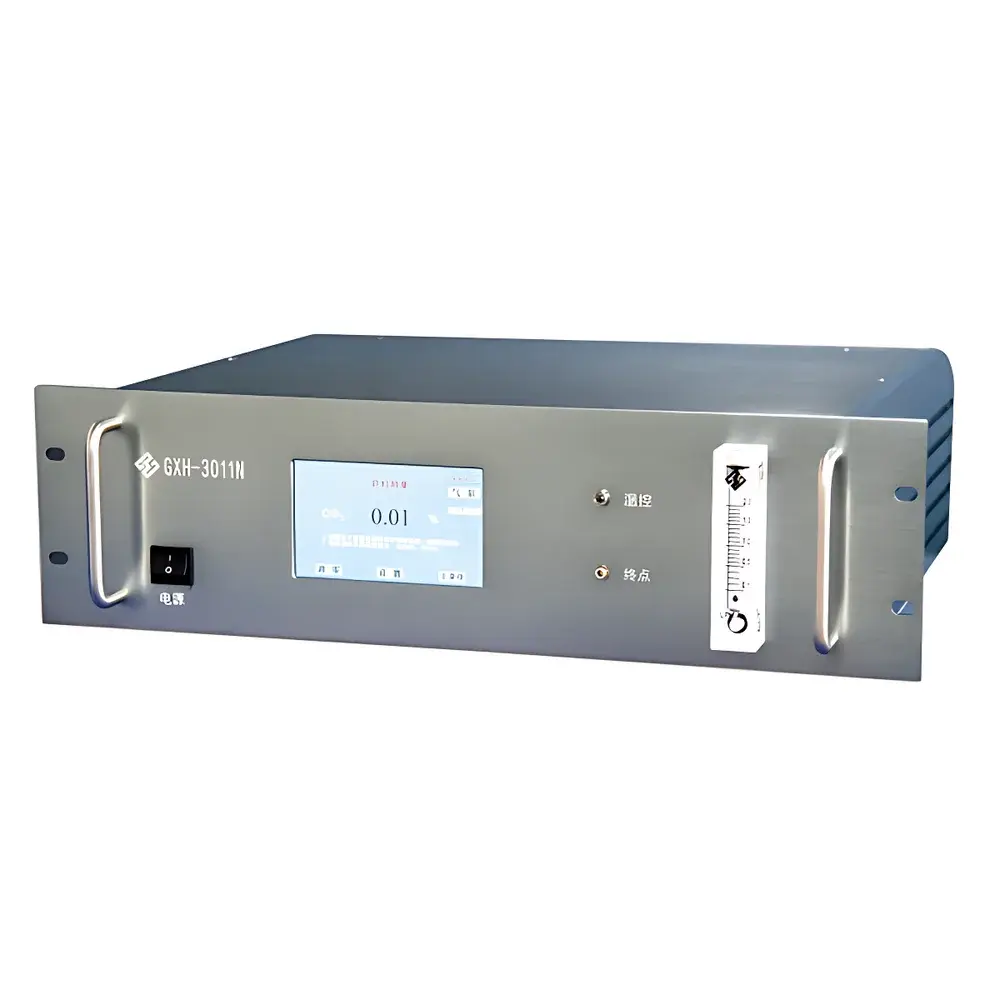
Huayun GXH-3011N Online NDIR Gas Analyzer
| Brand | Huayun |
|---|---|
| Origin | Beijing, China |
| Manufacturer Type | Manufacturer |
| Product Category | Domestic |
| Model | GXH-3011N |
| Instrument Type | Online |
| Detection Target | Single-component |
| Minimum Range | CO (0–500) × 10⁻⁶ |
| Repeatability | ≤ ±1% FS |
| Resolution | ≤ ±1% FS |
| Response Time | t₀–t₉₀ ≤ 30 s (from sample gas entry) |
| Zero Drift | ≤ ±2% FS / 72 h |
| Span Drift | ≤ ±2% FS / 72 h |
| Linearity Error | ≤ ±2% FS |
Overview
The Huayun GXH-3011N Online NDIR Gas Analyzer is an industrial-grade, continuous emission monitoring (CEM) instrument engineered for stable, long-term quantification of carbon monoxide (CO), carbon dioxide (CO₂), and methane (CH₄) in process or ambient gas streams. It operates on the principle of non-dispersive infrared (NDIR) spectroscopy—exploiting the characteristic absorption bands of target gases within the mid-infrared region (e.g., 4.6 µm for CO, 4.26 µm for CO₂, and 3.3 µm for CH₄). The optical architecture integrates Gas Filter Correlation (GFC) technology, which enhances spectral selectivity by modulating reference and measurement beams through matched gas-filled cells—effectively suppressing cross-interference from water vapor, hydrocarbons, and other common background species. Unlike broadband filter-based NDIR systems, GFC enables high specificity without moving parts or complex optical alignment, resulting in superior baseline stability and reduced calibration frequency. Designed for unattended operation in demanding environments, the GXH-3011N meets JJG 635–2011 (PRC National Verification Regulation for CO/CO₂ Infrared Gas Analyzers) and complies with enterprise standard Q/HDHYU0003–2013. Its modular 3U rack-mount chassis supports integration into centralized environmental monitoring networks or standalone plant-floor installations.
Key Features
- Gas Filter Correlation (GFC) optical design for enhanced selectivity and immunity to spectral overlap
- Simultaneous single-component analysis of CO, CO₂, or CH₄; configurable for multi-range deployment (e.g., CO: 0–500 ppm, CO₂: 0–500 ppm, CH₄: 0–1.000%)
- High metrological stability: zero drift ≤ ±2% FS / 72 h and span drift ≤ ±2% FS / 72 h under controlled ambient conditions (5–45 °C, ≤80% RH)
- Rapid response performance: t₀–t₉₀ ≤ 30 seconds from sample gas inlet—critical for real-time process control and alarm triggering
- Dual power input support: AC 220 V ±10%, 50 Hz ±10% or DC 12 V with reverse-charging capability—enabling solar-powered remote deployments
- Robust 3U (436 × 426 × 133 mm) chassis rated for horizontal cabinet mounting; weight ≤ 10 kg
- Integrated data handling: internal storage with user-configurable sampling intervals; direct TCP/IP access via RJ45 Ethernet port supporting static IP or DDNS registration
Sample Compatibility & Compliance
The GXH-3011N is optimized for clean, dry, particle-free sample streams. For applications involving humid, corrosive, or particulate-laden gases (e.g., flue gas, biogas, landfill off-gas), optional integration with the HY-3000 series sample conditioning system—including particulate filtration, condensate removal, and pressure regulation—is recommended. The analyzer conforms to PRC national metrological verification requirements (JJG 635–2011) and supports traceable calibration using certified reference gases traceable to NIM (National Institute of Metrology, China). While not certified to ISO 14001 or EPA Method 10/10A out-of-the-box, its measurement uncertainty profile and repeatability meet the foundational performance criteria required for regulatory-grade CEM in municipal wastewater treatment, boiler stack monitoring, and warehouse air quality surveillance per GB/T 16157–1996 and HJ 75–2017 guidelines.
Software & Data Management
Firmware includes embedded web server functionality accessible via standard HTTP/HTTPS—allowing remote configuration, real-time data visualization, and event log review through any modern browser. Measurement data are stored in CSV format on internal flash memory and can be retrieved via three parallel pathways: (1) direct TCP/IP socket readout for SCADA or DCS integration, (2) manual download through the web interface, or (3) physical extraction via removable microSD card. The unit supports Modbus RTU over RS232 and 4–20 mA analog output (isolated, HART-compatible) for legacy PLC interfacing. Audit trails—including parameter changes, calibration events, and system resets—are timestamped and retained for ≥30 days. Though not FDA 21 CFR Part 11 compliant by default, the logging architecture permits third-party validation for GLP/GMP-aligned QA/QC workflows where electronic records integrity is mandated.
Applications
- Continuous monitoring of CO emissions from industrial combustion sources (e.g., kilns, incinerators, boilers) per local environmental protection bureau reporting mandates
- Biogas composition analysis in anaerobic digestion facilities—tracking CH₄ purity and CO₂ content for energy recovery optimization
- Indoor air quality (IAQ) surveillance in enclosed logistics warehouses, cold storage facilities, and parking garages where CO accumulation poses occupational health risks
- Process gas monitoring in petrochemical refining units, particularly for catalyst regeneration off-gas streams containing low-level CO
- Research-grade gas concentration profiling in environmental simulation chambers and soil respiration studies requiring sub-ppm CO detection
FAQ
What gases can the GXH-3011N measure simultaneously?
It is configured for single-component analysis per installation—users select CO, CO₂, or CH₄ at time of order. Multi-gas capability requires separate analyzers or custom GFC module integration.
Is the instrument suitable for wet or corrosive sample streams?
No—direct exposure to condensate, SO₂, HCl, or high-humidity gas (>90% RH) may damage optics and sensors. Use with the HY-3000 sample conditioning system is mandatory for such applications.
Does it support remote calibration or automatic zero/span checks?
Manual zero and span calibration are supported via front-panel interface or web GUI; automated sequence execution requires external solenoid valve manifold and certified gas standards—not included as standard equipment.
Can measurement data be exported to cloud-based platforms?
Yes—via TCP/IP socket streaming or periodic CSV pull over HTTP, enabling ingestion into AWS IoT Core, Microsoft Azure IoT Hub, or proprietary cloud dashboards using standard REST or MQTT adapters.
What is the expected service interval for optical maintenance?
Under typical indoor industrial conditions, optical path inspection and window cleaning are recommended every 6 months; GFC cell lifetime exceeds 10 years with proper sample conditioning.
Related Products







