
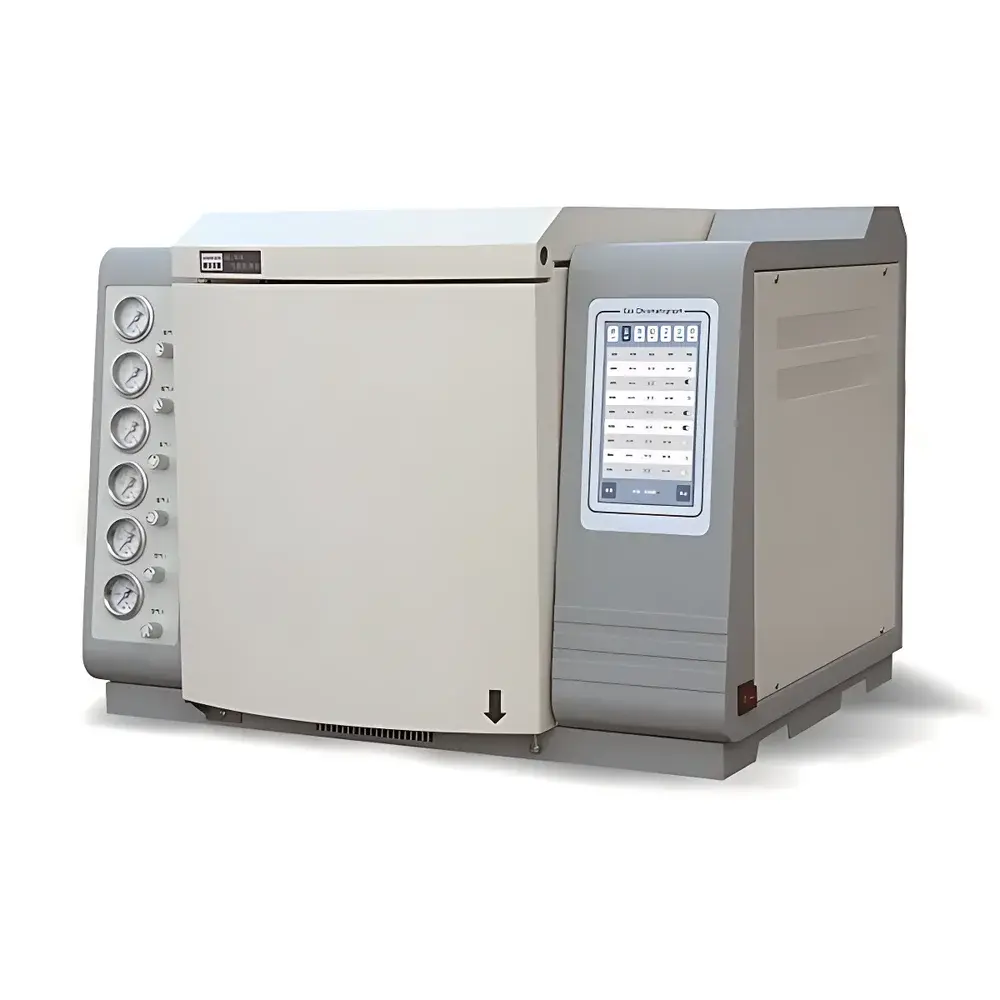
HUIFEN GC-7820 Dedicated Gas Chromatograph for Automotive Gasoline Analysis
| Brand | HUIFEN Instrument |
|---|---|
| Origin | Shandong, China |
| Model | GC-7820 Dedicated Gas Chromatograph for Automotive Gasoline |
| Temperature Control Range | Ambient + 3 °C to 450 °C |
| Oven Ramp Rate | 0.1–40 °C/min |
| Cool-down Time | ~8 min (450 °C → 50 °C) |
| Carrier Gas Flow Range & Control | 0–1200 mL/min |
| Carrier Gas Pressure Range & Control | 0–970 kPa |
| Injector Maximum Operating Temperature | 450 °C |
| Injector Pressure Setting Range | 0–970 kPa |
| Injector Total Flow Setting Range | 0–1200 mL/min |
Overview
The HUIFEN GC-7820 Dedicated Gas Chromatograph for Automotive Gasoline Analysis is a purpose-built laboratory gas chromatograph engineered to meet the stringent compositional testing requirements of modern fuel specifications. Designed in accordance with ASTM D4815, D5599, D6299, and Chinese national standards including GB 17930–2011 (Automotive Gasoline), GB 18351–2004 (Ethanol-blended Gasoline), SH/T 0663–1998 (Alcohols and Ethers in Gasoline), and SH/T 0693–2000 (Aromatic Hydrocarbons in Gasoline), the system delivers high reproducibility and regulatory compliance for routine QC/QA in petroleum refineries, third-party testing laboratories, and fuel certification facilities. Its core architecture employs capillary column-based separation coupled with electronic pressure control (EPC) and advanced dual-column heart-cutting (MDGC) configurations—enabling precise quantification of oxygenates (e.g., MTBE, TAME, DME), aromatic hydrocarbons (benzene, toluene), and individual alcohols across complex gasoline matrices.
Key Features
- Modular, field-upgradable platform supporting multiple detector configurations—including FID, TCD, ECD, FPD, and NPD—without hardware reconfiguration.
- Triple-threaded Ethernet communication architecture (10/100M adaptive interface, embedded TCP/IP stack) enabling simultaneous local operation, supervisory monitoring, and regulatory data forwarding to central DCS or LIMS via Modbus/TCP.
- Integrated EPC-driven pneumatic system eliminating mechanical pressure gauges; provides automatic leak detection, flame ignition sequence, carrier gas activation, and fail-safe shutdown on flameout or pressure deviation.
- Vacuum fluorescent display (VFD) with dual-language UI (English/Chinese), optimized for readability under ambient lighting conditions including direct sunlight exposure.
- Column oven with 16-stage programmable temperature ramping, maximum heating rate of 120 °C/min, and temperature stability of ±0.01 °C at setpoint—critical for retention time locking in multi-method workflows.
- Dedicated valve manifold system supporting automated multi-dimensional GC (MDGC) sequences: configurable 4-port, 6-port, and 10-port valves with auxiliary electronic flow controllers for precise heart-cut timing and backflush operations.
Sample Compatibility & Compliance
The GC-7820 is validated for direct injection of neat gasoline samples (ASTM D4057-compliant sampling), as well as pre-spiked standards containing internal references such as 2-hexanone (for benzene/toluene analysis) and diethylene glycol dimethyl ether (DME, for oxygenate profiling). Its flow-path design accommodates both TCEP pre-columns and high-resolution WCOT fused-silica columns (e.g., DB-1, DB-624, or equivalent), enabling sequential elution, retention gap removal, and selective backflushing of heavy ends (>C10). All analytical methods conform to GLP-aligned data integrity practices: audit trails, user authentication, electronic signatures, and full 21 CFR Part 11–compliant data archiving are supported through the IBrain workstation software. The instrument satisfies ISO/IEC 17025 method validation criteria when operated per manufacturer-recommended calibration protocols.
Software & Data Management
The IBrain Chromatography Data System (CDS) serves as the central control and reporting engine. It supports concurrent real-time acquisition from up to 253 GC units on a single network segment, with centralized method deployment, remote diagnostics, and automated report generation compliant with ISO 10648 and ASTM D6708. Built-in Modbus/TCP server functionality allows seamless integration into refinery-wide DCS environments for automated feedstock quality feedback loops. Raw data files (.IBD) are stored in vendor-neutral HDF5 format with embedded metadata (instrument parameters, method version, operator ID, timestamp), ensuring long-term readability and traceability. Batch processing modules support automated peak integration using retention time windows, area normalization, and internal standard response factor correction—all configurable per SH/T 0663 and SH/T 0693 calculation templates.
Applications
- Quantitative determination of oxygenated additives (MTBE, ETBE, TAME, DIPE, ethanol, methanol) in reformulated gasoline per GB 18351 and EPA Method 310.
- Simultaneous benzene and toluene assay with detection limits <10 ppm (w/w), meeting GB 17930’s 1.0% v/v upper limit for benzene and EU Directive 2009/30/EC specifications.
- Full aromatic hydrocarbon profiling (BTEX, C8–C10 alkylbenzenes) using SH/T 0693–2000-compliant MDGC configuration with TCEP/WCOT column switching.
- Stability assessment of ethanol-gasoline blends (E10, E15, E85) through accelerated phase separation studies and water content correlation.
- QC release testing of finished gasoline batches prior to distribution, with full electronic records supporting GMP-aligned documentation requirements.
FAQ
What regulatory standards does the GC-7820 directly support?
It is configured and validated for GB 17930–2011, GB 18351–2004, SH/T 0663–1998, SH/T 0693–2000, and aligns with ASTM D4815, D5599, and ISO 22854 methodologies.
Can the system perform unattended overnight analysis?
Yes—equipped with programmable autosampler-ready interfaces and scheduled run sequences, including timed valve actuation, column bake-out, and auto-zero cycles.
Is the IBrain software compatible with LIMS integration?
Yes—supports ASTM E1578-compliant LIMS connectivity via ODBC, HL7, and direct file export (CSV, XML, PDF) with embedded digital signatures.
What is the minimum detectable level for benzene using the FID configuration?
Under optimized SH/T 0693 conditions, the system achieves <5 ng benzene on-column with signal-to-noise ≥3, corresponding to ~0.5 ppm (w/w) in neat gasoline matrix.
Does the instrument support method transfer from legacy GC platforms?
Yes—retention time locking, EPC pressure tuning, and column dimension compensation algorithms enable robust cross-platform method portability without revalidation.





