
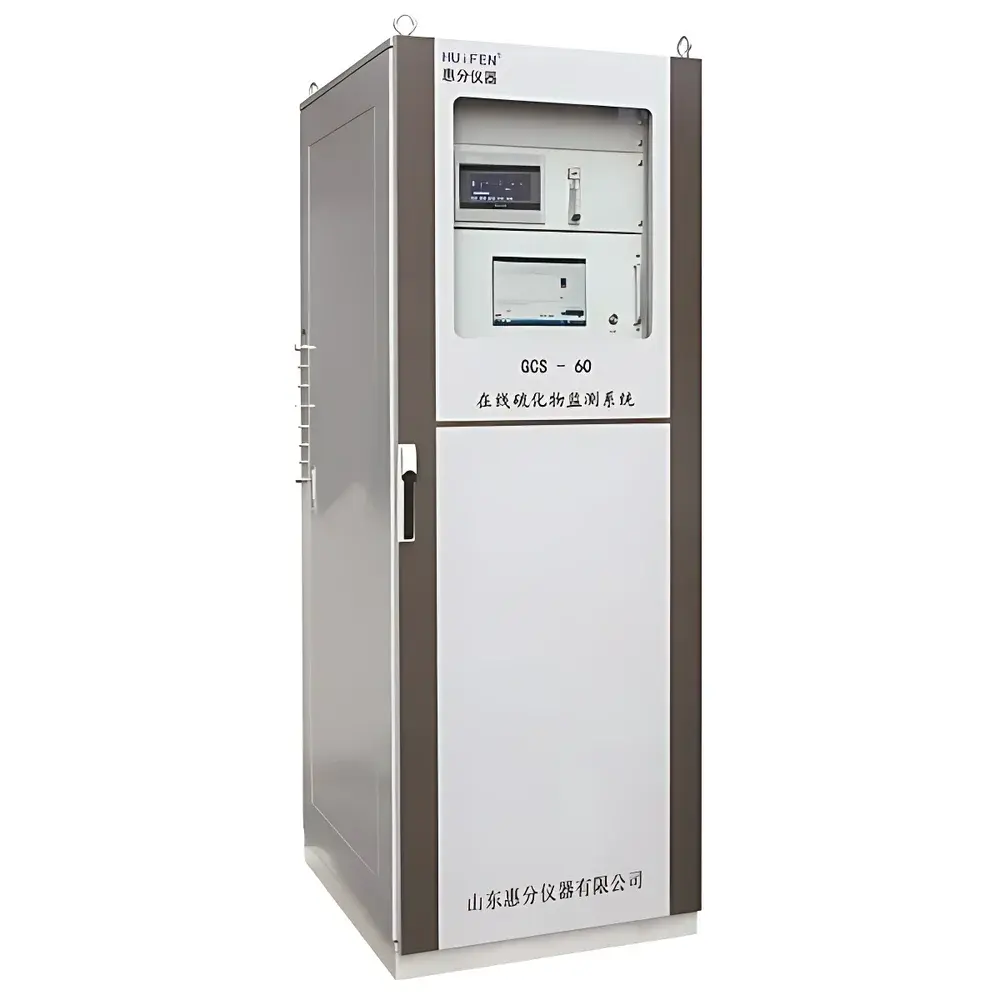
Huifen GCS-60 Online Sulfur Analyzer (Gas Chromatograph with Flame Photometric Detection)
| Brand | Huifen Instrument |
|---|---|
| Origin | Shandong, China |
| Model | GCS-60 |
| Instrument Type | Online Gas Chromatograph |
| Application Field | Petrochemical Industry |
| Oven Temperature Range | Ambient +5°C to 450°C |
| Maximum Ramp Rate | 80°C/min |
| Cooling Rate | ~10 min from 450°C to 50°C |
| Carrier Gas Flow Range & Control | 0–1000 mL/min, resolution 0.01 mL/min |
| Carrier Gas Pressure Range & Control | 0–100 psi, resolution 0.001 psi |
| Injector Max Operating Temperature | 400°C |
| Injector Pressure Set Range | 0–100 psi |
| Injector Total Flow Set Range | 0–1000 mL/min |
| Detector | Flame Photometric Detector (FPD) for Sulfur |
| Detection Range | 50 ppb – 0.1% (v/v) |
| Accuracy | ±5% for major components, ±10% for trace sulfur species |
| Output Signal | 4–20 mA analog |
| Communication | RS-232 / RS-485 (Modbus RTU protocol) |
| Power Supply | 220 VAC, 50 Hz |
| Ambient Operating Conditions | 5–45°C, 5–95% RH (non-condensing) |
| Dimensions (W×D×H) | 800 × 700 × 1900 mm |
| Net Weight | 170 kg |
Overview
The Huifen GCS-60 Online Sulfur Analyzer is a dedicated gas chromatographic system engineered for continuous, real-time quantification of sulfur-containing compounds—including hydrogen sulfide (H2S), carbonyl sulfide (COS), and total sulfur—in industrial process gases. It operates on the principle of capillary gas chromatography coupled with flame photometric detection (GC-FPD), a method standardized in GB/T 28727–2012 “Gas Analysis—Determination of Sulfur Compounds—Flame Photometric Gas Chromatographic Method.” Unlike laboratory-based GC systems requiring manual sampling and offline analysis, the GCS-60 integrates heated sample transfer lines, automated valving, and temperature-controlled separation columns into a single ruggedized cabinet, enabling unattended operation directly at the process point. Its design emphasizes analytical robustness under fluctuating plant conditions, with precise thermal management of the entire flow path—from sample introduction through column oven to detector—minimizing condensation, adsorption, and memory effects common in reactive sulfur species.
Key Features
- Integrated heated sample transport system (up to 200°C) with insulated, stainless-steel伴热 tubing to prevent sulfur compound loss or polymerization prior to injection;
- High-stability FPD detector with passivated internal surfaces (e.g., quartz-lined combustion chamber), reducing surface adsorption and improving reproducibility for low-level sulfur measurements;
- Imported PEEK multi-port rotary valve rated for ≥1 million actuation cycles, ensuring long-term reliability in high-duty-cycle online environments;
- Programmable oven with rapid thermal response (0–450°C range, up to 80°C/min ramp rate) and fast cooling capability (~10 min from 450°C to 50°C), supporting flexible method development and short cycle times;
- Advanced pneumatic control architecture: digitally regulated carrier gas pressure (0–100 psi, ±0.001 psi resolution) and mass flow (0–1000 mL/min, ±0.01 mL/min resolution), enabling retention time stability and method transferability;
- Intuitive HMI interface with real-time monitoring of critical parameters (oven temp, injector temp, detector status, pressure/flow readings) and configurable alarm thresholds for temperature excursions or gas supply anomalies;
- Compliance-ready analog output (4–20 mA) and digital communication (RS-232/RS-485, Modbus RTU) for seamless integration into DCS/SCADA systems and centralized data logging platforms.
Sample Compatibility & Compliance
The GCS-60 is validated for direct analysis of untreated or lightly filtered process streams including natural gas, coke oven gas, blast furnace gas, and refinery fuel gas. Sample matrices may contain moisture, hydrocarbons, CO, CO2, and particulates; optional inline filters and moisture traps are recommended upstream based on site-specific feed composition. The system meets mechanical and electrical safety requirements per IEC 61000-6-2 (immunity) and IEC 61000-6-4 (emissions). While not certified to ATEX or IECEx by default, it supports integration into hazardous area installations via appropriate barrier configurations and purged enclosures. Data integrity features—including timestamped event logs, parameter change history, and non-volatile method storage—support alignment with GLP and GMP documentation expectations. Method performance adheres to GB/T 28727–2012, and the instrument’s measurement uncertainty profile is consistent with ISO/IEC 17025 principles for in-house method validation.
Software & Data Management
The GCS-60 operates without proprietary PC software; all configuration, calibration, and diagnostics are executed locally via its embedded Linux-based controller and touchscreen HMI. Calibration routines support multi-point external standard addition and internal standard correction. All chromatograms, peak tables, and system logs are stored internally on industrial-grade SD card or exported via USB. Raw chromatographic data (retention time, peak area, calculated concentration) are transmitted continuously via 4–20 mA output or Modbus registers, enabling direct ingestion into plant historians (e.g., OSIsoft PI, AspenTech IP.21) or LIMS. Audit trail functionality records operator actions, method edits, and alarm events with user ID and timestamp—meeting foundational requirements for FDA 21 CFR Part 11 compliance when deployed within validated environments using supplementary procedural controls.
Applications
- Real-time H2S monitoring in natural gas transmission pipelines to ensure pipeline corrosion control and specification compliance (e.g., ≤4 ppmv per ISO 8573-1 Class 2);
- Process optimization in Claus sulfur recovery units by tracking COS and organic sulfur precursors upstream of the reactor;
- Quality assurance of syngas feedstocks in ammonia or methanol plants where sulfur poisoning of catalysts must be avoided;
- Environmental compliance reporting for SOx precursor emissions from coke ovens and steel mills;
- Refinery-wide sulfur balance studies across FCC, hydrotreater, and amine unit interfaces;
- Commissioning and troubleshooting of amine sweetening units by correlating inlet/outlet sulfur speciation profiles.
FAQ
What sulfur species can the GCS-60 quantify independently?
The system resolves and quantifies H2S, COS, CS2, and methyl mercaptan (CH3SH) using optimized capillary column chemistry and retention time windows. Total sulfur is derived from the sum of calibrated peaks plus residual unseparated sulfur response.
Is column maintenance required during routine operation?
Yes—capillary columns require periodic conditioning and replacement based on cumulative sample exposure. Typical service intervals range from 6 to 18 months depending on sample cleanliness and daily duty cycle. Column bake-out protocols are accessible via the HMI.
Can the GCS-60 operate in ambient temperatures below 5°C?
No—the specified operating range is 5–45°C. Sub-zero environments necessitate climate-controlled shelters or heated enclosures to maintain internal thermal stability and avoid condensation in the sample path.
Does the system support remote firmware updates?
Firmware updates are performed manually via USB drive following factory-issued release notes. No over-the-air (OTA) update capability is provided due to industrial cybersecurity best practices.
What is the minimum detectable level for H2S under typical operating conditions?
At optimal signal-to-noise ratio (S/N ≥ 3), the practical limit of detection (LOD) for H2S is approximately 30–50 ppb, consistent with FPD sensitivity and sample loop volume (typically 0.25–1.0 mL).





