
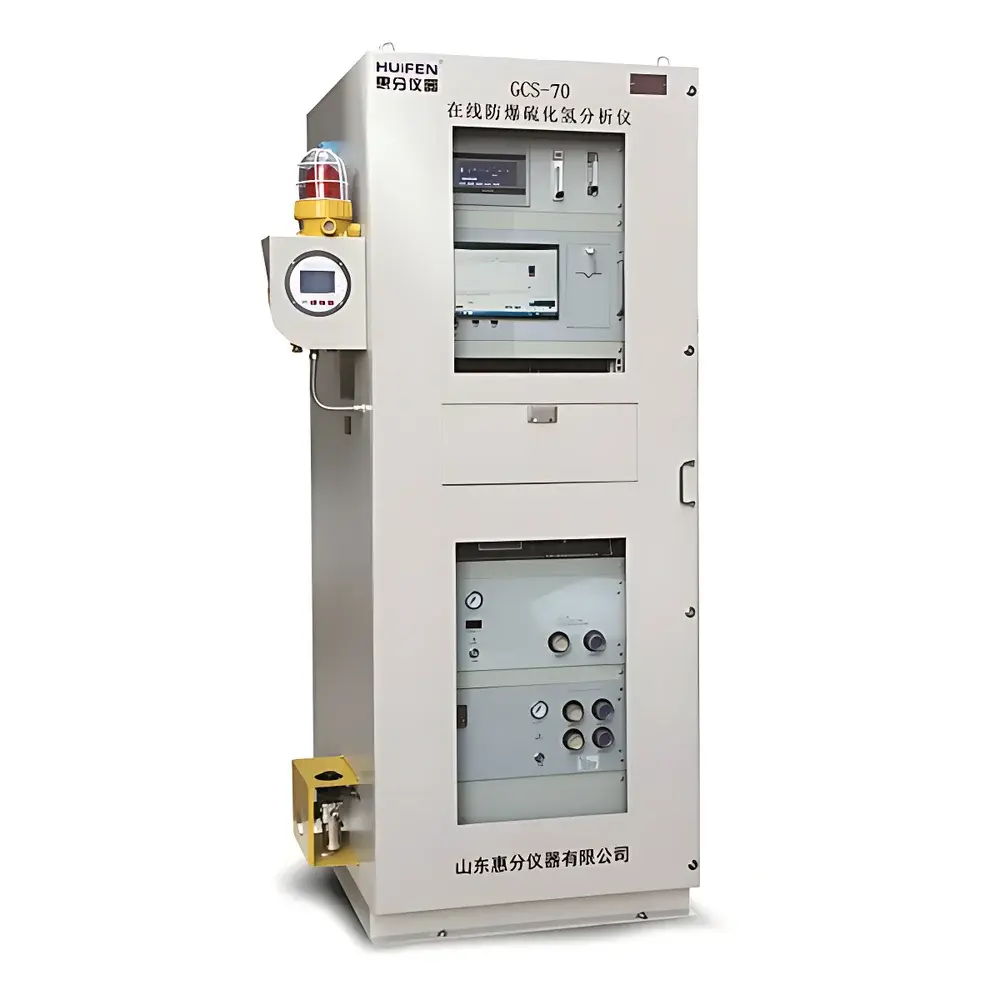
HUIFEN GCS-70 Industrial Online Gas Chromatograph
| Brand | HUIFEN Instrument |
|---|---|
| Origin | Shandong, China |
| Manufacturer Type | Authorized Distributor |
| Product Category | Domestic |
| Model | GCS-70 |
| Instrument Type | Online Gas Chromatograph |
| Application Field | Petrochemical Industry Specific |
| Temperature Control Range | Ambient +5°C to 450°C |
| Maximum Ramp Rate | 80°C/min |
| Cooling Rate | ~10 min from 450°C to 50°C |
| Carrier Gas Flow Range & Control | 0–1000 mL/min, resolution 0.01 mL/min |
| Carrier Gas Pressure Range & Control | 0–100 psi, resolution 0.001 psi |
| Injector Maximum Operating Temperature | 450°C |
| Injector Pressure Setting Range | 0–100 psi |
| Injector Total Flow Setting Range | 0–800 mL/min |
| Detector Options | TCD, FID, FPD (up to 3 simultaneously) |
| Detection Limits | TCD ≥100 ppm, FID ≥0.1 ppm, FPD ≥100 ppb |
| Explosion Protection | Positive-Pressure Enclosure, Ex d px II C T4 Gb |
| Ingress Protection | IP65 |
| Output Signal | 4–20 mA |
| Communication | RS232 / RS485 (Modbus RTU) |
| Instrument Air Requirement | Clean air, 0.4–0.6 MPa |
| Dimensions (W×D×H) | 900 × 1020 × 2080 mm |
| Net Weight | 310 kg |
Overview
The HUIFEN GCS-70 Industrial Online Gas Chromatograph is a process-integrated analytical system engineered for continuous, real-time compositional analysis of gas-phase streams in demanding industrial environments. Built on robust capillary or packed-column gas chromatography principles, the GCS-70 employs precise temperature-programmed separation coupled with high-sensitivity detection to resolve complex hydrocarbon and inorganic mixtures—common in petrochemical refining, coal-to-chemicals conversion, natural gas processing, steel off-gas monitoring, and air separation units. Its core architecture integrates a certified positive-pressure explosion-proof enclosure (Ex d px II C T4 Gb), enabling safe deployment in Zone 1/21 hazardous locations without requiring external purge systems. Unlike laboratory GCs, the GCS-70 is designed for unattended 24/7 operation, featuring hardened pneumatic control, integrated sample conditioning, and fail-safe thermal management—including rapid heating (up to 80°C/min) and controlled cooling (450°C → 50°C in ≈10 min) to support short-cycle analyses required in dynamic process control loops.
Key Features
- Positive-pressure explosion-proof cabinet compliant with IEC 60079-2 and GB 3836.5, rated Ex d px II C T4 Gb for Class I Division 1 / Zone 1 applications;
- Simultaneous multi-detector configuration: up to three independent detectors (TCD, FID, and FPD) installed in one chassis, enabling parallel quantification of permanent gases, hydrocarbons, sulfur compounds, and phosphorus-containing species;
- High-precision gas flow and pressure control: carrier gas flow regulated from 0–1000 mL/min (0.01 mL/min resolution); pressure controlled from 0–100 psi (0.001 psi resolution), ensuring retention time stability across variable backpressure conditions;
- Integrated sample conditioning subsystem: particulate filtration, moisture removal via thermoelectric or adsorbent traps, and optional heated sample lines (with configurable伴热 power) to prevent condensation in low-temperature or high-humidity feed streams;
- Remote operation capability via embedded web server and standard Modbus RTU protocol over RS232/RS485; supports integration into DCS, SCADA, and MES platforms for automated alarm handling and data archival;
- Industrial-grade mechanical design: IP65-rated front panel, stainless-steel internal plumbing, and vibration-damped column oven—optimized for installation on pipe racks, skids, or analyzer shelters with minimal maintenance intervals.
Sample Compatibility & Compliance
The GCS-70 accommodates a broad range of process gas matrices including refinery fuel gas, syngas, coke oven gas, LNG boil-off vapor, and cryogenic air separation streams. Sample introduction is compatible with both loop injection (0.25–5.0 mL) and direct capillary split/splitless modes. All wetted materials meet ASTM A269 TP316L specifications for corrosion resistance against H2S, CO2, and trace halides. The system complies with ISO/IEC 17025 preconditions for routine calibration traceability and supports GLP/GMP-aligned audit trails when paired with validated software configurations. While not inherently 21 CFR Part 11 compliant out-of-the-box, its data logging architecture permits third-party validation for regulated environments under client-defined SOPs.
Software & Data Management
The embedded control interface runs a deterministic real-time OS with dual-mode operation: local touchscreen HMI (7″ resistive display) and remote web-based GUI accessible via Ethernet. Chromatographic method setup includes customizable temperature ramps, detector parameter scheduling, and valve sequencing logic for multi-stream analysis. Raw chromatograms and processed results (peak area, retention time, concentration) are exported in CSV or XML format. The system logs all operational events—including oven temperature deviations, detector baseline shifts, and pressure fault triggers—with timestamped records stored onboard (≥30 days) and exportable via USB or network share. Optional OPC UA server module enables seamless interoperability with enterprise historian systems (e.g., OSIsoft PI, AspenTech IP.21).
Applications
- Petrochemical plants: Real-time monitoring of C1–C5 hydrocarbons in FCC off-gas, hydrogen purity in hydrotreater recycle loops, and H2S/mercaptan speciation in amine regenerator overheads;
- Coal chemical facilities: Quantitative analysis of CH4, CO, CO2, H2, and higher olefins in Fischer–Tropsch synthesis gas and methanol purge streams;
- Natural gas transmission: BTU calculation via compositional analysis (N2, O2, CO2, C1–C6), Wobbe index verification, and odorant (THT) concentration tracking;
- Steel industry: Blast furnace top gas analysis for CO/CO2/N2/H2 ratios used in energy balance modeling and emissions reporting;
- Air separation units: Trace argon, krypton, and xenon detection in liquid oxygen product lines per ISO 8573-1 Class 2 purity requirements.
FAQ
What explosion protection standard does the GCS-70 meet?
The GCS-70 utilizes a certified positive-pressure enclosure conforming to IEC 60079-2 and GB 3836.5, with marking Ex d px II C T4 Gb — suitable for Group II C gas atmospheres and surface temperatures ≤135°C.
Can the GCS-70 operate without manual intervention for extended periods?
Yes. Designed for unattended operation, it features automated leak checks, self-diagnostic routines, scheduled column bake-outs, and configurable alarm escalation (email/SMS via gateway) — supporting typical maintenance intervals of 3–6 months depending on sample cleanliness.
Is calibration traceable to national standards?
Calibration gases must be certified to ISO 6141 or NIST SRM equivalents. The instrument supports multi-point calibration curves with R² ≥0.9995 for linear ranges, and raw data files retain full metadata (gas lot number, expiration, cylinder pressure) for audit readiness.
How is data integrity ensured during communication with DCS systems?
All 4–20 mA outputs include HART digital overlay for diagnostic health reporting. Modbus RTU frames incorporate CRC-16 error checking, and write-protected registers prevent unauthorized configuration changes from upstream controllers.
What column types are supported?
Standard compatibility includes 1/8″ OD stainless-steel packed columns (e.g., Porapak Q, Molecular Sieve 5A) and 0.25–0.53 mm ID fused-silica capillaries (e.g., DB-1, DB-ALOHA, PLOT Al2O3). Column oven dimensions accommodate up to 3 m packed or 60 m capillary lengths.
Related Products




