
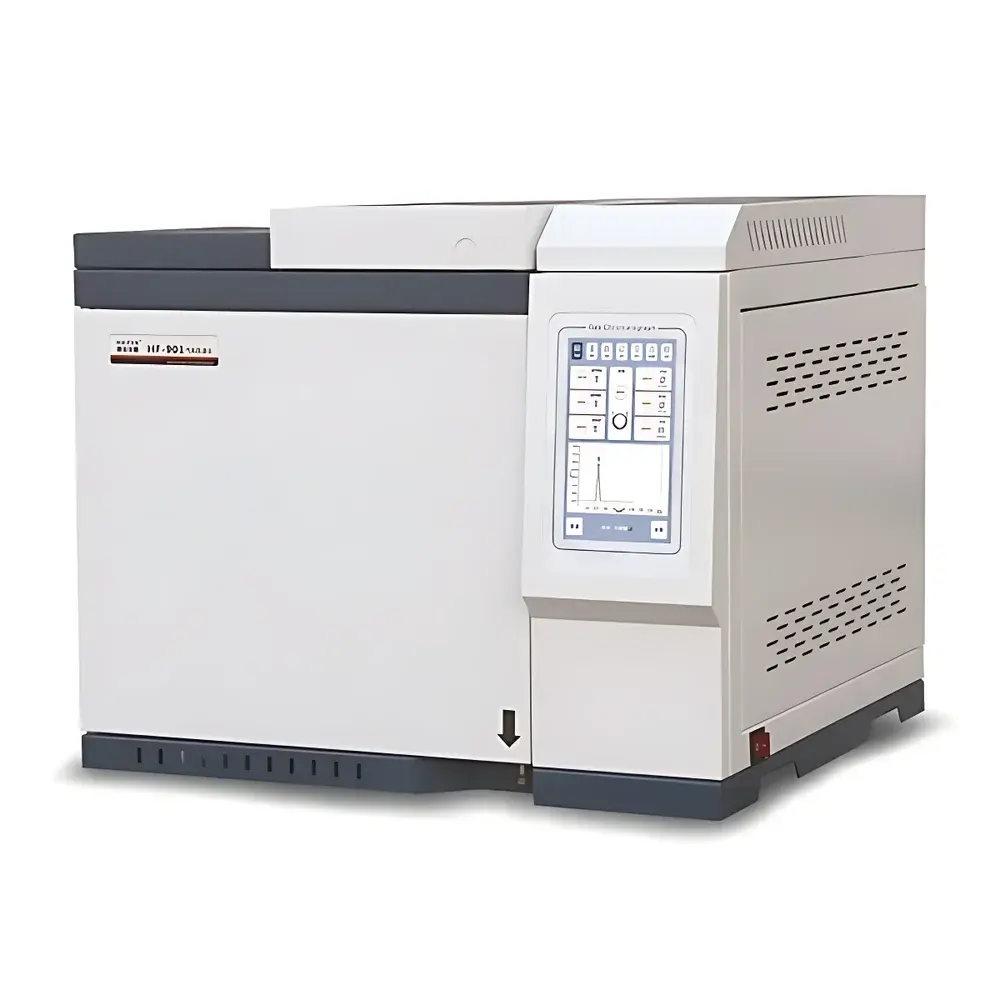
Huifen HF-901 Gas Chromatograph
| Brand | Huifen Instrument |
|---|---|
| Origin | Shandong, China |
| Model | HF-901 |
| Instrument Type | Laboratory Gas Chromatograph |
| Application Scope | General-purpose |
| Oven Temperature Range | Ambient + 3 °C to 450 °C |
| Maximum Ramp Rate | 120 °C/min |
| Cooling Time | <5 min (350 °C → 50 °C) |
| Carrier Gas Flow Range & Control | 0–1000 mL/min |
| Carrier Gas Pressure Range & Control | 0–0.6 MPa |
| Injector Maximum Operating Temperature | 450 °C |
| Injector Pressure Setting Range | 0–0.6 MPa |
| Injector Total Flow Setting Range | 0–1000 mL/min |
| Temperature Control Zones | 8 independent zones with auto-protection |
| Display | 7-inch industrial color LCD touchscreen |
| Language Support | English & Chinese |
| Programmable Temperature Steps | 99 stages |
| Maximum Run Time | 999.99 min |
| Injection Modes | Split/splitless capillary, packed column, valve injection, liquid/gas autosampler-compatible |
| Injector Ports | Up to 4 (max. 3 capillary inlets) |
| EPC Control Modes | Pressure, flow, linear velocity, and programmed variants (12-step) |
| EPC Accuracy | Pressure ±2% FS, Flow ±5% FS |
| EPC Repeatability | Pressure ±0.05 kPa, Flow ±0.5 kPa (FS) |
| Detector Capacity | Up to 4 simultaneous detectors |
| Compatible Detectors | FID, TCD, ECD, FPD, NPD, PDHID, PED |
Overview
The Huifen HF-901 Gas Chromatograph is a fully programmable, laboratory-grade analytical instrument engineered for precision separation and quantitative analysis of volatile and semi-volatile organic compounds. Based on classical gas chromatographic principles—where analytes are partitioned between a mobile phase (inert carrier gas) and a stationary phase (capillary or packed column)—the HF-901 delivers high-resolution separation through precise thermal control, digitally regulated electronic pressure control (EPC), and modular detector integration. Designed for routine QC/QA, environmental monitoring, petrochemical profiling, food safety screening, and academic research, the system meets core operational requirements defined in ASTM D3606, ISO 10301, USP , and EPA Methods 8021B, 8270, and 8082. Its architecture supports GLP-compliant workflows via audit-trail-enabled data acquisition, secure user access levels, and full 21 CFR Part 11 readiness when deployed with validated IBrainchrom software.
Key Features
- Eight independently controlled temperature zones—including oven, up to four injector ports, and up to four detector compartments—with real-time thermal protection and ±0.01 °C display resolution.
- Advanced EPC system with dual-range flow control (0–100 mL/min and 0–1000 mL/min), enabling accurate linear velocity programming and multi-step pressure/flow ramping (up to 12 steps per method).
- Ultra-fast thermal management: maximum heating rate of 120 °C/min and sub-5-minute cooling from 350 °C to 50 °C via intelligent rear-door airflow modulation.
- 7-inch industrial-grade color LCD touchscreen with dual-language (English/Chinese) firmware and intuitive menu navigation—no external PC required for basic operation.
- Modular detector bay supporting concurrent installation of up to four detectors, including FID, TCD, ECD, FPD, NPD, PDHID, and PED—each with factory-calibrated sensitivity and built-in safety interlocks (e.g., flame-out detection, carrier gas cut-off).
- Integrated hardware-level fault diagnostics: automatic ignition sequence for FID, hydrogen shutoff on flame failure, carrier gas purging on power-up, and self-check routines at boot.
Sample Compatibility & Compliance
The HF-901 accommodates diverse sample introduction methods: split/splitless capillary injection (with septum purge), packed-column direct injection, gas-tight syringe, valve-based loop injection, and compatibility with third-party liquid/gas autosamplers (e.g., CTC PAL, Gerstel MPS). All internal gas pathways undergo full chemical passivation to minimize active site adsorption—critical for phosphorus-containing pesticides, sulfur compounds, and base-sensitive analytes. The system complies with IEC 61010-1 for electrical safety and meets electromagnetic compatibility standards EN 61326-1. When configured with IBrainchrom and appropriate validation packages, it satisfies GMP/GLP documentation requirements for regulated laboratories under FDA, EMA, and NMPA guidelines.
Software & Data Management
The HF-901 is operated and controlled via IBrainchrom—a Windows-based chromatography data system (CDS) supporting up to 253 networked instruments simultaneously. It provides full bidirectional instrument control (including method download, real-time parameter adjustment, and remote diagnostics), peak integration with customizable baseline algorithms, calibration curve generation (linear, quadratic, weighted), and report templating compliant with ISO/IEC 17025. The software implements Modbus RTU protocol for seamless integration into distributed control systems (DCS) and SCADA environments. Audit trails record all user actions, method modifications, and data reprocessing events with timestamped, non-erasable entries. Raw data files adhere to AIA (.cdf) format for long-term archival and cross-platform interoperability.
Applications
- Petroleum & Petrochemicals: Hydrocarbon group-type analysis (PIONA), gasoline oxygenates (MTBE, ETBE), benzene/toluene/xylenes (BTX), and simulated distillation (ASTM D5292).
- Environmental Testing: Pesticide residue screening (organophosphates, organochlorines), PCB congener profiling, VOC emissions (EPA TO-17), and soil/water extract analysis.
- Food & Beverage Safety: Mycotoxin quantification (aflatoxins, ochratoxin A), flavor compound profiling, solvent residue testing (ICH Q3C), and adulterant detection.
- Pharmaceuticals: Residual solvent analysis (USP ), chiral separation of active pharmaceutical ingredients (APIs), and stability-indicating assays.
- Public Health & CDC Labs: Clinical toxicology (blood alcohol, volatile anesthetics), forensic drug screening (amphetamines, cannabinoids), and biomonitoring (urinary metabolites).
FAQ
Does the HF-901 support 21 CFR Part 11 compliance?
Yes—when used with validated IBrainchrom software, configured user roles, electronic signatures, and enabled audit trail logging, the system fulfills key technical controls for electronic records and signatures as specified in 21 CFR Part 11.
Can the instrument operate without a connected PC?
Yes—the embedded 7-inch touchscreen interface allows standalone method creation, run initiation, real-time chromatogram viewing, and basic data export via USB storage.
What is the minimum detectable amount for FID with standard configuration?
The certified detection limit is ≤1.0 × 10⁻¹² g/s for n-hexadecane on a standard FID, measured under optimized conditions per IUPAC recommendations.
Is column oven cooling performance validated across ambient temperature variations?
Cooling time specifications (<5 min from 350 °C to 50 °C) are verified at 25 °C ambient; performance may vary by ±15% at extremes of 15 °C or 35 °C ambient per IEC 61000-4-30 environmental classification.
Are detector modules field-replaceable without tools?
All detector assemblies feature quick-release bayonet mounts and pre-aligned electrical/optical interfaces—replacement requires no calibration recalibration or mechanical adjustment beyond zero-balance verification.







