
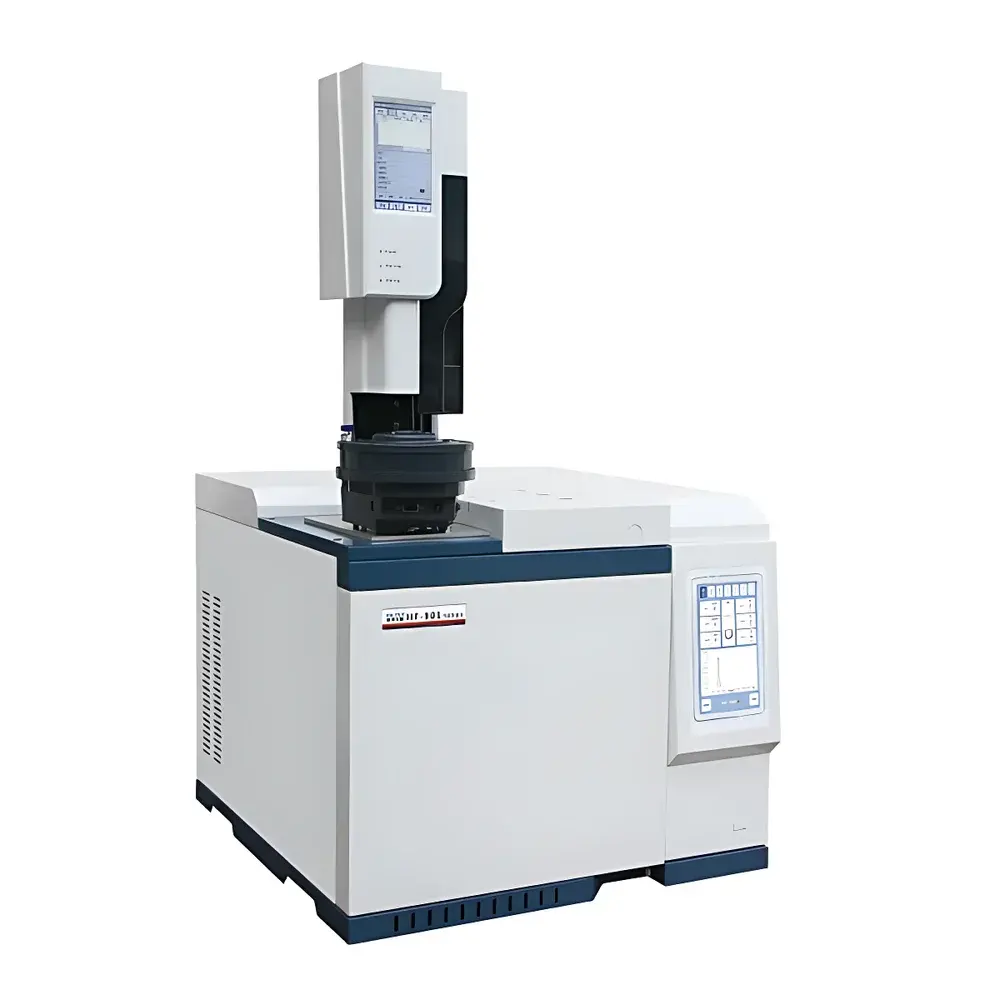
Huifen HF-901H Gas Chromatograph for Oxygenates and Aromatic Hydrocarbons Analysis
| Brand | Huifen Instrument |
|---|---|
| Origin | Shandong, China |
| Model | HF-901H |
| Instrument Type | Laboratory Gas Chromatograph |
| Application Field | Environmental Monitoring & Fuel Quality Control |
| Oven Temperature Range | Ambient + 5 °C to 450 °C |
| Ramp Rate | 0.1–80 °C/min |
| Cool-down Time | ~8 min (450 °C → 50 °C) |
| Carrier Gas Flow Range | 0–1200 mL/min |
| Carrier Gas Pressure Range | 0–970 kPa |
| Injector Max Temp | 450 °C |
| Injector Pressure Setting Range | 0–970 kPa |
| Injector Total Flow Setting Range | 0–1200 mL/min |
| Detector | FID (Min. Detectable Level: <5 pg C/s on n-hexadecane |
| Linear Dynamic Range | 10⁷ ±10% |
| Data Acquisition Rate | 20 Hz) |
| Temperature Control Precision | ±0.1 °C |
| Max Run Time | 999.99 min |
| Programmable Temperature Steps | 16 |
| Injector Options | Packed Column, Split/Splitless |
| Valve System | Configurable Auto-Controlled Valves (4-port, 6-port, 10-port, or Liquid Sampling Valve) |
| Solenoid Valve Lifetime | ≥1×10⁶ cycles (10 ms switching) |
Overview
The Huifen HF-901H Gas Chromatograph is a dedicated analytical platform engineered for the precise quantification of oxygenated compounds (e.g., methanol, ethanol, MTBE, ETBE, TAME) and aromatic hydrocarbons (e.g., benzene, toluene, ethylbenzene, xylenes — BTEX) in gasoline and related petroleum distillates. It operates on the principle of capillary or packed-column gas chromatography coupled with flame ionization detection (FID), delivering high-resolution separation and robust quantitation under regulated thermal programming conditions. Designed specifically to meet ASTM D4815 (for oxygenates), ASTM D5769 (for benzene), ASTM D6299 (precision and bias control), and ISO 20631:2020 (gasoline analysis), the system supports compliance-driven workflows in refinery QC labs, environmental monitoring agencies, and third-party testing laboratories. Its column oven architecture enables reproducible temperature ramping from ambient +5 °C to 450 °C at rates up to 80 °C/min, ensuring optimal resolution of co-eluting polar and non-polar analytes within complex hydrocarbon matrices.
Key Features
- Thermally stable column oven with 16-stage programmable temperature ramping and ±0.1 °C setpoint accuracy, enabling method transfer consistency across instruments.
- Dual-mode electronic pressure/flow control (EPC/EFC) for carrier gas and auxiliary gases, supporting both packed and fused-silica capillary columns with full digital regulation (0–970 kPa, 0–1200 mL/min).
- High-duty-cycle solenoid valve system (rated for ≥1 million actuations at 10 ms response time), configurable with 4-, 6-, or 10-port valves for automated backflush, heart-cutting, or multi-dimensional GC applications.
- FID detector featuring auto-ignition logic, hydrogen leak detection circuitry, and temperature-stable signal amplification optimized for continuous operation up to 450 °C.
- Injector options include split/splitless and packed-column configurations, all rated to 450 °C with independent pressure and flow control.
- Integrated cooling system achieves rapid oven cooldown (450 °C → 50 °C in ≈8 minutes), minimizing cycle time between sequential fuel samples.
Sample Compatibility & Compliance
The HF-901H is validated for direct injection of neat gasoline, reformulated gasoline (RFG), oxygenated blends (E10, E15, MTBE-doped), and synthetic fuel surrogates. It accommodates standard reference materials per NIST SRM 2710a (gasoline-like matrix) and CRM-101 (oxygenate calibration mix). The instrument satisfies regulatory data integrity requirements when operated under GLP-compliant SOPs and supports audit-ready reporting aligned with ISO/IEC 17025:2017 clause 7.7 (reporting results) and US EPA Method 8015M. While not inherently 21 CFR Part 11 compliant, its data acquisition software may be configured with user authentication, electronic signatures, and audit trail logging upon integration with validated LIMS environments.
Software & Data Management
The system operates via PC-based chromatography data system (CDS) software supporting method creation, sequence definition, real-time signal monitoring, peak integration (with retention time locking and spectral deconvolution for overlapping BTEX peaks), and report generation in PDF, CSV, and XML formats. Calibration curves are constructed using internal standard (e.g., fluorobenzene) or external standard methodologies, with linear regression (R² ≥ 0.9995 typical) and residual error analysis embedded in the quantitation engine. Raw data files retain full acquisition metadata (oven program, valve events, detector parameters, timestamped hardware status), facilitating traceability during regulatory inspections.
Applications
- Quantitative determination of C1–C5 alcohols and ethers in gasoline per ASTM D4815 and EN 15376.
- Benzene content verification in motor fuels per ASTM D5769, EU Directive 98/70/EC, and China GB 17930–2016.
- Multi-component aromatic profiling (BTEX, C9+ aromatics) for octane number correlation and reformulation studies.
- Quality control of biofuel blends (e.g., ethanol-gasoline, biodiesel-diesel) where oxygenate stability and phase separation behavior must be monitored.
- Refinery process stream analysis for FCC naphtha, reformate, and alkylate blending components.
FAQ
What standards does the HF-901H support for oxygenate analysis?
ASTM D4815, ASTM D5599, EN 15376, and GB/T 22030–2017 are fully implementable with appropriate column selection and calibration protocols.
Can the system analyze both oxygenates and BTEX in a single run?
Yes — using dual-column configuration (e.g., DB-624 and DB-1) with a 10-port valve and heart-cutting interface, simultaneous quantification is achievable without re-injection.
Is the FID detector compatible with both packed and capillary columns?
Yes — the detector’s optimized jet design and adjustable hydrogen/air flows ensure stable response across column types and dimensions.
What maintenance intervals are recommended for routine operation?
Injector liner replacement every 100 injections; FID jet cleaning every 250 runs; column trimming every 500–1000 injections; annual EPC sensor calibration verification.
Does the system support unattended overnight operation?
Yes — with validated sequence files, automatic shutdown logic, and hardware-level thermal safety interlocks (oven overtemperature cutoff, FID flame-out detection).






