
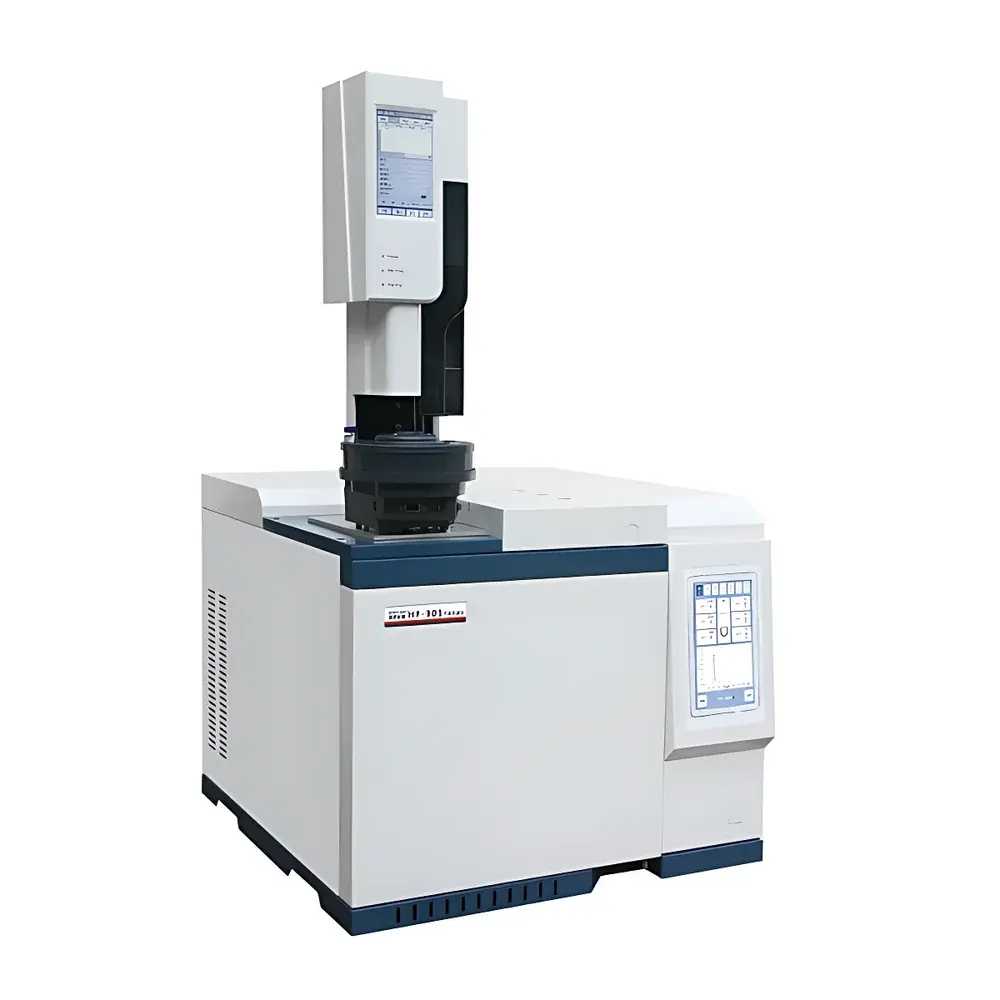
Huifen HF-901Q Gasoline PONA Analyzer (Laboratory Gas Chromatograph)
| Brand | Huifen Instrument |
|---|---|
| Origin | Shandong, China |
| Model | HF-901Q Gasoline PONA Analyzer |
| Instrument Type | Laboratory Gas Chromatograph |
| Application Field | Petroleum Refining & Petrochemical QC/QA |
| Temperature Control Range | Ambient + 3 °C to 450 °C |
| Oven Ramp Rate | 0.1–40 °C/min |
| Cooling Rate | ~8 min (450 °C → 50 °C) |
| Carrier Gas Flow Range & Control | 0–1200 mL/min |
| Carrier Gas Pressure Range & Control | 0–970 kPa |
| Injector Maximum Operating Temperature | 450 °C |
| Injector Pressure Setpoint Range | 0–970 kPa |
| Injector Total Flow Setpoint Range | 0–1200 mL/min |
Overview
The Huifen HF-901Q Gasoline PONA Analyzer is a dedicated laboratory gas chromatograph engineered for precise hydrocarbon group-type analysis in gasoline and related refinery streams. It implements ASTM D6730 (Standard Test Method for Determination of Individual Hydrocarbons in Spark Ignition Engine Fuels by Gas Chromatography) and aligns with IP 395 and ISO 6974-2 methodologies for PONA quantification—where P denotes paraffins (n- and iso-alkanes), O denotes olefins (mono- and di-olefins), N denotes naphthenes (cycloalkanes), and A denotes aromatics (including benzene, toluene, xylenes, and alkylbenzenes). The system utilizes high-resolution capillary column separation coupled with flame ionization detection (FID) as standard, supported by advanced electronic pressure control (EPC) for reproducible retention time alignment across runs. Its oven architecture enables precise thermal programming critical for resolving co-eluting C4–C12 hydrocarbons, while the 450 °C maximum operating temperature ensures robustness for heavy-end elution and column conditioning.
Key Features
- Modular, field-upgradable platform supporting optional detectors including FID, TCD, ECD, FPD, and NPD—enabling method flexibility beyond PONA (e.g., sulfur speciation, oxygenates, or trace contaminants)
- Integrated EPC-controlled pneumatic system replacing mechanical pressure gauges; provides digital setpoint accuracy ±0.1 kPa and flow stability <0.5% RSD over 24 h
- 7-inch full-color resistive touchscreen display with dual-language UI (English/Chinese), enabling intuitive local operation without external PC dependency
- 10/100M adaptive Ethernet interface with embedded TCP/IP stack—supports remote instrument control, real-time data streaming, and integration into LIMS or MES environments
- Automated safety protocols: flame-out detection with auto-reignition, carrier gas failure shutdown, leak-responsive pressure hold, and scheduled cold-start sequences for unattended overnight analysis
- Optimized cooling design achieving 450 °C → 50 °C in ≤8 minutes—reducing cycle time between high-temperature runs without compromising column integrity
Sample Compatibility & Compliance
The HF-901Q accommodates liquid samples (neat gasoline, reformate, FCC naphtha) via split/splitless injection and gaseous samples (refinery off-gas, vapor-phase headspace) when equipped with appropriate sampling valves and loop injectors. All hardware and firmware comply with IEC 61000-6-3 (EMC) and IEC 61010-1 (electrical safety) standards. The IBrainChrom software supports audit-trail-enabled operation per FDA 21 CFR Part 11 requirements—including electronic signatures, user access levels, and immutable method/data versioning—making it suitable for GLP- and GMP-regulated laboratories. Retention index calibration is performed in situ using n-alkane standards (C5–C12), ensuring method transferability across instruments within a site network.
Software & Data Management
IBrainChrom workstation serves as the central analytical engine, capable of concurrently managing up to 253 chromatographic channels. Its PONA3000 module implements automated peak identification via relative retention index matching against instrument-specific reference libraries—eliminating manual alignment. Overlay visualization displays sample and calibration chromatograms on identical time–amplitude axes, with color-coded peak groups (P/O/N/A) for rapid visual verification. Quantitation uses internal standard normalization (e.g., dodecane or tetradecane) with linear dynamic range spanning 0.05–100 wt%. Raw data export conforms to ASTM E1947-compliant .cdf format; Modbus RTU server integration enables direct SCADA/DCS telemetry of compositional results (e.g., total olefins %, benzene content, RON/MON proxy values).
Applications
- Gasoline blending optimization: real-time monitoring of paraffin/olefin ratio to meet regulatory limits (e.g., EU Fuel Quality Directive 2009/30/EC)
- Catalytic reformer and FCC unit performance tracking through naphthene saturation and aromatic yield trends
- Quality release testing per ASTM D4814 (specifications for automotive spark-ignition fuel)
- Research into alternative feedstocks (bio-naphthas, pyrolysis oils) requiring detailed hydrocarbon mapping
- Forensic fuel analysis for adulteration detection (e.g., kerosene dilution, solvent contamination)
FAQ
What hydrocarbon ranges does the HF-901Q resolve in PONA analysis?
It separates and quantifies saturated and unsaturated C4–C12 species, including isomers of butanes, pentanes, hexanes, heptanes, octanes, nonanes, and decanes—covering >95% of typical gasoline boiling point distribution.
Is method validation support included with the system?
Yes—the instrument ships with pre-validated PONA3000 method templates compliant with ASTM D6730 Annex A1; users receive documented system suitability criteria (resolution >1.5 for critical pairs, RSD <1.0% for replicate injections).
Can the HF-901Q be integrated into an existing refinery DCS?
Absolutely: its built-in Modbus RTU server maps key output parameters (e.g., %Olefins, %Aromatics, Benzene ppm) to configurable holding registers, enabling seamless read-only polling by Emerson DeltaV, Honeywell Experion, or Yokogawa CENTUM VP.
What maintenance intervals are recommended for routine operation?
FID jet cleaning every 200 injections; column trimming every 6 months or after 500 injections; EPC valve calibration annually—documented in the provided GLP-compliant maintenance log template.
Does the system support unattended operation for shift-based labs?
Yes: timed start sequences, auto-shutdown after final run, and email/SNMP alerts for abnormal conditions (pressure deviation >5%, flame loss, temperature fault) enable fully autonomous overnight batch processing.





