
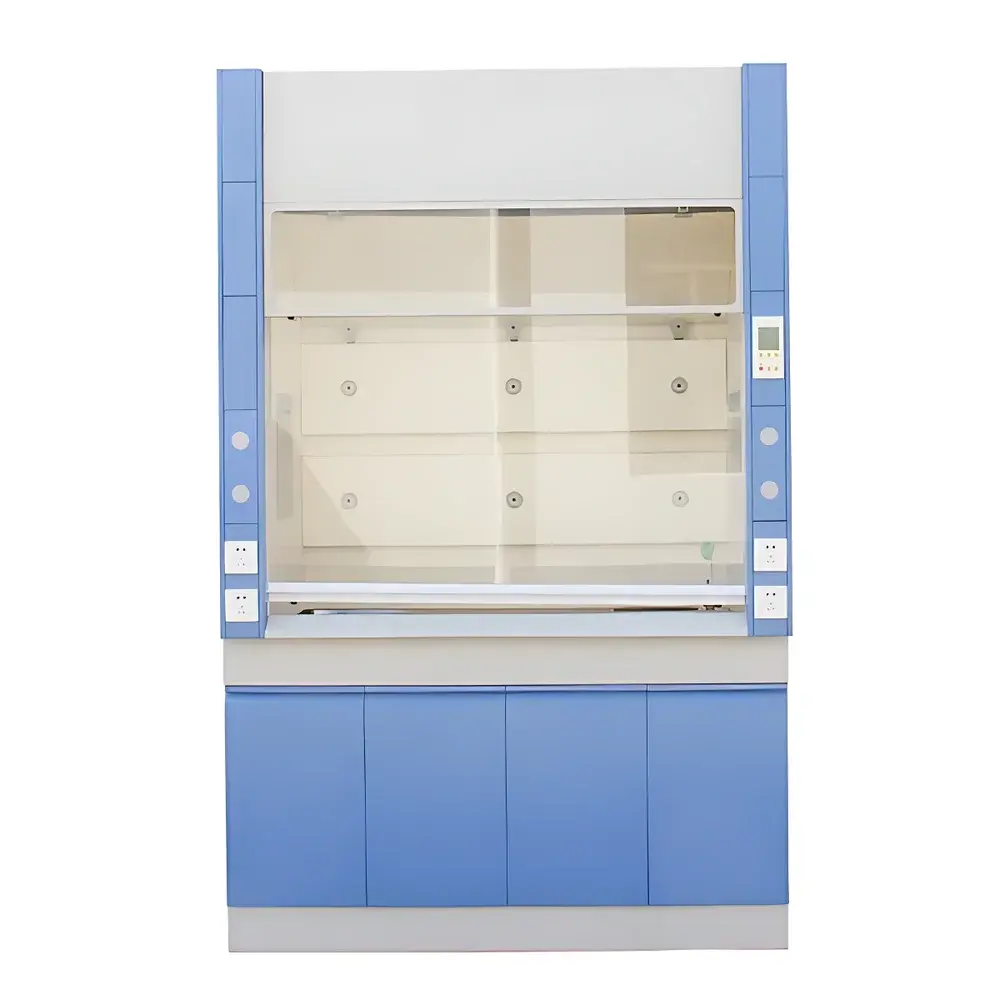
Hujing Purification ZJ-TFG-12 Full-Steel Fume Hood
| Brand | Hujing Purification (HJ) |
|---|---|
| Origin | Shanghai, China |
| Manufacturer Type | Direct Manufacturer |
| Region of Origin | Domestic (China) |
| Model | ZJ-TFG-12 |
| Price | USD 1,250 (FOB Shanghai) |
| Cabinet Material | Full Steel Construction |
| Configuration | Single-Face Operation |
| Exhaust Mode | Ducted (100% Exhaust) |
| Face Velocity | 0.5 m/s |
| Power Supply | 220 V AC, 50 Hz |
| Max. Power Consumption | 0.3 kW |
| Net Weight | 150 kg |
| Work Area Dimensions (W×D×H) | 988 × 655 × 1200 mm |
| Overall Dimensions (W×D×H) | 1200 × 850 × 2350 mm |
| Lighting | One 12 W LED Lamp |
| Work Surface | 12.7 mm Solid Phenolic Chem-Resistant Laminate |
| Inner Liner | 5 mm Grey High-Density Anti-Corrosion Compact Laminate (Antibacterial & Acid/Alkali Resistant) |
| Outer Shell | 1.0 mm Cold-Rolled Steel, CNC Precision Fabricated, Phosphated & Epoxy Powder-Coated |
| Service Integration | Integrated Water, Electrical, and Gas Utility Ports with Concealed Routing |
| Access Panel | Rear Service Hatch for Maintenance of Utilities and Duct Connections |
| Compliance | Designed to meet ISO 14644-1 Class 8 cleanroom-adjacent lab safety requirements |
Overview
The Hujing Purification ZJ-TFG-12 Full-Steel Fume Hood is an engineered solution for safe containment and exhaust of hazardous vapors, particulates, and reactive gases generated during routine chemical handling, synthesis, and analytical procedures in academic, industrial, and quality control laboratories. Built on a robust structural platform using precision CNC-fabricated cold-rolled steel, the unit operates on the principle of laminar face velocity control—maintaining a consistent 0.5 m/s inflow across the sash opening to prevent escape of contaminants into the laboratory environment. Its ducted (100% exhaust) configuration ensures complete removal of effluent air via external ventilation systems, eliminating recirculation risks. The design integrates utility delivery—water, electricity, and optional gas lines—within concealed internal channels, minimizing clutter and maximizing operator workflow efficiency while adhering to fundamental principles of laboratory ventilation hygiene as defined in ANSI/AIHA Z9.5–2022 and aligned with ISO 14644-1 environmental classification guidelines for adjacent clean zones.
Key Features
- Structural integrity: 1.0 mm thick cold-rolled steel outer shell, CNC-cut, bent, and welded with full seam coverage; treated with phosphate conversion coating and finished with electrostatically applied epoxy powder cured at 180°C for superior corrosion resistance and surface hardness.
- Chemically inert interior: 5 mm grey high-density compact laminate liner (antibacterial, acid/alkali/organic solvent resistant), fully bonded and sealed to prevent delamination under repeated exposure to aggressive reagents.
- Operator-safe work surface: 12.7 mm solid phenolic chem-resistant laminate, non-porous, NSF-certified for low leaching, thermally stable up to 135°C, and rated for long-term exposure to concentrated HCl, NaOH, acetone, and ethanol.
- Integrated utility management: Front-access quick-connect water valve (brass body, ceramic disc), recessed GFCI-protected 220 V / 16 A dual-outlet power strip, and optional gas inlet ports—all routed internally and terminated behind removable service panels.
- Optimized airflow architecture: Low-noise axial exhaust fan mounted at the top plenum; adjustable sash counterbalance system with vertical sliding tempered glass (6 mm thickness, UV-stabilized); integrated LED lighting (12 W, 5000 K CCT, IP44-rated) positioned to eliminate shadow zones across the work surface.
- Maintenance accessibility: Rear service hatch (400 × 600 mm) enables non-intrusive inspection and servicing of duct connections, wiring harnesses, and fluid manifolds without disassembly of primary structure.
Sample Compatibility & Compliance
The ZJ-TFG-12 accommodates standard bench-scale glassware (up to 2 L round-bottom flasks, condensers, separatory funnels) and modular apparatus such as reflux setups, distillation trains, and small-scale reaction vessels. Its interior geometry supports both open-vessel manipulation and semi-enclosed configurations using optional acrylic side shields. While not certified to EN 14175 or UL 508A out-of-the-box, the unit’s mechanical construction, material traceability (steel grade Q235B, laminate batch documentation available), and utility routing comply with foundational requirements for GLP-compliant lab infrastructure. It is routinely deployed in facilities operating under CNAS-CL01 (equivalent to ISO/IEC 17025) and meets prerequisite engineering controls referenced in China’s GB/T 24810.1–2009 for fume hood performance validation—including face velocity uniformity, containment verification via ASHRAE 110 tracer gas testing (user-conducted), and structural fire resistance (Class B1 per GB 8624).
Software & Data Management
This is a mechanically controlled, non-automated fume hood; no embedded firmware, touchscreen interface, or digital monitoring system is included. All operational parameters—including sash position, fan status, and utility activation—are manually managed. However, the unit is designed for seamless integration with third-party building management systems (BMS) via optional analog 4–20 mA face velocity sensor output (add-on kit available). Audit-ready maintenance logs—including filter replacement dates (if retrofitted with pre-filter), sash calibration records, and annual ASHRAE 110 test reports—can be maintained in accordance with ISO/IEC 17025 Clause 8.9 and FDA 21 CFR Part 11–aligned electronic record practices when paired with validated laboratory documentation software.
Applications
- General chemistry teaching labs requiring durable, low-maintenance containment for undergraduate experiments involving volatile solvents, dilute acids/bases, and dye synthesis.
- QC/QA laboratories in pharmaceutical excipient manufacturing where intermittent handling of ethanol-based cleaning agents, isopropyl alcohol, or low-concentration hydrogen peroxide solutions occurs.
- Materials science labs performing metal etching (e.g., FeCl₃ on copper substrates), thin-film deposition precursor handling, or solvent-based polymer dissolution.
- Environmental testing facilities conducting TCLP extractions, heavy metal digestions (HNO₃/HF mixtures), and VOC headspace sampling preparation.
- Biotechnology support labs managing formaldehyde fixation, glutaraldehyde crosslinking, or chloroform-based nucleic acid extraction protocols.
FAQ
Is the ZJ-TFG-12 certified to EN 14175 or UL 508A?
No. It is manufactured to GB/T 24810.1–2009 and aligns with ANSI/AIHA Z9.5–2022 engineering recommendations. Third-party certification can be arranged through authorized testing labs upon request.
Can this fume hood be retrofitted with variable air volume (VAV) control?
Yes—via optional add-on kits including duct-mounted pitot tube sensors, modulating damper actuators, and BMS-compatible controllers. Hujing provides mechanical interface drawings and commissioning support.
What is the recommended duct connection diameter and static pressure tolerance?
Standard connection: Ø250 mm circular duct. Maximum allowable system static pressure: 350 Pa at 0.5 m/s face velocity. Consult local HVAC engineer for branch duct sizing and fan curve matching.
Does the unit include a sash alarm or airflow monitor?
Not by default. An audible/visual sash position alarm and digital face velocity display are available as field-installable accessories (model HJ-AF-01).
Are replacement parts—such as the sash glass, liner panels, or LED module—available separately?
Yes. All major subassemblies are serialized and stocked globally via Hujing’s spare parts portal (order code prefix: ZJ-TFG-12-SP-XXX). Lead time: 2–3 weeks ex-warehouse Shanghai.



