
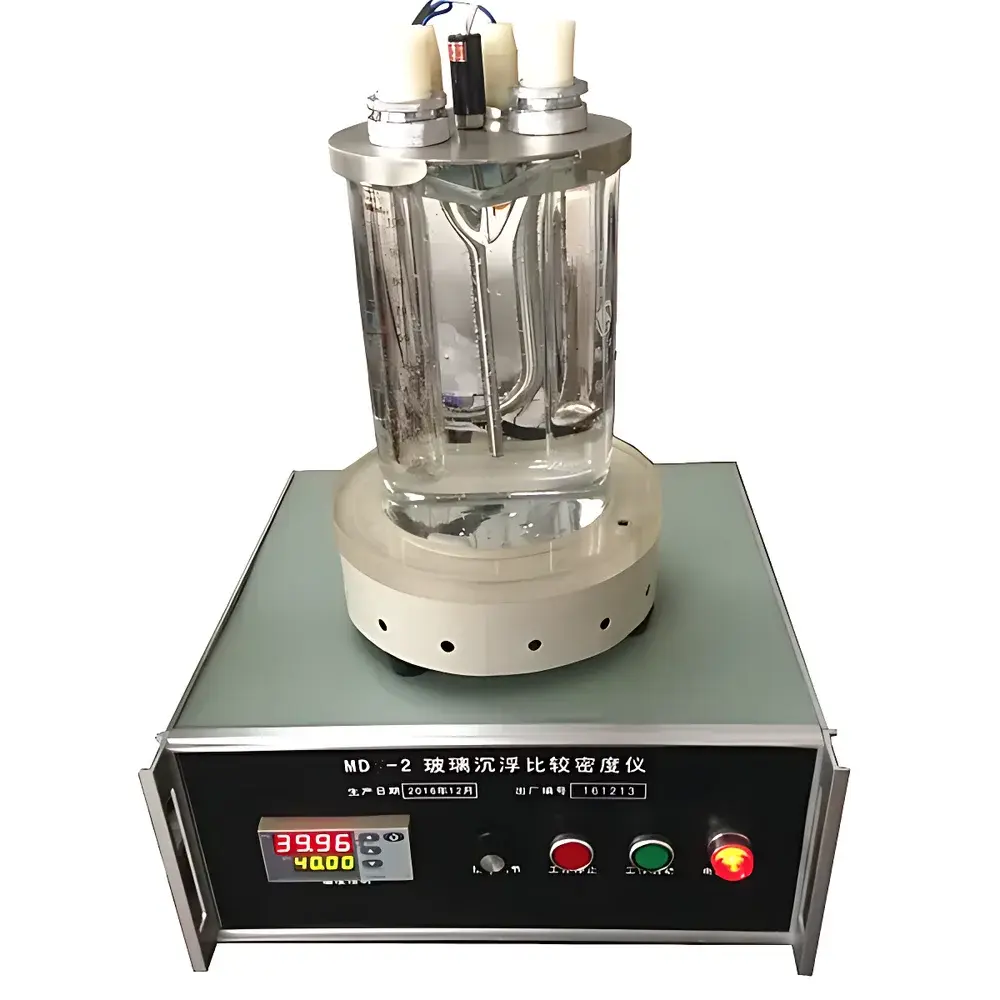
Hunan-made MD-2/4/5 Glass Sink-Float Comparative Density Analyzer
| Origin | Hunan, China |
|---|---|
| Manufacturer Type | Authorized Distributor |
| Origin Category | Domestic (PRC) |
| Model | MD-2 / MD-4 / MD-5 |
| Price Range | USD 700–1,400 (FOB) |
| Application Scope | General-purpose solid density measurement |
| Instrument Type | Buoyancy-based density analyzer |
| Form Factor | Benchtop laboratory instrument |
| Sample Type | Non-porous solids (glass, ceramics, sintered materials) |
| Density Range | 1.1–3.3 g/cm³ |
| Density Resolution | 0.0001 g/cm³ |
| Density Accuracy | ±0.0001 g/cm³ |
| Temperature Control Range | 10–50 °C |
| Temperature Stability | ±0.01 °C |
| Horizontal Bath Uniformity | ±0.01 °C |
| Vertical Bath Uniformity | ±0.03 °C |
| Heating Rate | ≥0.1 °C/min (±0.02 °C/min) |
| Magnetic Stirring | Stepless speed control, 1–1000 rpm |
| Power Supply | 220 V AC, 1000 W |
| Compliance Standard | GB/T 14901–1994 (Glass — Determination of Density by Sink-Float Method) |
| Minimum Sample Mass | 1 g |
Overview
The MD-2/4/5 Glass Sink-Float Comparative Density Analyzer is a precision benchtop instrument engineered for the accurate determination of true density and apparent density of non-porous and low-porosity solid materials—primarily optical, container, and specialty glasses—within the range of 1.1 to 3.3 g/cm³. It operates on the classical sink-float principle: a sample is suspended in a temperature-controlled liquid medium (typically aqueous sodium polytungstate or cesium chloride solutions), and its equilibrium position is observed relative to calibrated reference spheres of known densities. When the sample neither sinks nor floats but remains neutrally buoyant, the density of the immersion liquid matches that of the sample. By precisely measuring the density of the equilibrated liquid—using calibrated reference standards and high-stability thermostatic control—the instrument delivers traceable, reproducible density values compliant with fundamental metrological principles. This method eliminates surface tension and wetting artifacts common in pycnometric techniques and avoids volumetric errors associated with irregular geometries. The analyzer is specifically designed for routine quality assurance in glass manufacturing facilities and for comparative material research in academic and industrial laboratories where high-resolution density profiling correlates directly with compositional homogeneity, thermal history, and structural relaxation behavior.
Key Features
- Benchtop thermostatic bath with dual-zone temperature uniformity control: horizontal gradient ≤ ±0.01 °C, vertical gradient ≤ ±0.03 °C
- Digital PID temperature controller with ±0.01 °C display resolution and programmable ramp rate (≥0.1 °C/min, accuracy ±0.02 °C/min)
- Stepless magnetic stirring (1–1000 rpm) ensuring homogeneous density distribution without introducing mechanical vibration or sample disturbance
- High-resolution digital density readout with 0.0001 g/cm³ resolution and certified accuracy of ±0.0001 g/cm³ at 25 °C
- Modular design supporting three configurations (MD-2, MD-4, MD-5) optimized for different throughput requirements and calibration frequency protocols
- Compliance with GB/T 14901–1994, the national standard for glass density determination using the sink-float method
- Integrated safety interlocks for overtemperature and dry-run protection
Sample Compatibility & Compliance
The MD-2/4/5 is validated for use with non-porous solids including soda-lime, borosilicate, aluminosilicate, and lead crystal glasses; dense ceramics (e.g., alumina, zirconia); and sintered metal or polymer compacts with known open porosity. For porous samples, the instrument supports apparent density calculation when bulk volume and open porosity are independently characterized. All measurements require minimal sample mass (≥1 g), enabling analysis of production-line cuttings or small research specimens. The system meets core requirements for GLP-compliant density testing: full traceability to NIST-traceable reference spheres, documented temperature calibration logs, and operator-accessible audit trails for all critical parameters. While not FDA 21 CFR Part 11–certified out-of-the-box, the instrument’s deterministic analog signal path and manual data recording workflow are compatible with validated laboratory information management systems (LIMS) for regulated environments.
Software & Data Management
The MD-2/4/5 operates via embedded microcontroller interface with real-time LCD display—no proprietary software installation required. Temperature, stir speed, and elapsed stabilization time are continuously monitored and logged internally (non-volatile memory, 1000+ entries). Optional RS-232 or USB-to-serial interface enables export of timestamped measurement records (CSV format) for post-processing in Excel, MATLAB, or LIMS platforms. Calibration certificates—including temperature sensor verification, density standard traceability, and bath uniformity mapping—are supplied with each unit and updated annually per ISO/IEC 17025–recommended practice. Raw data files include metadata fields for operator ID, sample ID, ambient lab conditions, and reference standard lot numbers.
Applications
- Quality control of molten glass batch composition via density drift monitoring across furnace campaigns
- Verification of annealing efficacy through density–relaxation correlation studies
- Comparative evaluation of dopant incorporation (e.g., TiO₂, La₂O₃) in optical glass formulations
- Apparent density assessment of porous ceramic filters and catalyst supports (when combined with mercury intrusion porosimetry data)
- Material authentication and counterfeit detection in heritage glass conservation labs
- Teaching laboratories demonstrating Archimedean principles, thermal expansion effects on density, and metrological uncertainty propagation
FAQ
What liquids are recommended for the sink-float bath?
Aqueous sodium polytungstate (SPT) solutions are preferred for their non-toxicity, wide density tunability (1.0–3.1 g/cm³), and thermal stability. Cesium chloride may be used for higher-density ranges (>3.1 g/cm³), though handling precautions apply.
Can the instrument measure powdered or granular samples?
No—only intact, non-porous solids ≥1 g are suitable. Powders require helium pycnometry or mercury intrusion techniques.
Is temperature calibration performed at the factory?
Yes—each unit undergoes full bath uniformity mapping and PT100 sensor calibration against a Fluke 724 temperature calibrator prior to shipment, with certificate included.
How often must reference spheres be recalibrated?
Annually, or per ISO 17025 internal calibration schedule; certified density values are traceable to NIST SRM 1484 (glass density standards).
Does the system support automated density gradient generation?
No—it relies on manual preparation of discrete density steps. Gradient columns require external column-forming equipment and are outside the scope of this instrument’s design intent.



