
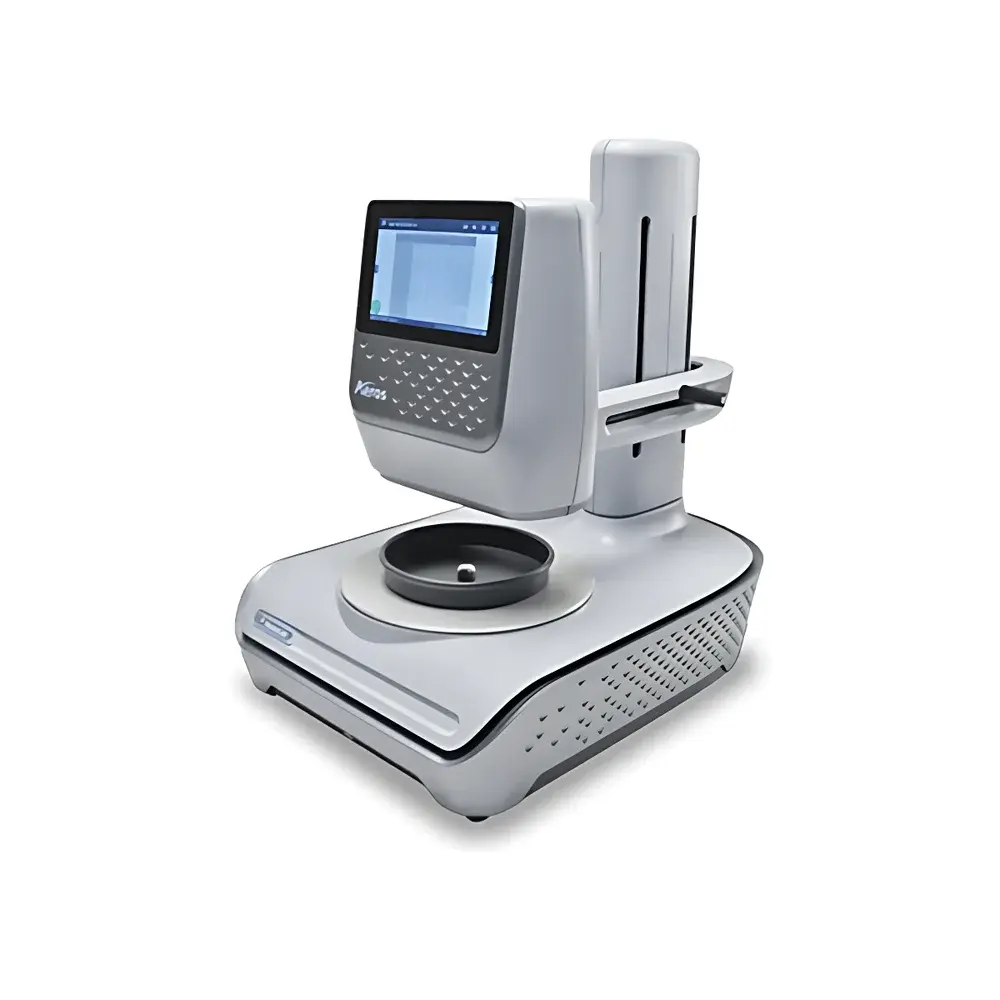
HunterLab Aeros-ARS Non-Contact Spectrophotometer
| Brand | HunterLab |
|---|---|
| Origin | USA |
| Model | Aeros-ARS |
| Instrument Type | Benchtop |
| Optical Geometry | 0/45° Integrating Sphere |
| Light Source | Full-Spectrum LED |
| Spectral Range | 400–700 nm |
| Repeatability | ΔE*ab ≤ 0.03 (mean, CIE Lab) |
Overview
The HunterLab Aeros-ARS is a benchtop non-contact spectrophotometer engineered for high-fidelity color measurement of heterogeneous, irregular, and textured surfaces without physical contact or sample preparation. Unlike conventional 0/45° instruments constrained by flat, uniform substrates, the Aeros-ARS employs a patented optical architecture combining real-time height-sensing, motorized rotational sampling, and full-spectrum LED illumination to deliver statistically robust color data across complex geometries. Its measurement principle relies on diffuse reflectance spectroscopy within the visible spectrum (400–700 nm), calibrated to CIE 1931 standard observer functions and compliant with ASTM E308, ISO 11664, and CIE Publication No. 15. The system captures 35 spatially distributed spectral readings per 5-second rotation—covering up to 223.2 cm² (34.6 in²)—and computes weighted mean colorimetric values (L*, a*, b*, ΔE*ab, Yellowness Index, Whiteness Index, etc.) with traceable uncertainty consistent with ISO/IEC 17025 laboratory practices.
Key Features
- Auto-height positioning: Integrated ultrasonic distance sensor dynamically adjusts probe-to-sample working distance (25–120 mm range) to maintain optimal focus and illumination geometry—critical for variable-topography samples such as coffee beans or granular polymers.
- Non-contact measurement: Eliminates cross-contamination, surface abrasion, and calibration drift caused by mechanical pressure or thermal transfer—preserving both sample integrity and long-term photometric stability.
- Motorized rotating sample platform: Precision-engineered with sealed brushless DC motor and IP54-rated enclosure; completes one full 360° rotation in 5 seconds, enabling spatial averaging across macroscopic heterogeneity.
- Industrial-grade touchscreen interface: 7-inch capacitive LCD with chemically strengthened Gorilla Glass; supports multi-touch gestures, offline operation, and embedded workflow navigation—no external PC required for routine measurement or report generation.
- Embedded EasyMatch Essentials software: Pre-installed color management suite supporting CIE L*a*b*, L*C*h*, ΔE*00, YI E313, WI CIE, and custom tolerancing; includes audit-trail logging compliant with FDA 21 CFR Part 11 requirements when deployed in regulated environments.
- HunterLab Remote Access Support (RAS): Secure TLS-encrypted connection enabling certified service engineers to remotely diagnose hardware faults, update firmware, validate calibration, and conduct live operator training—reducing downtime and eliminating on-site dispatch costs.
Sample Compatibility & Compliance
The Aeros-ARS is validated for direct measurement of non-planar, non-uniform, and particulate materials including roasted coffee beans, snack food clusters, polymer pellets, ceramic powders, pharmaceutical tablets, and industrial minerals. Its 0/45° geometry conforms to ASTM D2244 (color difference), ASTM E1331 (reflectance factor), and ISO 7724-1 (general principles of color measurement). All factory calibrations are traceable to NIST SRM 2035 and NPL standards. Instrument design meets IEC 61000-6-2 (EMC immunity) and IEC 61000-6-4 (EMC emissions), with optical components housed in hermetically sealed modules to prevent dust ingress and spectral drift over time.
Software & Data Management
EasyMatch Essentials operates natively on the Aeros-ARS’s ARM-based embedded Linux platform. It supports direct export of measurement records via SMTP email, USB-hosted PDF/CSV reports, network printing (IPP, LPD), and secure RESTful API integration with LIMS (e.g., Thermo Fisher SampleManager, LabVantage), MES, and SPC platforms (e.g., Minitab Workspace, InfinityQS ProFicient). Audit trails record user ID, timestamp, instrument serial number, calibration status, and raw spectral data—retained for ≥180 days unless externally archived. Optional EasyMatch QC add-on enables SPC charting, pass/fail logic with visual alerts, and automated compliance reporting aligned with ISO 9001 and IATF 16949 quality systems.
Applications
- Food & Beverage: Quantitative color grading of whole-bean coffee, roasted nuts, extruded snacks, and freeze-dried fruits where surface texture and dimensional variance preclude contact-based methods.
- Plastics & Polymers: Batch-to-batch consistency monitoring of injection-molded parts, recycled pellet blends, and masterbatch dispersions without grinding or pressing.
- Pharmaceuticals: Visual quality control of coated tablets and capsules per USP guidance—non-destructive assessment of film coating uniformity and aging effects.
- Building Materials: Color matching of natural stone aggregates, ceramic glazes, and architectural concrete samples with high surface roughness.
- Mining & Minerals: Rapid field-deployable analysis of ore concentrates, pigments, and clay slurries under ambient lighting conditions.
FAQ
Does the Aeros-ARS require annual recalibration?
No—its solid-state LED light source and thermally stabilized detector array exhibit <0.01 nm/hour spectral drift; however, quarterly verification using HunterLab-certified ceramic tile standards (SRM-1001) is recommended per ISO/IEC 17025 Clause 6.5.
Can it measure transparent or translucent samples?
Not directly—the 0/45° geometry is optimized for opaque, diffusely reflecting surfaces; translucent materials require transmission-mode instrumentation such as the HunterLab UltraScan VIS.
Is RAS connectivity compatible with corporate firewalls?
Yes—RAS uses outbound-only HTTPS (port 443) with certificate-pinned authentication; no inbound ports need opening, satisfying enterprise IT security policies.
What is the warranty coverage?
Standard 24-month parts-and-labor warranty inclusive of on-site sensor recalibration; extended service plans available with predictive maintenance analytics.
How is traceability maintained for regulatory submissions?
Each measurement embeds digital signatures, cryptographic hash of raw spectra, and instrument configuration metadata—exportable in ASTM E2912-compliant .xml format for FDA eCTD submission.






