
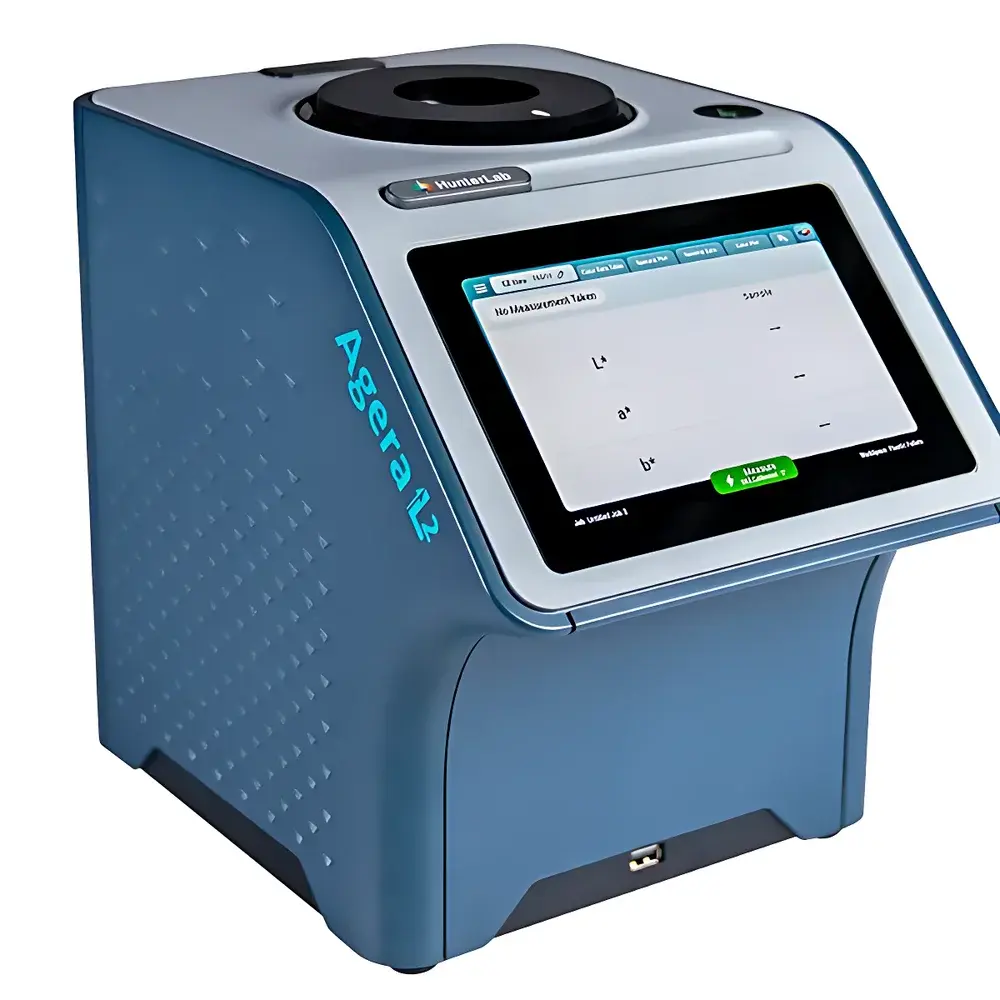
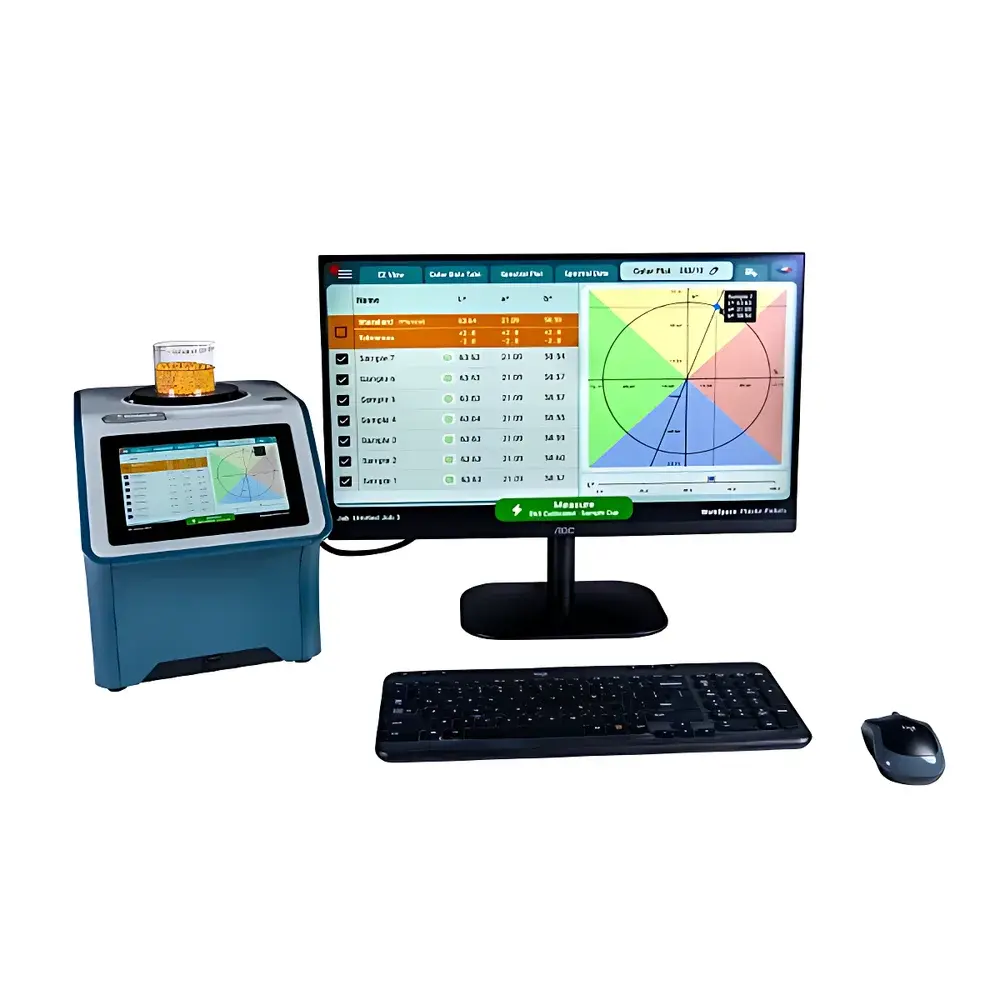
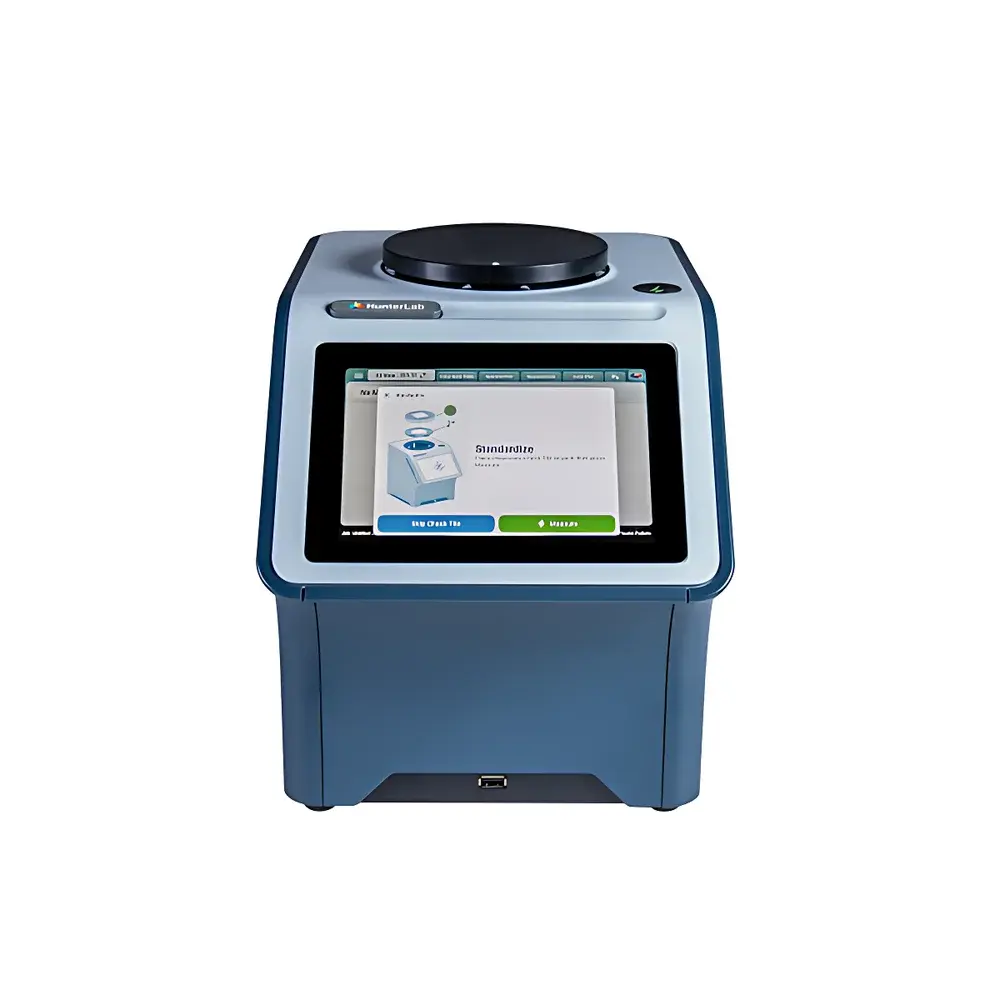
HunterLab Agera L2-AGRL2 Benchtop Spectrophotometer for Yellowness Index and Color Measurement
| Brand | HunterLab |
|---|---|
| Origin | USA |
| Model | Agera L2-AGRL2 |
| Instrument Type | Benchtop |
| Optical Geometry | 45/0° |
| Light Source | Full-spectrum balanced LED array |
| Spectral Range | 400 nm – 700 nm |
| Repeatability | ΔE* ≤ 0.03 |
| Product Category | Color Difference Meter |
| Application Focus | Yellowness Index (YI) measurement for plastic pellets, recycled polymers, low-reflectance materials (R ≤ 20%) |
Overview
The HunterLab Agera L2-AGRL2 is a high-precision benchtop spectrophotometer engineered specifically for quantitative color assessment—including ASTM D1925 and ASTM E313 yellowness index (YI) calculations—in low-reflectance, heterogeneous, or textured materials such as virgin and recycled plastic pellets, polymer granules, safety films, and matte-coated substrates. Operating on a 45/0° optical geometry, the instrument eliminates directional sensitivity to surface texture and minimizes interferences from gloss or micro-roughness—critical for consistent YI evaluation in extruded thermoplastics where batch-to-batch spectral drift directly impacts regulatory compliance and customer acceptance. Its full-spectrum balanced LED illumination replicates the spectral power distribution of CIE Standard Illuminant D65 across 400–700 nm, enabling visually correlated measurements independent of ambient lighting conditions. Unlike traditional 0/45° or diffuse/8° instruments, the Agera L2’s fixed-angle design ensures geometric invariance—essential for ISO 11664-4 and ASTM D2244-compliant color difference reporting in quality control environments subject to GLP or ICH Q5E guidelines.
Key Features
- Large-area measurement port (up to 16× larger than standard 45/0° apertures), enabling statistically robust averaging over heterogeneous pellet beds without manual repositioning or multiple readings.
- Integrated high-resolution sample-viewing camera with real-time screen recording; captures contextual imagery synchronized with each spectral measurement for full metrological traceability and operator training validation.
- Simultaneous acquisition of CIE L*a*b*, YI (ASTM D1925/E313), and 60° gloss in a single measurement cycle—eliminating sequential instrument reconfiguration and reducing total test time by ≥40% in routine QC workflows.
- Optical architecture validated per CIE Publication 15:2018 and NIST-traceable calibration standards; factory-certified repeatability of ΔE* ≤ 0.03 (k = 2) for repeated measurements on stable white tile (BCRA II).
- Robust mechanical housing rated IP52 for dust resistance and vibration-damped optical bench—designed for continuous operation in production laboratories adjacent to extrusion lines or compounding stations.
Sample Compatibility & Compliance
The Agera L2-AGRL2 is optimized for solid, opaque, or semi-opaque samples with reflectance values ≤20%—a performance envelope validated for polyethylene (PE), polypropylene (PP), polycarbonate (PC), PET flakes, and post-consumer recycled (PCR) resin pellets. Its 45/0° geometry inherently suppresses specular component exclusion artifacts common in textured plastics, ensuring conformance with ASTM D6290 (Standard Test Method for Color Measurement of Plastics) and ISO 7724-1 (Colorimetry — Part 1: CIE Standard Colorimetric Observers). Instrument firmware supports audit-ready data logging compliant with FDA 21 CFR Part 11 (electronic records/signatures), including user authentication, immutable measurement history, and configurable electronic signatures for release-critical YI reports in pharmaceutical excipient or medical-grade polymer manufacturing.
Software & Data Management
Controlled via HunterLab’s Universal Software Platform (USP v5.1+), the Agera L2 integrates seamlessly into enterprise LIMS and MES systems through OPC UA and HL7-compatible APIs. Measurement data—including raw spectra, derived YI values, gloss units, timestamped images, and operator metadata—are stored in vendor-agnostic SQLite or SQL Server databases with configurable retention policies. The software enforces role-based access control (RBAC), automated calibration verification logs, and deviation alerts triggered by out-of-spec YI drift (>0.5 YI units from master standard). All spectral data exports comply with ASTM E2534 (Standard Practice for Digital Exchange of Spectral Data) and support third-party statistical process control (SPC) packages such as Minitab or JMP via CSV/Excel templates.
Applications
- Quantitative yellowness index monitoring of virgin and recycled plastic pellets during compounding and extrusion process validation.
- Batch release testing of medical-grade polymers per USP Color and Appearance requirements.
- Stability assessment of light- and heat-sensitive resins under accelerated aging protocols (ISO 4892-2).
- Supplier qualification for low-gloss, high-pigment packaging films where conventional 8° sphere instruments yield non-reproducible YI due to texture-induced scattering.
- Regulatory submission support for FDA 510(k) dossiers requiring objective, instrument-based color consistency evidence for Class II devices.
FAQ
Does the Agera L2 meet ASTM D1925 for yellowness index calculation?
Yes—the instrument applies the exact tristimulus integration algorithm defined in ASTM D1925 using CIE 1931 2° standard observer functions and D65 illuminant data, with spectral bandwidth ≤5 nm FWHM.
Can it measure yellowing in translucent polymer sheets?
No—it is designed exclusively for reflective mode (45/0°); transmission or diaphanous samples require the HunterLab UltraScan VIS with integrating sphere.
Is the 60° gloss measurement traceable to ISO 2813?
Yes—gloss optics are calibrated against NIST SRM 2011 and validated per ISO 2813:2014 Annex B procedures.
What is the minimum sample size required for valid YI measurement?
A minimum coverage area of 25 mm diameter is required to fully illuminate the large-port aperture; smaller pellets must be measured in bulk configuration per ASTM D6290 Section 7.3.
Does the system support multi-instrument network calibration synchronization?
Yes—USP v5.1 includes Master-Slave calibration propagation across up to 32 Agera L2 units, ensuring inter-laboratory YI result equivalence per ISO/IEC 17025:2017 Clause 7.7.





