
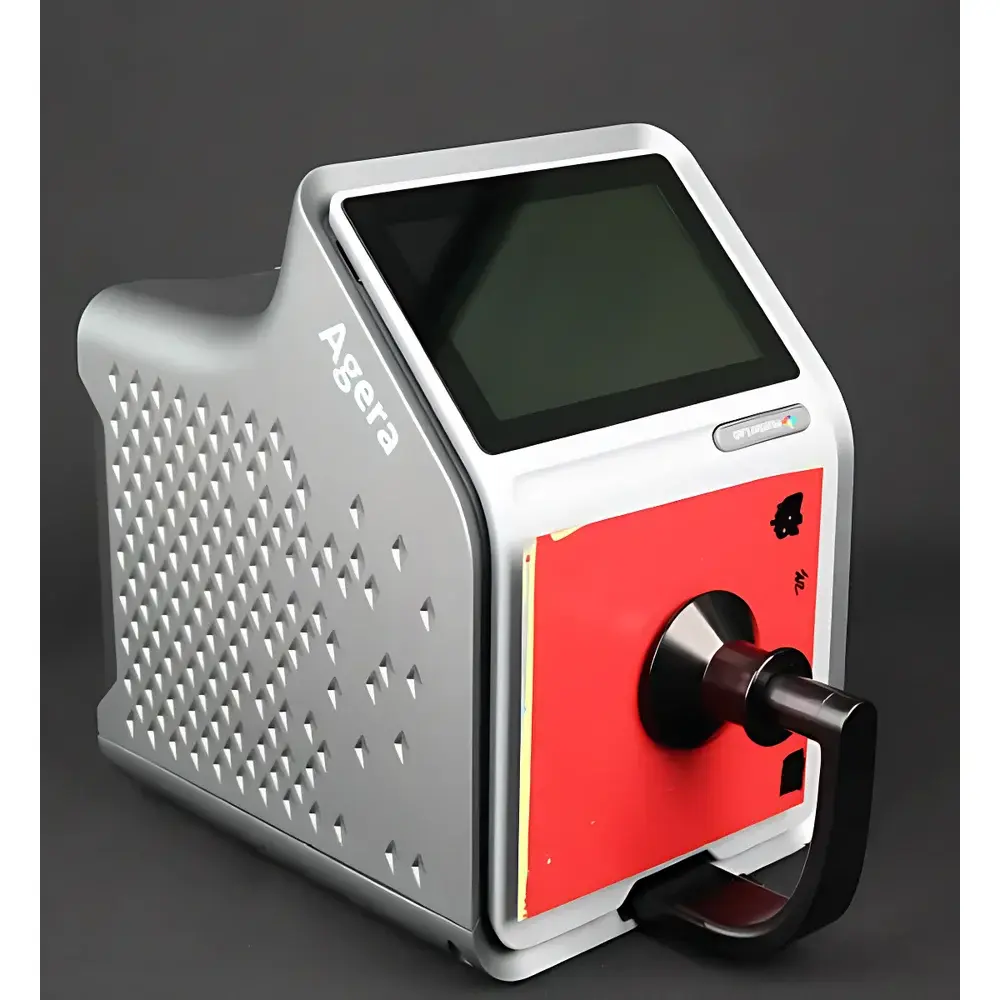
HunterLab Agera Polyurethane & TPU Color Measurement Instrument
| Brand | HunterLab |
|---|---|
| Origin | USA |
| Manufacturer Type | Authorized Distributor |
| Product Category | Imported Instrument |
| Model | Agera Polyurethane/TPU Colorimeter |
| Product Type | Benchtop Color Difference Meter |
| Optical Geometry | 0°/45° Integrating Sphere |
| Light Source | Full-Spectrum Balanced LED Array |
| Spectral Range | 400 nm – 700 nm |
| Repeatability | ΔE*ab ≤ 0.03 (for white tile, 10 readings) |
| UV Control | Dual-mode UV filter (UV-included / UV-excluded measurement) |
| Aperture Sizes | 50.8 mm (2"), 25.4 mm (1"), 15.89 mm (5/8") |
| Gloss Measurement | 60° geometry, compliant with ASTM D523 and ISO 2813, NIST-traceable calibration certificate provided |
Overview
The HunterLab Agera Polyurethane & TPU Color Measurement Instrument is a benchtop spectrophotometer engineered for high-precision color evaluation of thermoplastic polyurethane (TPU), elastomeric polymers, and other optically complex translucent or semi-opaque materials. It operates on the standardized 0°/45° optical geometry — a configuration that emulates human visual perception by illuminating the sample at 0° normal incidence and collecting reflected light over a 45° annular ring. This geometry eliminates directional bias associated with surface texture, gloss, or micro-roughness—critical for consistent color assessment across molded, extruded, or coated TPU components. Unlike diffuse/8° or d/0 instruments, the Agera’s 0°/45° design ensures metrological alignment with industrial visual standards used in quality control labs, manufacturing floors, and R&D facilities handling flexible polymers.
Key Features
- Full-spectrum balanced LED illumination system delivering stable, low-heat, long-life spectral output (rated > 5 years at typical usage), eliminating intensity drift and warm-up variability inherent in xenon flash or tungsten-halogen sources.
- Triple aperture selection (50.8 mm, 25.4 mm, and 15.89 mm) enables optimized measurement of large sheets, small molded parts, or textured surfaces while maintaining geometric compliance and signal-to-noise ratio.
- Dual-mode UV filtration: integrated mechanical UV filter allows rapid switching between UV-included (for fluorescent brightener assessment) and UV-excluded (for pigment-only evaluation), with factory-calibrated UV settings traceable to NIST SRM 2021 and ISO 13655.
- Simultaneous 60° gloss measurement per ASTM D523 and ISO 2813, using a dedicated photodiode channel co-aligned with the color sensor—enabling correlated analysis of color shift vs. surface reflectance without repositioning the sample.
- Robust thermal management and internal reference stability algorithms ensure <0.03 ΔE*ab repeatability (white calibration tile, 10 consecutive readings), meeting ISO 17025–compliant laboratory requirements for inter-instrument agreement.
Sample Compatibility & Compliance
The Agera is validated for use with opaque, translucent, and semi-crystalline TPU formulations—including aliphatic and aromatic grades—as well as polyether- and polyester-based variants. Its 0°/45° geometry accommodates textured, embossed, matte-finished, or lightly pigmented samples without requiring masking or averaging protocols. The instrument complies with CIE Publication No. 15:2018, ISO/CIE 11664 (Colorimetry), and ASTM E308 (Standard Practice for Computing the Colors of Objects). UV calibration adheres to ISO 13655:2017 (Spectral measurement of fluorescent materials), and gloss functionality satisfies the repeatability and linearity criteria outlined in ASTM D523 Annex A1. All factory calibrations are documented with NIST-traceable certificates issued under ISO/IEC 17025-accredited procedures.
Software & Data Management
Controlled via HunterLab’s EasyMatch QC software (v5.0+), the Agera supports full spectral data capture (10 nm intervals), CIE L*a*b*, L*C*h°, ΔE*ab, ΔE00, Yellowness Index (YI E313), Whiteness Index (WI CIE), and custom tolerance sets. Audit trail functionality complies with FDA 21 CFR Part 11 requirements when deployed in regulated environments (e.g., medical-grade TPU production). Data export formats include CSV, XML, and PDF reports with embedded metadata (operator ID, timestamp, instrument serial number, calibration status). Optional integration with LIMS or MES platforms is supported through HL-XML and OPC UA protocols.
Applications
- Batch-to-batch color consistency verification for TPU pellets, films, and injection-molded components in automotive interior trim, wearable electronics, and medical tubing.
- Fluorescent additive quantification in UV-stabilized TPU compounds, supporting formulation development and raw material supplier qualification.
- Gloss–color correlation studies for surface finish optimization—particularly relevant for soft-touch coatings and dual-layer extrusions where top-layer gloss influences perceived hue.
- QC release testing in ISO 9001-certified polymer processing facilities, where simultaneous color and gloss metrics reduce inspection cycle time by up to 40% versus sequential instrumentation.
- Technical service support for global supply chains, leveraging HunterLab’s international calibration network and cross-instrument transfer standards (e.g., Agera-to-Ultrascan PRO mapping).
FAQ
Does the Agera require annual recalibration to maintain traceability?
Yes. While the LED source and internal reference remain stable, annual NIST-traceable recalibration is recommended per ISO/IEC 17025 and internal quality system requirements. HunterLab offers certified on-site or depot calibration services with full uncertainty budget reporting.
Can the Agera measure colored TPU films thinner than 0.2 mm?
Yes—provided the film is mounted on a non-fluorescent black backing and tensioned flat. The 15.89 mm aperture minimizes edge diffraction effects; spectral data should be interpreted using CIE 15:2018 transmission-corrected colorimetric models.
Is UV calibration performed per batch or per instrument?
UV calibration is instrument-specific and performed during final factory verification using SRM 2021 and customer-supplied fluorescent standards. Custom UV settings can be saved per material group within EasyMatch QC.
How does the Agera handle measurement of textured or grain-finished TPU surfaces?
The 45° annular viewing geometry inherently averages micro-reflections across the measurement area. For highly directional textures (e.g., leather-grain embossing), use the 50.8 mm aperture and enable multi-shot averaging (3–5 readings) to improve statistical confidence.
Is gloss measurement affected by sample curvature or thickness?
Gloss readings assume planar geometry per ASTM D523. For curved or thin flexible substrates, mount on a rigid, flat backing plate to minimize deviation from the 60° specular angle; results remain valid if surface radius exceeds 100 mm.




