
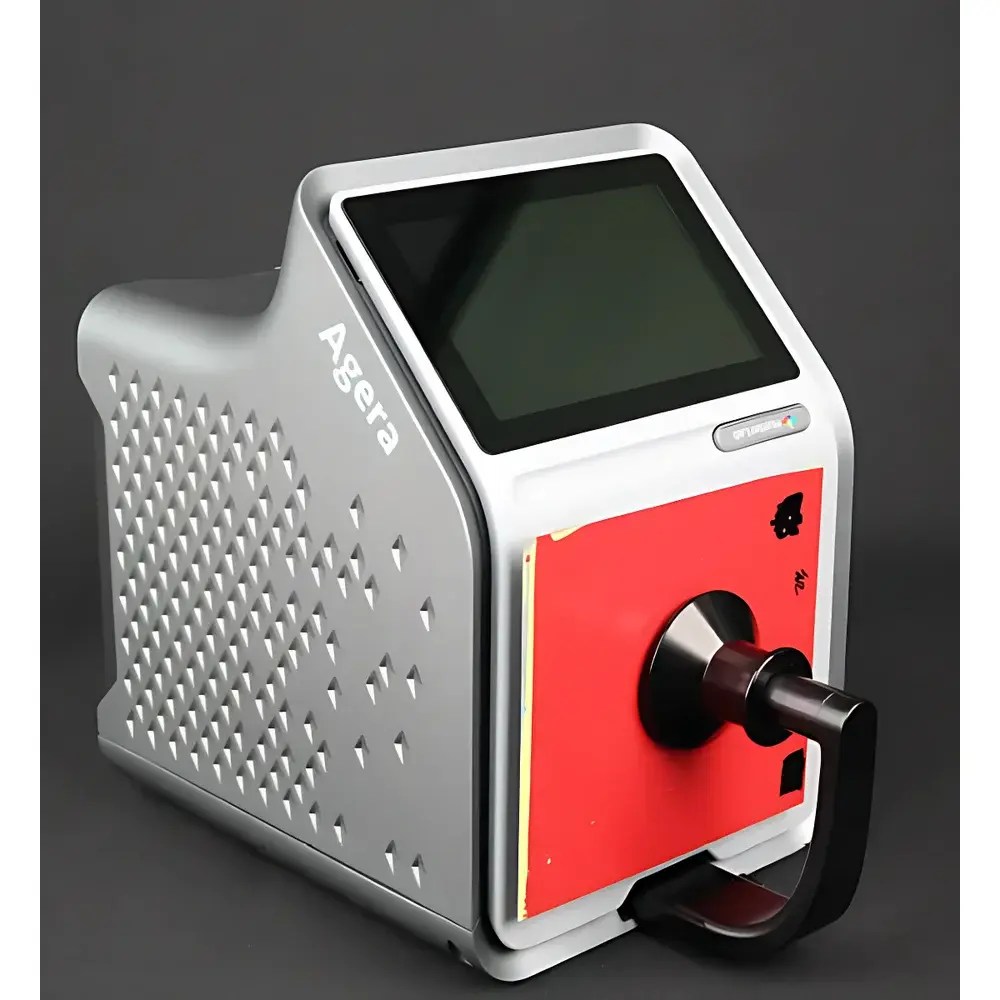
HunterLab Agera Yellowing Index Meter
| Brand | HunterLab |
|---|---|
| Origin | USA |
| Manufacturer Type | Authorized Distributor |
| Product Category | Imported Instrument |
| Model | Agera Yellowing Index Meter |
| Product Type | Color Difference Meter |
| Instrument Form Factor | Benchtop |
| Optical Geometry | 0/45° Integrating Sphere |
| Light Source | Full-Spectrum Balanced LED Array |
| Spectral Range | 400 nm – 700 nm |
| Repeatability | ΔYI ≤ 0.03 |
| Gloss Measurement | 60°, compliant with ASTM D523 and ISO 2813 |
| UV Filter Functionality | Switchable UV-included / UV-excluded mode with factory-traceable UV calibration |
| Aperture Sizes | 2 in (50.8 mm), 1 in (25.4 mm), 5/8 in (15.89 mm) |
| Integrated Imaging | 5 MP camera with 45° full-spectrum illumination |
| Display | High-resolution color touchscreen |
| Data Export | USB flash drive support |
| Connectivity | PC software interface (EasyMatch QC™) and future-ready remote diagnostic & firmware update capability |
Overview
The HunterLab Agera Yellowing Index Meter is a precision benchtop optical measurement instrument engineered for quantitative assessment of yellowing index (YI), color coordinates (CIE L*a*b*, CIE XYZ, etc.), and 60° gloss—simultaneously and traceably—in a single measurement cycle. It operates on the principle of spectrophotometric reflectance analysis using a 0/45° integrating sphere geometry, which eliminates directional bias and ensures high geometric reproducibility across diverse surface textures—from matte polymers to glossy coated metals. Unlike legacy xenon-based systems, the Agera employs a thermally stabilized full-spectrum LED array (400–700 nm), delivering superior photometric stability over time and temperature. This results in exceptional short- and long-term repeatability (ΔYI ≤ 0.03), critical for quality control in regulated environments where batch-to-batch consistency must be objectively verified. The instrument complies with ASTM E313 (Calculating YI), ASTM D1925 (Standard YI for Plastics), and ISO 17223 (Plastics — Determination of Yellowing Index), making it suitable for method validation under GLP and GMP frameworks.
Key Features
- High-resolution capacitive color touchscreen interface enabling fully standalone operation—no PC required for routine measurements, data review, or pass/fail evaluation.
- Integrated 5-megapixel camera with coaxial 45° full-spectrum illumination, capturing spatially registered images aligned with spectral measurement zones to detect non-uniformity, contamination, or surface defects.
- Dual-mode UV filtration: user-selectable UV-included and UV-excluded measurement modes, supported by NIST-traceable UV calibration standards for accurate quantification of fluorescent whitening agents (FWAs) in textiles, paper, and detergents.
- Three interchangeable apertures (50.8 mm, 25.4 mm, and 15.89 mm) accommodate varied sample geometries—from large sheet metal panels to small molded plastic parts—without compromising optical path integrity.
- Simultaneous acquisition of CIE colorimetric values (L*, a*, b*, ΔE*), Yellowing Index (ASTM E313/D1925), and 60° specular gloss (per ASTM D523 and ISO 2813), each with independent uncertainty budgets and metrological traceability.
- Remote service readiness: embedded secure connectivity supports authenticated remote diagnostics, firmware updates, and live technician-assisted training—designed to minimize instrument downtime and ensure continuous compliance with internal SOPs.
Sample Compatibility & Compliance
The Agera accommodates opaque, translucent, and semi-glossy solid samples—including thermoplastics, elastomers, painted panels, spunbonded fabrics, food packaging films, and ceramic glazes—provided they fit within the selected aperture and present a stable, non-moving surface during measurement. Its 0/45° geometry excludes specular reflectance, minimizing interference from surface texture and ensuring robustness against minor scratches or orange-peel effects. All optical calibrations are performed using certified reference tiles traceable to NIST SRMs, and gloss calibration follows ISO 2813 procedures with certified gloss standards. The system meets electromagnetic compatibility (EMC) requirements per IEC 61326-1 and safety standards per IEC 61010-1, supporting deployment in Class 10,000 cleanrooms and industrial QA laboratories alike.
Software & Data Management
Instrument control and data analysis are supported via HunterLab’s EasyMatch QC™ software (Windows-compatible), which provides audit-trail-enabled workflows compliant with FDA 21 CFR Part 11 requirements—including electronic signatures, user-level permissions, and immutable record retention. All raw spectral data (31-point 10-nm intervals across 400–700 nm), calculated indices, gloss values, and annotated images are stored in vendor-neutral CSV and XML formats. Batch reporting templates can be customized to export directly to LIMS or ERP systems. USB export preserves full metadata—including timestamp, operator ID, calibration status, and environmental sensor logs (optional ambient temperature/humidity monitoring)—ensuring full data lineage for regulatory submissions.
Applications
- Petrochemicals: Monitoring thermal oxidation-induced yellowing in polyolefins and lubricants during accelerated aging studies.
- Coatings & Paints: Validating color stability of automotive clearcoats and coil-coated steel under QUV and xenon-arc exposure testing.
- Food Packaging: Assessing YI drift in PET trays and LDPE films exposed to UV sterilization or storage light.
- Pharmaceutical Excipients: Quantifying subtle chromatic shifts in lactose or microcrystalline cellulose caused by Maillard reactions during drying.
- Textiles & Nonwovens: Evaluating UV resistance of optical brighteners in medical gowns and filtration media per AATCC TM183.
FAQ
What standards does the Agera use to calculate Yellowing Index?
The instrument computes Yellowing Index per ASTM E313 (for general materials) and ASTM D1925 (specifically for plastics), both referenced in ISO 17223. Users may select the appropriate formula during method setup.
Is 60° gloss measurement traceable to national standards?
Yes—gloss calibration uses certified standards traceable to NIST SRM 1951b, and the optical path is validated per ISO 2813 Annex A verification protocols.
Can the Agera measure fluorescent samples accurately?
Yes—its switchable UV filter and factory-calibrated UV source enable precise discrimination between inherent color and fluorescence contribution, essential for paper, detergents, and whitened polymers.
Does the instrument support IQ/OQ/PQ documentation?
HunterLab provides comprehensive validation documentation packages—including Installation Qualification (IQ) checklists, Operational Qualification (OQ) test protocols, and Performance Qualification (PQ) templates aligned with ISO/IEC 17025 and ASTM E2918.





