
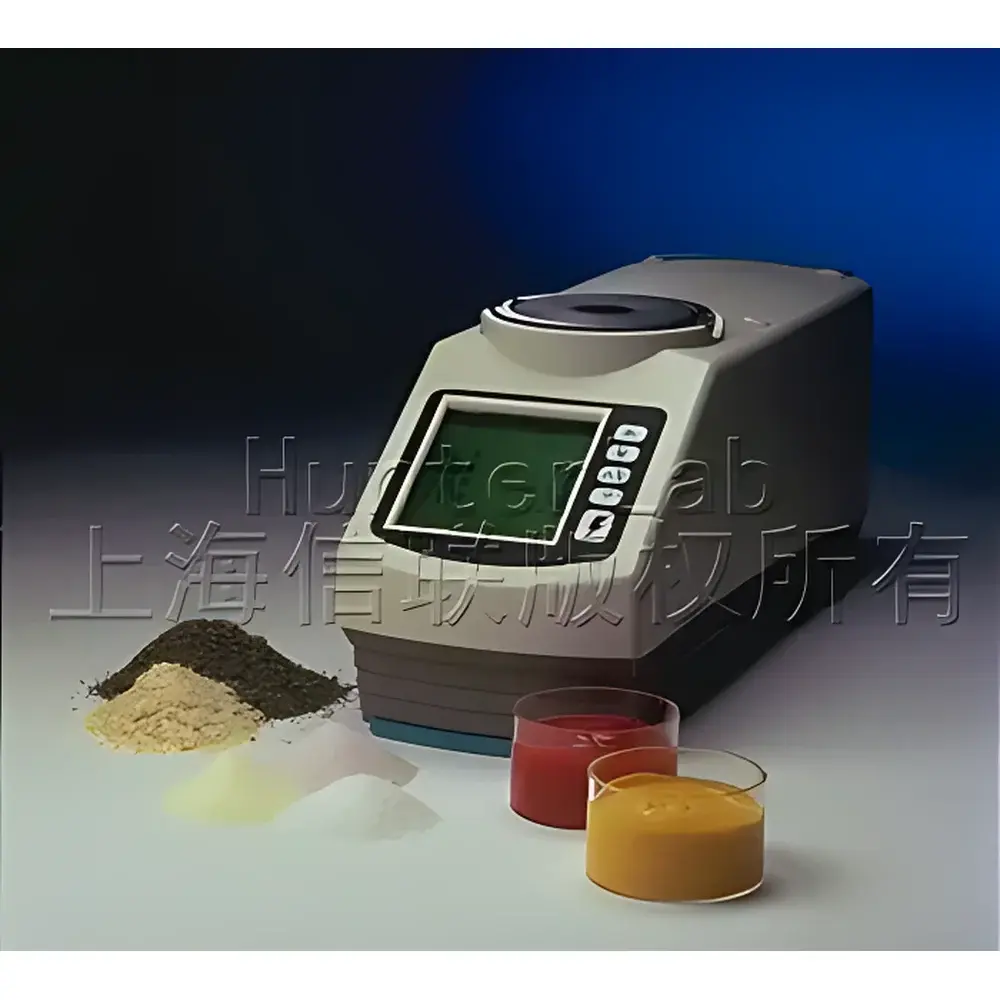
HunterLab ColorFlex Desktop Spectrophotometer for Pork Color Measurement
| Brand | HunterLab |
|---|---|
| Origin | USA |
| Model | ColorFlex |
| Product Type | Spectrophotometric Colorimeter |
| Instrument Type | Benchtop |
| Optical Geometry | 0/45° Integrating Sphere |
| Light Source | Pulsed Xenon Lamp |
| Spectral Range | 400–700 nm |
| Repeatability | ΔE* < 0.05 (BCRA II Tiles) |
| Display | 6.4 × 6.4 cm LCD |
| Dimensions (L×W×H) | 36 × 13 × 16 cm |
| Weight | 4.5 kg |
| Power Supply | 120–220 VAC, 48–62 Hz |
| Operating Temperature | 0–40 °C (non-condensing) |
| Communication | RS-232 |
Overview
The HunterLab ColorFlex Desktop Spectrophotometer is a precision benchtop instrument engineered for objective, repeatable color measurement of raw and processed pork products in quality control, research, and regulatory compliance environments. It operates on the principle of spectrophotometric reflectance analysis using a pulsed xenon light source and a diffraction grating monochromator to acquire full-spectrum data across the visible range (400–700 nm) at 10-nm reporting intervals. Its 0/45° optical geometry—compliant with ASTM D2244 and ISO 11664-4—minimizes directional bias from surface texture and gloss, making it especially suitable for heterogeneous biological surfaces such as fresh pork loin, belly, or ground meat. Unlike tristimulus meters, the ColorFlex captures spectral reflectance curves, enabling advanced color space transformations (CIELAB, CIELCH, Hunter Lab), metamerism evaluation (MI), and calculation of industry-specific indices including Whiteness Index (WI), Yellowness Index (YI), and USDA-defined lean color scores. Its high-speed acquisition (≤0.05 s per measurement) and robust thermal stability support high-throughput lab workflows without compromising inter-instrument agreement (ΔE* < 0.15 between units, BCRA II validation).
Key Features
- True spectrophotometric architecture with 256-channel silicon photodiode array and 12-nm effective bandwidth for high-fidelity spectral resolution
- Pulsed xenon lamp with >500,000 flashes lifetime—no warm-up time, no spectral drift, and stable output across full spectral range
- 0/45° optical configuration with integrated integrating sphere for diffuse illumination and directional viewing—optimized for non-uniform, semi-opaque food matrices
- Multi-standard color space support: CIE XYZ, CIELAB, CIELCH, Hunter Lab, Yxy, Rdab; plus derived metrics: ΔE*, ΔECMC, WI, YI, MI, ISO color change, and stain resistance
- Configurable illuminants (A, C, D65, F2, F7, F11, Tungsten Illuminant 84) and standard observer angles (2° and 10°)
- Onboard 6.4 × 6.4 cm LCD display with multilingual UI (English, Chinese, French, German, Italian, Spanish)
- RS-232 serial interface for direct integration into LIMS or QC data management systems
- Compliance-ready design: supports audit trails, user access levels, and electronic signature protocols when paired with EasyMatch-QC software under FDA 21 CFR Part 11 and GLP/GMP frameworks
Sample Compatibility & Compliance
The ColorFlex accommodates standard pork sample formats—including intact muscle sections (e.g., M. longissimus dorsi), minced meat patties, and cured or smoked slices—via its 31.8 mm measurement aperture (0/45° mode). Sample presentation is standardized using HunterLab’s optional sample holders and calibration tiles (certified BCRA II set). The instrument meets key international standards for food color assessment: ASTM E308 (computing color coordinates from spectral data), ISO 11664-4 (CIE colorimetric observers), and AOAC Official Method 992.02 (color evaluation of meat products). Its repeatability performance (ΔE* ≤ 0.05 over repeated measurements on homogeneous pork tissue) satisfies internal QC thresholds used by USDA-FSIS-recognized laboratories and global food manufacturers operating under HACCP and BRCGS Food Safety Issue 9.
Software & Data Management
The ColorFlex is fully compatible with HunterLab’s EasyMatch-QC software—a validated, 21 CFR Part 11-compliant platform for method development, statistical process control (SPC), and report generation. Users can define custom pass/fail tolerances for pork color parameters (e.g., L* ≥ 42.5 ± 1.2, a* = 12.8 ± 0.8, b* = 6.1 ± 0.5), generate trend charts for batch-to-batch consistency, and export CSV, PDF, or XML files for traceability. Audit trail functionality logs all user actions, parameter changes, and calibration events with timestamps and operator IDs. Optional EasyMatch-Coatings module enables comparative analysis against reference pork color libraries developed in collaboration with universities (e.g.,江南大学 Food Science Department,华中农业大学 Meat Quality Lab) and industrial R&D centers.
Applications
- Objective quantification of pork lean color (L*, a*, b*, chroma, hue angle) per USDA AMS grading guidelines
- Monitoring oxidation-induced discoloration (e.g., metmyoglobin formation) during chilled storage or modified-atmosphere packaging trials
- Validation of curing agent efficacy (e.g., nitrite concentration impact on redness retention)
- Raw material screening of imported pork batches against established color specifications
- Correlation studies between instrumental color values and sensory panel assessments (e.g., visual pinkness, grayness, or brownness scores)
- Supporting shelf-life determination protocols in accordance with ISO 20933 (meat quality indicators)
- Method transfer between QC labs across multinational supply chains (e.g., Nestlé, Unilever, PepsiCo, COFCO subsidiaries)
FAQ
What is the recommended calibration frequency for pork color testing?
Daily zero and white calibration using supplied ceramic tiles is required before first use and after ambient temperature shifts >5°C. Full verification with BCRA II tiles is recommended weekly or per shift in high-volume production labs.
Can the ColorFlex measure through transparent packaging film?
No—optical path integrity requires direct surface contact or close-proximity measurement. Transparent films introduce reflection artifacts and spectral interference; samples must be presented unpackaged or in open-top trays.
Does this instrument comply with FDA 21 CFR Part 11 for electronic records?
Yes—when operated with EasyMatch-QC v4.5+ under controlled IT administration (user authentication, audit trail enablement, and electronic signature configuration), it satisfies predicate rule requirements for regulated food manufacturing environments.
How does the 0/45° geometry improve accuracy on pork compared to d/8° instruments?
The 0/45° design eliminates sensitivity to surface gloss and directional scattering common in moist, fibrous meat tissues—yielding more consistent L* and a* values across varying cut orientations and fat marbling patterns.
Is spectral data export supported for third-party chemometric modeling?
Yes—full 400–700 nm reflectance spectra (10-nm intervals) can be exported as ASCII text for PCA, PLS regression, or machine learning applications in MATLAB, Python (scikit-learn), or Unscrambler X.






