
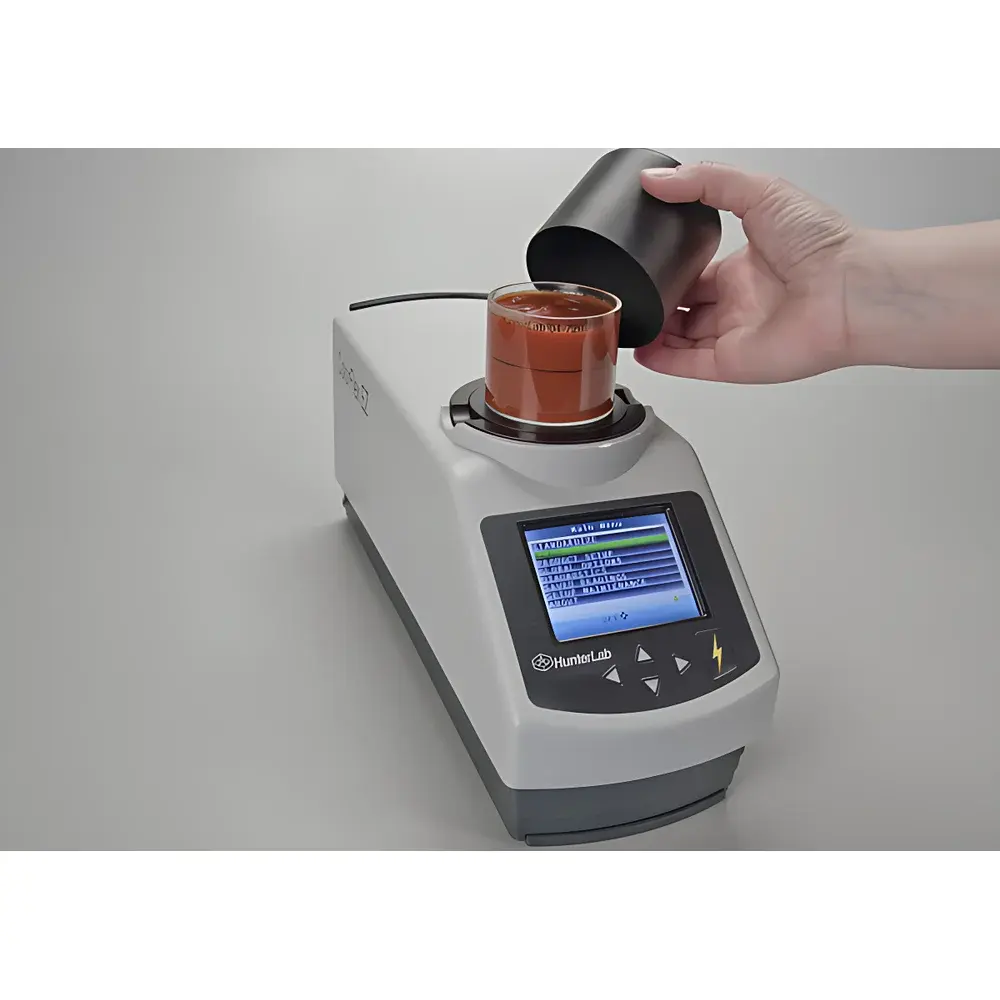
HunterLab ColorFlex EZ Tomato Colorimeter
| Brand | HunterLab |
|---|---|
| Origin | USA |
| Manufacturer Type | Authorized Distributor |
| Origin Category | Imported |
| Model | ColorFlex EZ Tomato Colorimeter |
| Product Type | Color Difference Meter |
| Instrument Type | Benchtop |
| Optical Geometry | 0/45° Integrating Sphere |
| Light Source | Pulsed Xenon Lamp |
| Spectral Range | 400–700 nm |
| Repeatability | ΔE* ≤ 0.05 |
Overview
The HunterLab ColorFlex EZ Tomato Colorimeter is a purpose-engineered benchtop color measurement instrument designed exclusively for the quantitative evaluation of tomato-based products across the entire processing chain—from fresh fruit and juice to concentrated paste, ketchup, and sauce. Operating on the principle of 0/45° reflectance geometry with a pulsed xenon light source, it delivers high-fidelity spectral data within the visible range (400–700 nm), enabling precise calculation of color indices defined by industry-standard methodologies including ASTM E313-96 (for yellowness/whiteness index under C/2° and D65/10° illuminants) and USDA-recommended tomato-specific metrics. Unlike general-purpose colorimeters, the ColorFlex EZ Tomato integrates traceable calibration against NIST-traceable enamel steel standards and UC Davis primary reference materials, ensuring metrological continuity with the USDA’s official tomato color grading system. Its compact footprint (requiring only 15 cm of bench space) and sealed membrane keypad support robust operation in production environments subject to humidity, thermal fluctuation, or incidental splashing.
Key Features
- Built-in tomato-specific color algorithms: Tomato Paste Score (TPS), Tomato Sauce Score (TSS), Tomato Catsup Score (TCS), Tomato Juice Score (TJS), Fresh Tomato Color Index (FTCI), and a/b ratio—calculated directly without external software or licensing fees.
- Integrated lycopene estimation: Utilizes proprietary spectral modeling at 457 nm to derive lycopene concentration proxies aligned with AOAC and USDA analytical protocols.
- High repeatability performance: ΔE* ≤ 0.05 under controlled conditions, validated per ISO 13655:2017 and ASTM D2244 for instrumental color difference assessment.
- Self-contained display interface: Large backlit LCD with intuitive navigation; supports real-time viewing of L*, a*, b*, and derived indices without PC connection.
- Expandable connectivity: Optional RS-232 or USB interface for printer output, data logging, or integration into QC reporting systems compliant with FDA 21 CFR Part 11 audit trail requirements.
Sample Compatibility & Compliance
The ColorFlex EZ Tomato accommodates opaque, translucent, and semi-viscous samples—including raw tomato homogenates, clarified juice, hot-break and cold-break pastes, stabilized ketchups, and low-oil sauces—via standardized sample cups and reusable quartz or glass viewing cells. All optical path components meet ISO 9001-certified manufacturing tolerances. Calibration traceability is maintained through factory-installed enamel steel standards certified to UC Davis reference values, with documented chain-of-custody alignment to USDA Agricultural Marketing Service (AMS) specifications for tomato color grading. The instrument conforms to IEC 61000-4 electromagnetic compatibility standards and operates within GLP/GMP-aligned laboratory workflows when paired with optional electronic logbook modules.
Software & Data Management
While fully functional as a standalone unit, the ColorFlex EZ Tomato supports optional EasyMatch QC™ software for advanced data trending, statistical process control (SPC), and report generation. Raw spectral data (10-nm intervals) and calculated indices are exportable in CSV or XML formats compatible with LIMS platforms. Audit trail functionality—when enabled—records operator ID, timestamp, calibration event history, and parameter modifications in accordance with FDA 21 CFR Part 11 requirements. Data integrity safeguards include password-protected method locking, user-level access controls, and automatic backup to removable USB storage.
Applications
- Quality assurance in tomato processing facilities: Real-time verification of batch consistency against USDA Grade A/B/C thresholds.
- R&D formulation development: Correlation of pigment stability (e.g., lycopene degradation) with thermal treatment profiles and pH adjustments.
- Supplier qualification: Objective validation of incoming raw material color compliance prior to blending or concentration.
- Regulatory documentation: Generation of auditable color records supporting USDA AMS inspection reports and export certification (e.g., EU Regulation (EC) No 1333/2008 Annex II).
- Process optimization: Monitoring color drift during evaporation, homogenization, or enzymatic treatment to minimize over-processing and preserve sensory attributes.
FAQ
Does the ColorFlex EZ Tomato require annual recalibration?
No mandatory annual recalibration is required; however, daily verification using the included enamel steel standard is recommended per ASTM D6290. Full recalibration is advised every 12 months or after physical impact, lamp replacement, or environmental exposure exceeding manufacturer-specified limits.
Can the instrument measure fresh whole tomatoes?
Yes—using the optional Fresh Tomato Fixture (FTF-1), which standardizes surface contact and minimizes specular reflection from waxy cuticles while maintaining compliance with FTCI calculation methodology.
Is lycopene quantification validated against HPLC reference methods?
The 457-nm lycopene proxy has been cross-validated against AOAC Official Method 2005.07 HPLC results across 120+ commercial tomato cultivars and processed matrices (r² = 0.982); full validation report available upon request.
What regulatory frameworks does the software support?
EasyMatch QC™ v5.3+ provides configurable audit trails, electronic signatures, and data encryption meeting FDA 21 CFR Part 11, EU Annex 11, and ISO/IEC 17025 documentation requirements.
How is traceability to UC Davis standards documented?
Each instrument ships with a Certificate of Conformance listing UC Davis reference lot numbers, NIST-traceable spectral irradiance data, and deviation tolerances per ASTM E2539-16 Annex A1.



