
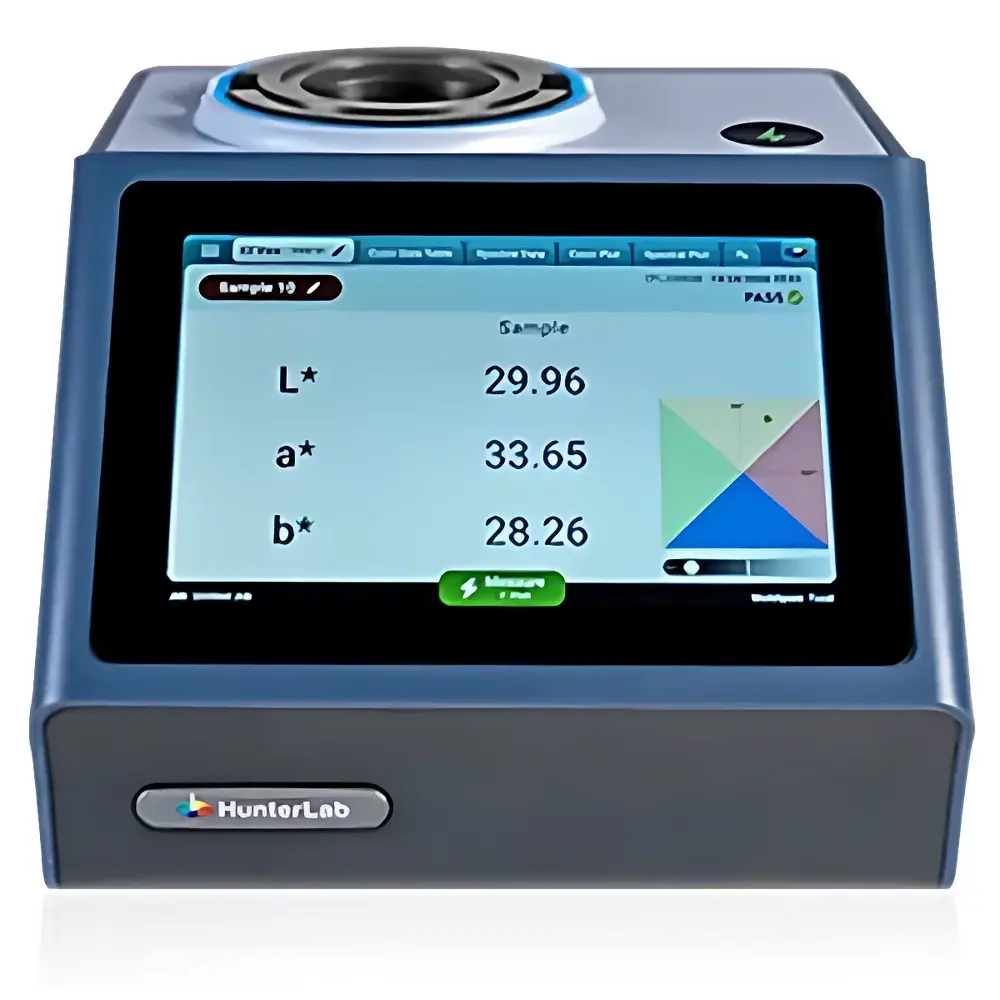
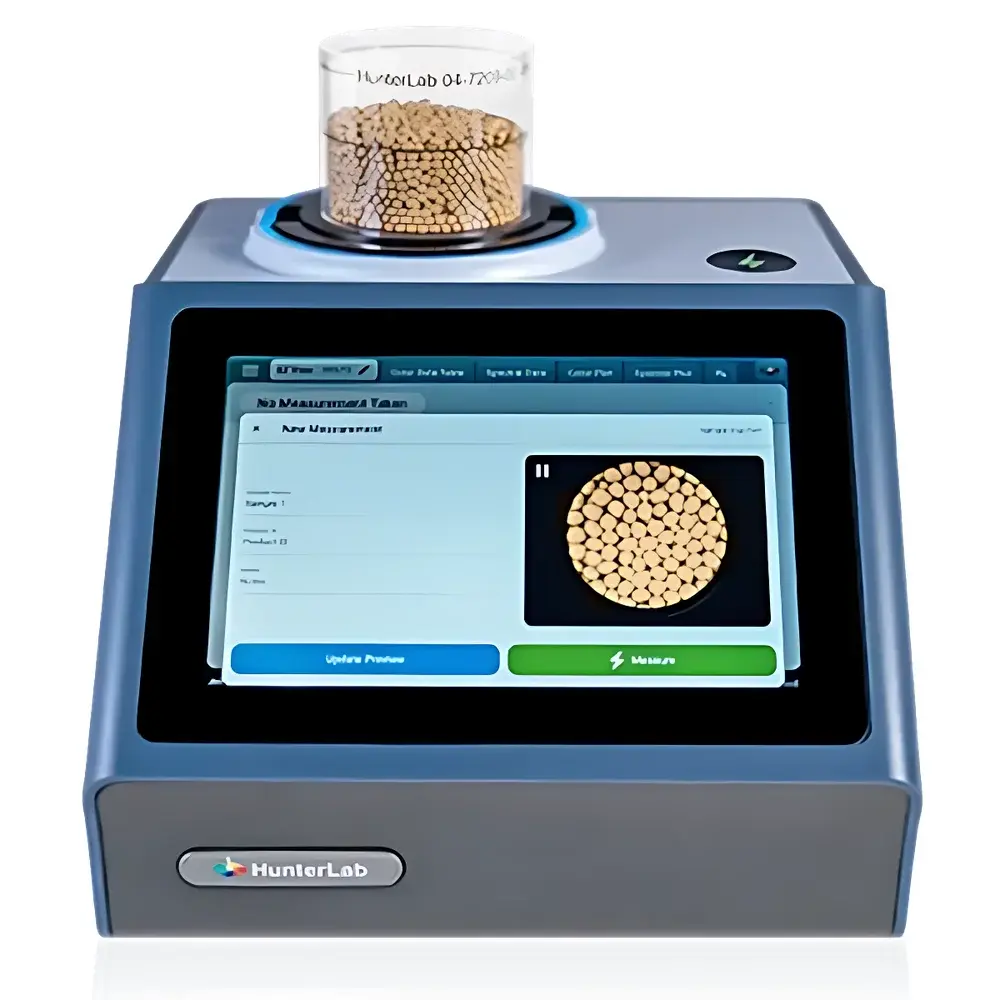
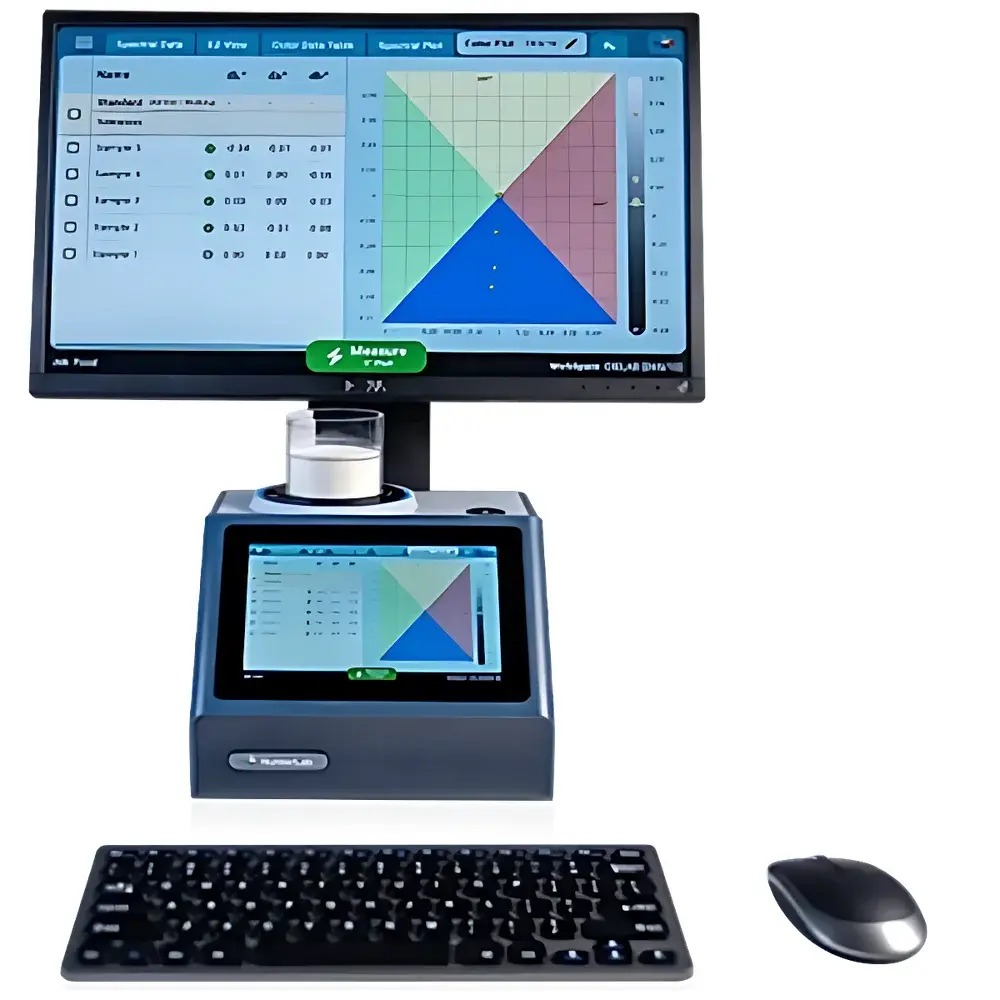
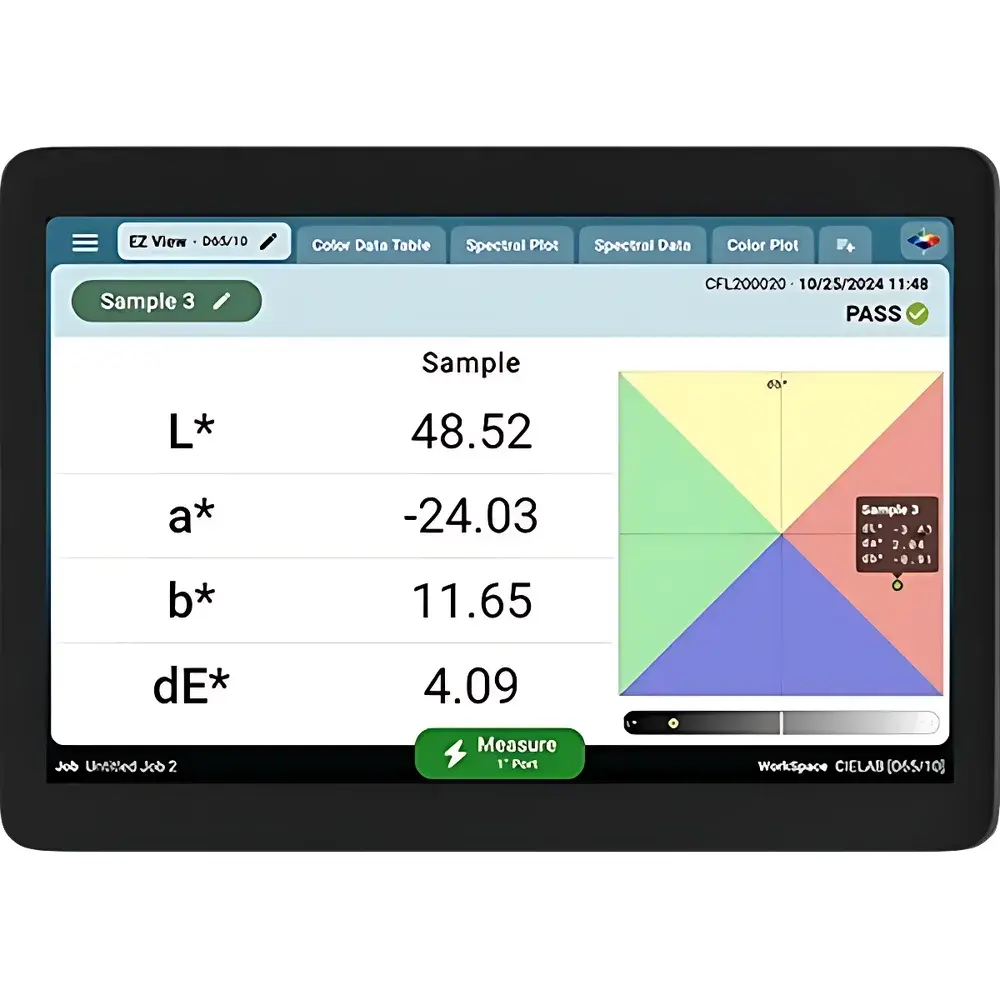
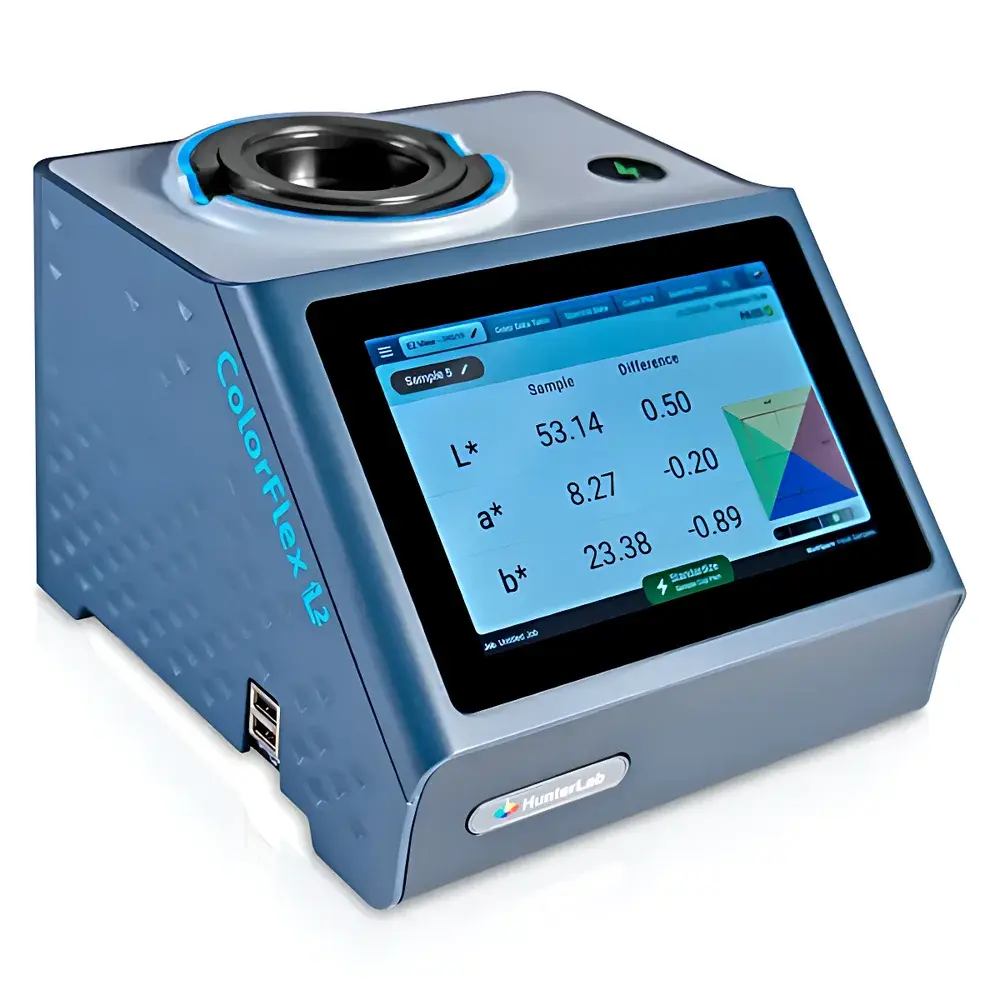
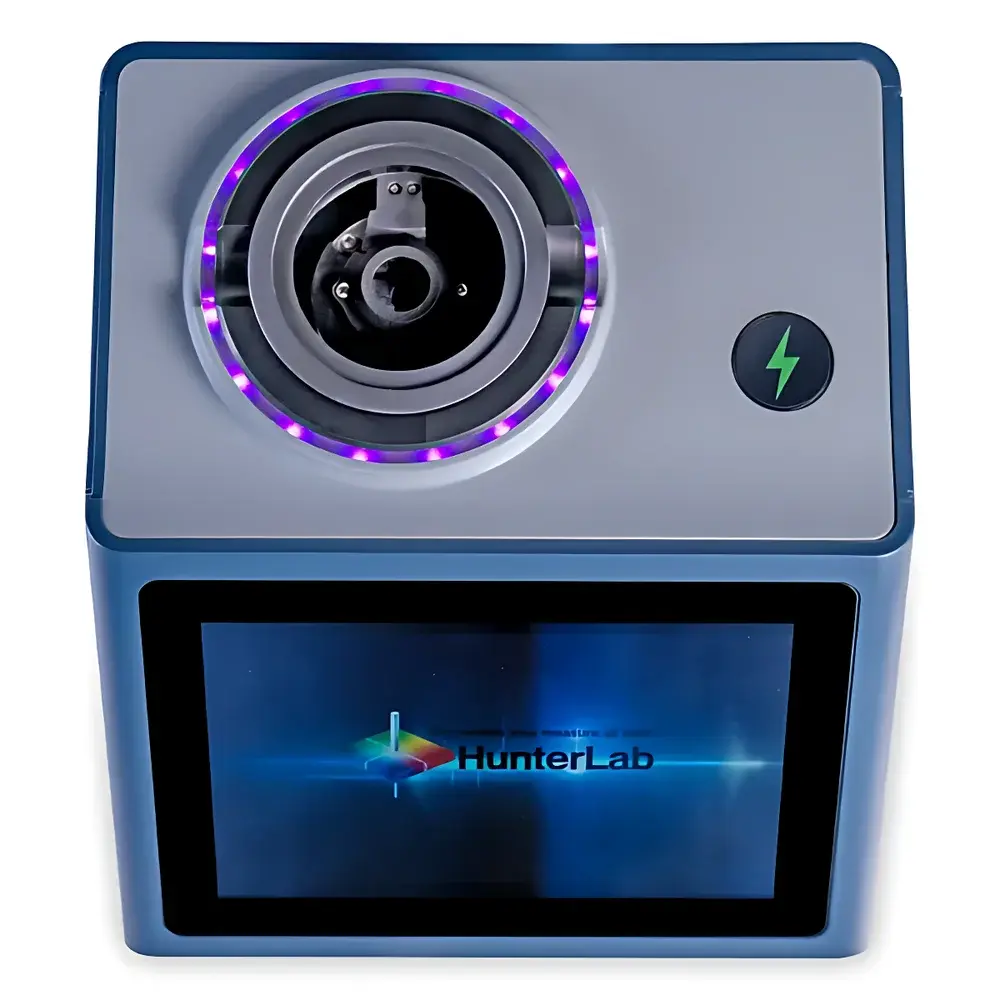
HunterLab ColorFlex L2 45°/0° Spectrophotometric Colorimeter
| Brand | HunterLab |
|---|---|
| Origin | USA |
| Model | ColorFlex L2 |
| Spectral Range | 400–700 nm |
| Spectral Resolution | < 3 nm |
| Effective Bandwidth | 10 nm |
| Illuminant Options | A, C, D50, D55, D65, D75, F2, F7, F11 |
| Observer Angles | 2° and 10° |
| Geometry | 45°/0° (specular component excluded) |
| Aperture | 31.8 mm illumination / 25.4 mm measurement |
| Repeatability | ΔE*2000 < 0.03 (D65/10°, white tile, 20 readings) |
| Inter-instrument Agreement | ΔE*2000 < 0.15 (D65/10°, BCRA CCSII tiles) |
| Light Source | Pulsed Xenon Lamp (10-year typical lifetime) |
| Measurement Time | 1 second |
| Compliance | CIE 15:2004, ISO 7724-1, ASTM E1164, DIN 5033-7, JIS Z 8722 Condition C |
| Traceability | NIST-traceable calibration per CIE Pub. 44 and ASTM E259 |
| Display | 7-inch high-resolution touchscreen (1280 × 800) |
| Dimensions | 16 cm H × 21 cm W × 24 cm D |
| Weight | 2.75 kg |
| Operating Environment | 10–30 °C, 10–90% RH (non-condensing) |
Overview
The HunterLab ColorFlex L2 is a benchtop 45°/0° spectrophotometric colorimeter engineered for precision, reproducibility, and operational efficiency in industrial quality control environments. It employs dual-beam spectral analysis with pulsed xenon illumination and a fixed 45°/0° optical geometry—designed to exclude specular reflectance—to deliver highly stable and traceable color measurements across diverse sample types. This geometry conforms to international standards including ISO 7724-1 and ASTM E1164, ensuring compatibility with legacy color specifications and facilitating seamless migration from prior-generation instruments such as the ColorFlex EZ. The instrument’s spectral response spans 400–700 nm at <3 nm resolution, with 10 nm effective bandwidth and triangular-equivalent reporting intervals, enabling accurate calculation of CIE tristimulus values under multiple illuminants and observer angles. Its NIST-traceable calibration—certified per CIE Publication 44 and ASTM E259—supports audit-ready compliance in regulated industries requiring documented metrological traceability.
Key Features
- Robust 45°/0° optical architecture with specular component exclusion (SCE), optimized for consistent measurement of textured, matte, and semi-gloss surfaces.
- 7-inch high-resolution capacitive touchscreen (1280 × 800) with intuitive UI and context-sensitive help—designed for glove-compatible operation in production labs.
- Pulsed xenon lamp with >10-year service life and no warm-up delay; delivers full-spectrum illumination without UV degradation or thermal drift.
- Compact footprint (21 × 24 cm base) and low mass (2.75 kg) enable integration into space-constrained QC stations or mobile lab carts.
- Integrated high-resolution camera for synchronized image capture with spectral data—critical for correlating visual defects with quantitative color deviations.
- Dual USB ports, HDMI video output, Ethernet interface, and footswitch input support automated workflows, remote monitoring, and integration into MES or LIMS platforms.
Sample Compatibility & Compliance
The ColorFlex L2 accommodates opaque solids (e.g., painted panels, plastic pellets), translucent liquids (juices, sauces), powders (coffee, dairy powders), granules (sugar, resins), and semi-transparent films—without requiring accessory reconfiguration. Its 25.4 mm measurement aperture ensures representative sampling of heterogeneous materials while minimizing edge effects. All measurements comply with CIE 15:2004 spectral computation protocols and are validated against BCRA Series II ceramic tiles per ISO 7724-1 Annex B. Instrument inter-agreement (ΔE*2000 < 0.15) and repeatability (ΔE*2000 < 0.03 on white reference) meet requirements for GLP/GMP-aligned color release testing. Optional software modules support FDA 21 CFR Part 11 compliance—including electronic signatures, audit trails, and role-based access control—for pharmaceutical, food, and cosmetic applications.
Software & Data Management
Essentials 2.0 software provides an integrated environment for method setup, real-time pass/fail evaluation, statistical process control (SPC), and automated report generation. It supports multi-illuminant comparison (D65/10°, F2/2°, etc.), delta-E vector analysis (ΔL*a*b*, ΔL*C*h, CMC 2:1), and specialized indices including ASTM E313 whiteness/yellowness, D1925 yellowness, opacity, and metamerism index. Data export is native to CSV and Excel formats; USB flash drive functionality enables secure backup, cross-instrument configuration cloning, and offline analysis. The system logs timestamps, operator IDs, environmental conditions, and full spectral scans—enabling full traceability per ISO/IEC 17025 documentation requirements.
Applications
Validated across global supply chains, the ColorFlex L2 supports color-critical workflows in food & beverage (juice brix consistency, sauce hue uniformity), coatings (automotive paint batch matching), plastics (recycled resin color stability), pharmaceuticals (tablet film coating homogeneity), and construction materials (cement and concrete batch verification). Its ability to measure powdered dairy, roasted coffee beans, cheese curds, liquid detergents, and cured epoxy adhesives—without sample preparation—reduces operator variability and accelerates inspection cycles. In R&D settings, it enables formulation optimization via spectral difference mapping and batch-to-batch deviation trending over time.
FAQ
Is the ColorFlex L2 compatible with existing ColorFlex EZ standards and methods?
Yes—the identical 45°/0° optical geometry and spectral engine ensure direct transfer of standards, tolerances, and historical datasets without recalibration or revalidation.
Does the instrument support regulatory compliance for pharmaceutical or food manufacturing?
When configured with Essentials 2.0’s optional 21 CFR Part 11 module, it provides full electronic record integrity, user authentication, and immutable audit trails required for FDA and EU GMP submissions.
Can the ColorFlex L2 measure small or irregularly shaped samples?
Its 25.4 mm measurement area is suitable for most routine QC specimens; optional aperture masks (12.7 mm and 8 mm) are available for localized analysis of textured or patterned surfaces.
How is spectral calibration maintained over time?
Each unit ships with NIST-traceable white and black calibration tiles. Annual verification using certified reference standards—per ISO 13655—is recommended; HunterLab-certified service technicians perform on-site recalibration and uncertainty assessment.
What environmental conditions affect measurement stability?
Operation is specified between 10–30 °C and 10–90% RH (non-condensing); internal temperature stabilization and xenon pulse timing compensation mitigate ambient fluctuations during rapid sequential measurements.





