
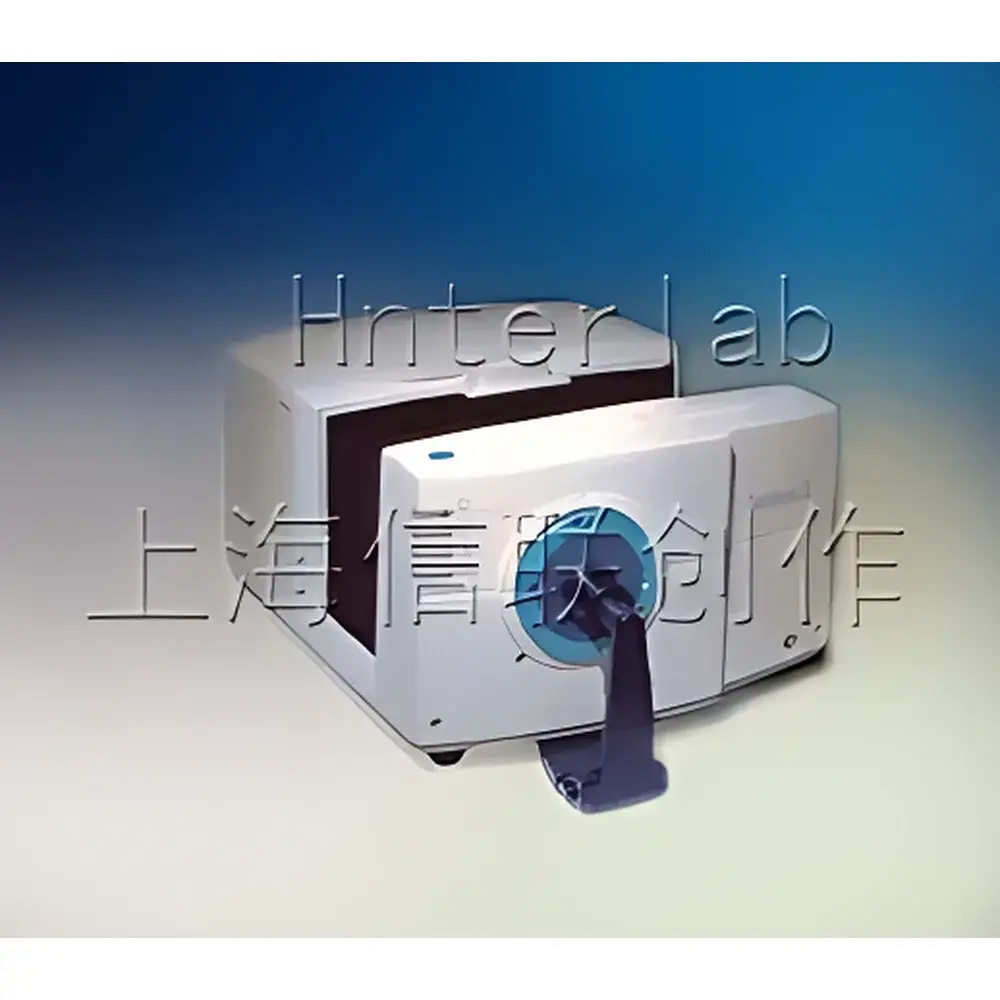
HunterLab ColorQuest XE Benchtop Spectrophotometer
| Brand | HunterLab |
|---|---|
| Origin | USA |
| Model | HL CQXE |
| Product Type | Benchtop Spectrophotometer |
| Optical Geometry | d/8° Integrating Sphere |
| Light Source | Pulsed Xenon Lamp |
| Spectral Range | 400–700 nm |
| Repeatability (ΔE*ab) | ≤ 0.03 |
| Wavelength Resolution | < 3 nm |
| Wavelength Accuracy | ±0.1 nm |
| Effective Bandwidth | 10 nm (triangular) |
| Photometric Range | 0–200% |
| Photometric Resolution | 0.003% (reported as 0.01%) |
| Measurement Time | < 1 s |
| Minimum Interval Between Measurements | 3 s |
| Transmission Modes | Direct and Total |
| Integrating Sphere Diameter | 152 mm |
| Sphere Coating | Spectraflect® |
| Viewing Apertures | LAV (25.4 mm illum. / 19.0 mm meas.), SAV (9.5 mm illum. / 6.3 mm meas.), MAV (4 mm meas.) |
| Specular Component | Auto-Included/Auto-Excluded |
| Lamp Lifetime | > 1,000,000 flashes |
Overview
The HunterLab ColorQuest XE is a benchtop spectrophotometer engineered for high-precision color measurement across diverse industrial and laboratory environments. It operates on the principle of dual-beam spectral photometry with a d/8° integrating sphere geometry—compliant with ASTM E308, ISO/CIE 15, and CIE 116 standards—to ensure metrological traceability and inter-instrument agreement. Its optical architecture employs a 256-element diode array detector coupled with a high-resolution concave holographic grating, enabling accurate spectral acquisition from 400 nm to 700 nm at 10 nm reporting intervals. The instrument utilizes a pulsed xenon lamp filtered to simulate CIE Standard Illuminant D65, delivering stable, flash-based illumination without thermal drift or lamp aging effects during routine operation. With a 152 mm (6″) integrating sphere coated in Spectraflect®, the system achieves uniform diffuse illumination and high signal-to-noise ratio—even for low-reflectance or highly scattering samples.
Key Features
- Auto-switching apertures: Motorized LAV (25.4 mm illumination / 19.0 mm measurement), SAV (9.5 mm / 6.3 mm), and MAV (4 mm measurement) options enable rapid adaptation to sample size and surface heterogeneity without manual alignment.
- Specular component control: Fully automated inclusion or exclusion of specular reflectance supports both SCI (Specular Component Included) and SCE (Specular Component Excluded) measurements per ISO 7724-1 and ASTM D2244.
- Dual transmission capability: Supports both direct (directional) and total transmission modes via a three-sided open transmission chamber, accommodating clear, translucent, and turbid liquid or film samples.
- Robust xenon lamp system: Rated for over one million flashes with user-replaceable modules—eliminating downtime associated with filament degradation or recalibration cycles common in tungsten-halogen systems.
- High-speed acquisition: Full spectral scan completed in under one second; minimum interval between measurements is 3 seconds—optimized for high-throughput QC workflows.
- Thermal and mechanical stability: Cast aluminum housing and precision-machined optical path minimize drift due to ambient temperature fluctuations or vibration, supporting GLP-compliant daily verification protocols.
Sample Compatibility & Compliance
The ColorQuest XE accommodates opaque, translucent, and transparent solids and liquids—including powders, pellets, films, coatings, textiles, glass, and aqueous or solvent-based solutions. Its configurable apertures and dual-mode transmission support standardized evaluation of whiteness (CIE Whiteness, Ganz, Berger), yellowness (ASTM E313, ASTM D1925), APHA/Pt-Co color (ASTM D1209), haze (ASTM D1003), and opacity (ASTM D5344). All measurement algorithms conform to ISO 11664, ASTM E2539, and USP , ensuring regulatory readiness for pharmaceutical, food, and cosmetic applications. Instrument validation includes factory-certified NIST-traceable calibration using SRM 2035 and SRM 2036, with optional IQ/OQ documentation packages available for FDA 21 CFR Part 11–aligned environments.
Software & Data Management
The instrument integrates with Vision™ software (v5.0+), providing full spectral data export (CSV, XML), customizable report templates, and statistical process control (SPC) charting. Audit trail functionality logs all user actions—including method changes, calibration events, and result modifications—with timestamped, non-erasable records compliant with 21 CFR Part 11 requirements. Data encryption, role-based access control, and electronic signature support facilitate GMP/GLP implementation. Raw spectral files are stored in industry-standard JCAMP-DX format, enabling third-party analysis in MATLAB, Python, or chemometric platforms such as Unscrambler® or Pirouette®.
Applications
This spectrophotometer serves as a primary color measurement platform in quality control laboratories across paint & coatings (color matching, batch release), plastics (pigment dispersion, weathering studies), textiles (dye lot consistency), paper & packaging (brightness, shade variation), food & beverage (browning index, juice clarity), and pharmaceuticals (tablet coating uniformity, excipient color stability). Its ability to quantify both reflectance and transmittance parameters—including Yellowness Index (YI), Whiteness Index (WI), APHA, and Haze—makes it suitable for R&D method development, supplier qualification, and multi-site harmonization initiatives.
FAQ
What standards does the ColorQuest XE comply with?
It conforms to ASTM E308, ISO/CIE 15, CIE 116, ISO 7724-1, ASTM D2244, ASTM E2539, and USP , with optional validation kits meeting ISO/IEC 17025 and FDA 21 CFR Part 11 requirements.
Can the instrument measure small or irregularly shaped samples?
Yes—via optional SAV and MAV apertures, and with the use of sample holders designed for tablets, fibers, or granules; custom fixtures are available for OEM integration.
Is spectral data export supported for external analysis?
Yes—raw spectra are exportable in JCAMP-DX, CSV, and XML formats, preserving wavelength, absorbance, and reflectance values at native 10 nm resolution.
How often does the instrument require calibration verification?
Daily verification using supplied ceramic tiles (LAV and SAV) is recommended; full recalibration is typically required annually or after major maintenance, per ISO 17025 guidelines.
Does the system support networked deployment in multi-user labs?
Yes—Vision™ software supports concurrent licensing, centralized database storage, and remote instrument monitoring via Ethernet or USB, with TLS-secured data transfer.



