
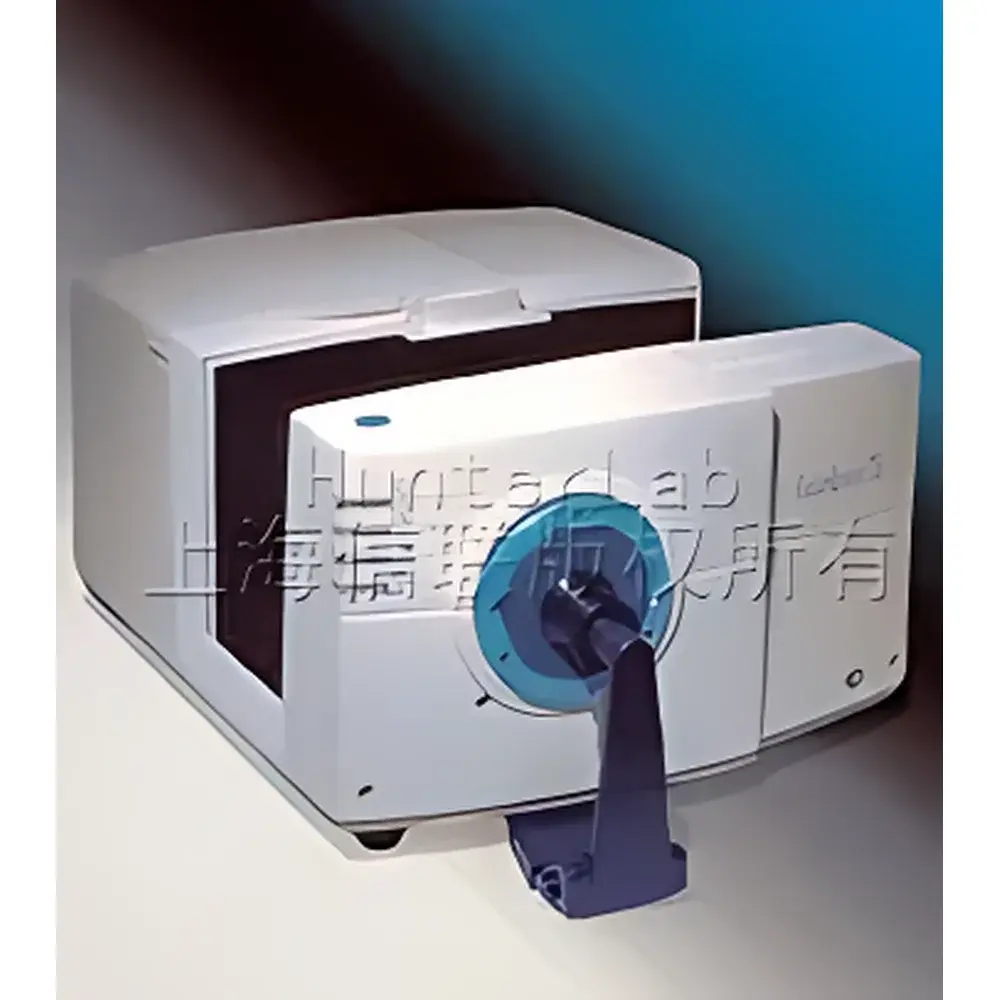
HunterLab ColorQuest XE Spectrophotometer
| Brand | HunterLab |
|---|---|
| Origin | USA |
| Model | ColorQuest XE |
| Product Type | Benchtop Spectrophotometer |
| Optical Geometry | d/8° Integrating Sphere |
| Light Source | Pulsed Xenon Lamp |
| Spectral Range | 400–700 nm |
| Repeatability | ΔE*ab ≤ 0.03 |
| Wavelength Resolution | < 3 nm |
| Wavelength Accuracy | ±0.1 nm |
| Photometric Range | 0–200% |
| Photometric Resolution | 0.003% (reported as 0.01%) |
| Measurement Time | < 1 s |
| Lamp Lifetime | > 1,000,000 flashes |
| Transmission Modes | Direct and Total |
| Integrating Sphere Diameter | 152 mm |
| Sphere Coating | Spectraflect® |
| Standard Aperture | 25.4 mm (illumination) / 19.0 mm (measurement) |
| Optional Apertures | 9.5 mm / 6.3 mm (SAV), 4 mm (MAV) |
| Specular Component | Auto-Included/Auto-Excluded |
| Report Interval | 10 nm |
Overview
The HunterLab ColorQuest XE is a benchtop spectrophotometer engineered for precision color measurement across reflective, transmissive, and translucent samples in industrial quality control and R&D environments. Based on dual-beam spectral photometry with a 152 mm integrating sphere coated with Spectraflect®—a highly diffuse, near-Lambertian reflectance material—the instrument conforms to CIE-compliant d/8° geometry (diffuse illumination, 8° viewing angle) with automatic specular component compensation (SCI/SCE). Its pulsed xenon lamp delivers stable, D65-simulated illumination without thermal drift, enabling rapid (<1 s), repeatable measurements (ΔE*ab ≤ 0.03) across the visible spectrum (400–700 nm). Designed for robust daily operation in production labs and QC settings, the ColorQuest XE supports standardized evaluation of color difference, whiteness (CIE Whiteness, Ganz, Berger), yellowness (ASTM E313, ASTM D1925), APHA/Pt-Co/Hazen color, haze (ASTM D1003), opacity, translucency, and total/direct transmission—making it suitable for compliance-driven workflows in regulated industries.
Key Features
- Dual-beam optical architecture with 256-element diode array detector and high-resolution concave holographic grating for high signal-to-noise ratio and long-term wavelength stability
- Automated aperture switching between Large Area View (LAV: 25.4 mm / 19.0 mm) and optional Small Area View (SAV: 9.5 mm / 6.3 mm) or Micro Area View (MAV: 4 mm), all motorized and software-controlled
- Auto-compensated specular reflection mode (SCI/SCE) with real-time toggle—critical for accurate color assessment of textured, glossy, or coated surfaces
- Pulsed xenon light source with >1,000,000 flash lifetime; no warm-up required, minimal heat generation, and consistent D65 spectral power distribution per ASTM E308 and ISO/CIE 11664-4
- Triple-opening transmission chamber supporting both direct (collimated) and total (diffuse + collimated) transmission measurements per ASTM D1003 and ISO 13468
- Integrated thermal stabilization and humidity-resistant optics—designed for continuous operation in non-climate-controlled manufacturing environments
Sample Compatibility & Compliance
The ColorQuest XE accommodates opaque solids (e.g., plastics, textiles, ceramics), semi-transparent films (e.g., PET, PVC), clear liquids (e.g., solvents, beverages), and turbid suspensions (e.g., coatings, pharmaceutical solutions). Its configurable apertures and transmission cell options ensure metrological validity for samples ranging from 1 mm thick polymer sheets to 100 mm pathlength liquid cuvettes. The system complies with ISO 7724-1 (colorimetry), ASTM D2244 (color difference), ASTM E308 (computing tristimulus values), and ISO 11664-4 (CIE colorimetric observers). Data integrity meets GLP/GMP requirements through audit-trail-enabled software (see below), and measurement protocols align with FDA 21 CFR Part 11 when deployed with compliant configuration and user access controls.
Software & Data Management
Operated via HunterLab’s EasyMatch QC software (Windows-based), the ColorQuest XE supports full spectral data capture, customizable pass/fail tolerancing, multi-instrument network synchronization, and automated report generation (PDF, CSV, XML). All measurements include embedded metadata: date/time stamp, operator ID, instrument serial number, calibration status, aperture mode, and geometry setting. Audit trails record every parameter change, result modification, or calibration event—enabling full traceability for internal audits or regulatory submissions. Raw spectral data (10 nm intervals, 400–700 nm) is exportable for third-party analysis or integration into LIMS and MES platforms via OPC UA or TCP/IP protocols.
Applications
- Plastics & Polymers: Batch-to-batch color consistency, masterbatch qualification, UV stabilizer impact assessment
- Paints & Coatings: Formulation validation, gloss–color interaction analysis, weathering studies (ΔE tracking over time)
- Food & Beverage: Liquid clarity (APHA), fruit juice browning index (YI), dairy product whiteness
- Pharmaceuticals: Excipient color uniformity, capsule shell hue verification, dissolution medium turbidity (NTU-equivalent)
- Paper & Packaging: Brightness (ISO 2470), yellowness index (TAPPI T452), print contrast ratio
- Glass & Ceramics: Transmittance uniformity, coating interference color shift, surface defect mapping via spatial averaging
FAQ
What standards does the ColorQuest XE support for color difference reporting?
It computes ΔE*ab, ΔE00 (CIEDE2000), ΔEcmc, and ΔE94 per ISO 11664-6 and ASTM D2244, with selectable illuminants (D65, A, F2, etc.) and observers (2° or 10°).
Can the instrument measure APHA and Hazen color in liquids?
Yes—using its calibrated transmittance mode and built-in APHA/Hazen scale algorithms aligned with ASTM D1209 and ASTM D5386.
Is calibration traceable to NIST?
All factory calibrations use NIST-traceable ceramic tile standards and liquid filters; users receive a certificate of calibration with uncertainty budget per ISO/IEC 17025 guidelines.
How is instrument-to-instrument agreement maintained across a multi-site operation?
Via HunterLab’s Instrument Matching Protocol (IMP), which uses inter-instrument transfer standards and matrix-based correction to achieve ΔE*ab < 0.15 between units under identical conditions.
Does the software support electronic signatures and 21 CFR Part 11 compliance?
Yes—when configured with role-based user accounts, digital signature enforcement, and audit trail archiving, EasyMatch QC satisfies FDA 21 CFR Part 11 requirements for electronic records and signatures.



