
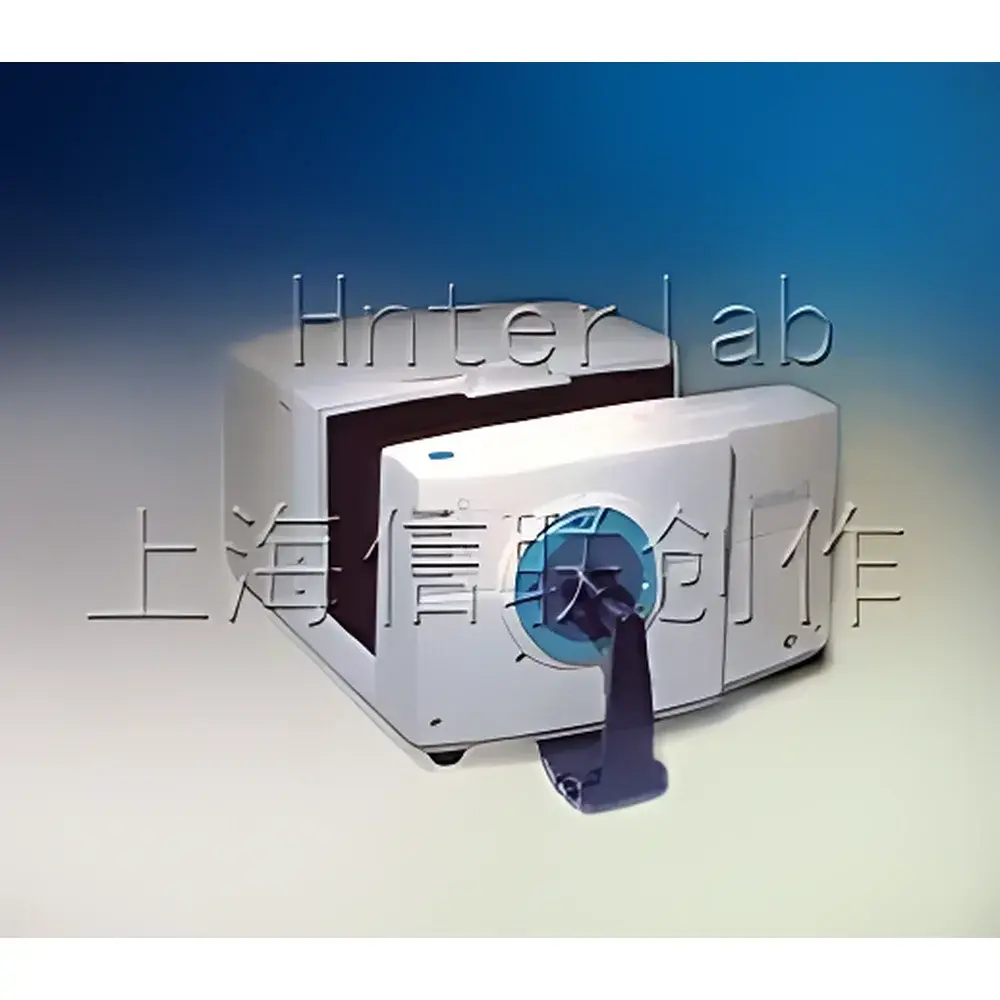
HunterLab ColorQuest XE Spectrophotometer
| Brand | HunterLab |
|---|---|
| Origin | USA |
| Model | CQXE |
| Product Type | Benchtop Spectrophotometric Colorimeter |
| Optical Geometry | d/8° integrating sphere |
| Light Source | Pulsed Xenon Lamp |
| Spectral Range | 400–700 nm |
| Spectral Resolution | < 3 nm |
| Wavelength Accuracy | ±0.1 nm |
| Effective Bandwidth | 10 nm (FWHM) |
| Repeatability (ΔE*ab) | ≤ 0.03 |
| Integrating Sphere Diameter | 152 mm |
| Sphere Coating | Spectraflect® |
| Standard Aperture | 25.4 mm (illuminated), 19.0 mm (measured) |
| Optional Apertures | 9.5 mm / 6.3 mm (SAV), 4 mm (MAV) |
| Specular Component | Auto-Included / Auto-Excluded |
| Aperture Switching | Motorized and Automatic |
Overview
The HunterLab ColorQuest XE is a benchtop spectrophotometric colorimeter engineered for precision, stability, and operational efficiency in both laboratory and production environments. It operates on the principle of dual-beam spectral photometry, utilizing a high-fidelity 256-element diode array detector coupled with a high-resolution concave holographic grating to deliver consistent spectral data across the visible spectrum (400–700 nm). Its d/8° optical geometry—compliant with CIE, ASTM E308, ISO 7724, and USP —ensures robust measurement of reflectance, transmittance, and haze-related parameters under standardized illumination and viewing conditions. The instrument’s 152-mm integrating sphere, internally coated with Spectraflect®, provides uniform diffuse illumination and minimizes spatial non-uniformity errors. Designed for long-term calibration stability, the pulsed xenon lamp eliminates thermal drift associated with continuous tungsten or LED sources and enables rapid, flash-based measurements without sample heating—critical for heat-sensitive films, gels, or liquid emulsions.
Key Features
- Motorized, automatic aperture switching between Large Area View (LAV), Small Area View (SAV), and Micro Area View (MAV) configurations—enabling consistent measurement of heterogeneous surfaces, small parts, or localized defects without manual recalibration.
- Auto-specular component control: programmable inclusion or exclusion of specular reflectance (SCI/SCE modes) to meet ASTM D2244, ISO 27677, and AATCC TM173 requirements for gloss-inclusive or gloss-excluded color evaluation.
- High signal-to-noise ratio achieved via optimized optical path design and temperature-stabilized detector electronics—supporting reliable measurement of low-reflectance blacks, translucent polymers, and optically dense liquids.
- Robust mechanical architecture with vibration-dampened base and sealed optical chamber—designed for deployment in manufacturing floors where ambient temperature fluctuation, dust, and mechanical shock are common.
- Compliance-ready firmware supporting audit trails, user access levels, and electronic signature capability per FDA 21 CFR Part 11 and EU Annex 11 when integrated with optional QualiSight™ software.
Sample Compatibility & Compliance
The ColorQuest XE accommodates opaque solids (e.g., painted panels, plastic pellets), semi-transparent materials (e.g., PET films, laminated glass), and transparent liquids (e.g., solvents, pharmaceutical solutions, beverage concentrates). Its configurable apertures and transmission cell holders support APHA, Gardner, and Pt-Co color scale measurements per ASTM D1209, D5386, and ISO 6271. For turbidity and haze analysis, it computes ASTM D1003-compliant %Haze and ISO 14782-defined clarity metrics using dual-channel transmittance ratios. All measurement protocols adhere to GLP and GMP documentation standards when used with validated SOPs and calibrated reference tiles (e.g., NIST-traceable white and black standards).
Software & Data Management
Instrument control and data analysis are performed via EasyMatch QC software—supporting real-time spectral visualization, multi-parameter reporting (L*a*b*, ΔE*ab, Yellowness Index ASTM E313, Whiteness Index CIE/ISO 11475), and statistical process control (SPC) charting. Raw spectral data (1-nm intervals) is exportable in CSV or XML formats for integration into LIMS or MES platforms. Optional QualiSight™ adds full 21 CFR Part 11 compliance: role-based permissions, electronic signatures, change history logs, and secure database encryption. Calibration verification routines include daily instrument standardization checks with built-in pass/fail criteria aligned to internal quality thresholds.
Applications
The ColorQuest XE serves as a primary color measurement platform across regulated and industrial sectors: QC release testing of pigment dispersions in coatings; batch-to-batch consistency validation in polymer extrusion lines; APHA color grading of purified water in pharmaceutical manufacturing; yellowness index trending in aging studies of polycarbonate lenses; haze and clarity assessment of medical-grade tubing; and whiteness qualification of paperboard substrates per TAPPI T485. Its spectral fidelity supports method development for custom color tolerances (e.g., ΔE00-based acceptability limits) and cross-instrument correlation studies within multi-site supply chains.
FAQ
What is the difference between SCI and SCE measurement modes?
SCI (Specular Component Included) captures total reflectance—including surface gloss—and is used for appearance matching under controlled lighting. SCE (Specular Component Excluded) measures only diffuse reflectance, correlating more closely with human visual perception under typical viewing conditions.
Can the ColorQuest XE measure APHA and Hazen color scales?
Yes—it directly reports APHA (ASTM D1209) and Pt-Co values for clear liquids using preconfigured algorithms and certified liquid cell accessories.
Is the instrument suitable for measuring translucent or backlit materials?
Yes—its d/8° geometry and optional transmission accessories enable accurate transmittance and translucency analysis, including Yellowness Index (ASTM E313) and Haze (ASTM D1003) calculations.
How often does the instrument require calibration verification?
Daily standardization with the provided white tile is recommended; annual factory recalibration is advised for ISO/IEC 17025-compliant operations.
Does the system support networked deployment in a multi-user lab environment?
Yes—EasyMatch QC supports concurrent client connections over LAN, with centralized database hosting and shared method libraries accessible via Windows domain authentication.



