
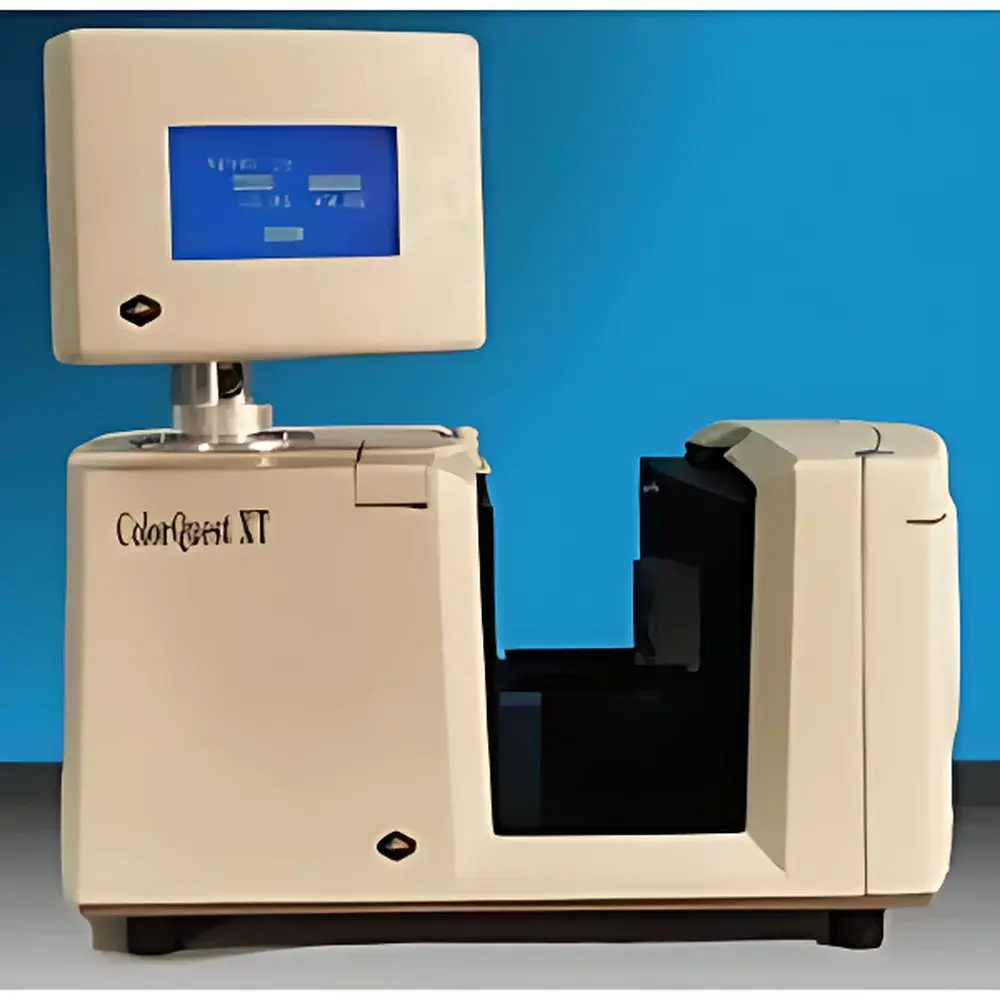
HunterLab ColorQuest XT Benchtop Spectrophotometer
| Brand | HunterLab |
|---|---|
| Origin | USA |
| Model | ColorQuest XT |
| Product Type | Spectrophotometric Colorimeter |
| Instrument Type | Benchtop |
| Optical Geometry | d/8° integrating sphere |
| Light Source | Pulsed Xenon Lamp |
| Spectral Range | 400–700 nm |
| Wavelength Interval | 10 nm |
| Effective Bandwidth | 10 nm (triangular) |
| Repeatability | ΔE* ≤ 0.03 |
| Measurement Time | < 1.5 s |
| Minimum Inter-Reading Interval | 3 s |
| Lamp Lifetime | > 1,000,000 flashes |
| Display | Backlit Touchscreen LCD |
| Communication Interface | RS-232C (D9 female) |
| Operating Environment | 10–40 °C, 10–90% RH (non-condensing) |
| Power Supply | 100–240 VAC, 47–63 Hz |
| Standby Power | 60 W |
| Operational Power | 120 W |
Overview
The HunterLab ColorQuest XT is a precision benchtop spectrophotometer engineered for high-reproducibility transmission color measurement of transparent liquids and solids. Based on dual-beam optical architecture and pulsed xenon illumination, it delivers stable spectral acquisition across the visible range (400–700 nm) with 10 nm wavelength resolution and a 10 nm effective bandwidth. Its d/8° integrating sphere geometry complies with CIE No. 15.2, ASTM E1164, and DIN 5033 standards, ensuring metrological traceability for industrial color quality control. Unlike visual comparison methods, the ColorQuest XT eliminates observer bias through objective, instrument-based quantification—making it suitable for regulated environments where consistency, auditability, and compliance are critical.
Key Features
- Dual-beam spectrophotometric design with pulsed xenon lamp (≥1,000,000 flashes lifetime), enabling rapid (<1.5 s), thermally stable measurements without warm-up delay or spectral drift.
- Backlit touchscreen LCD interface supporting multilingual operation (including English and Chinese), intuitive navigation, alphanumeric sample ID entry, and real-time result display under variable ambient lighting conditions.
- Configurable macro scripting environment allowing users to define custom workflows—including measurement sequences, on-screen prompts, arithmetic operations, and pass/fail logic—downloadable directly to the instrument firmware.
- Integrated transmission chamber (10.2 cm depth × 35.6 cm width × 16.5 cm height) with three-sided open access, optimized for cuvettes, bottles, glass cells, and irregularly shaped transparent samples.
- Comprehensive built-in color scale library compliant with major industry standards: APHA/PtCo/Hazen (ASTM D1209, D5386), Gardner (ASTM D6166), Saybolt (ASTM D156, D6045), ASTM D1500, ASBC, EBC, ADMI, and Y transmittance.
- Support for both total and directional transmittance modes, facilitating differentiation between clear and slightly hazy media in pharmaceutical excipients, polymer melts, or solvent-based coatings.
Sample Compatibility & Compliance
The ColorQuest XT is validated for routine use with transparent and semi-transparent homogeneous media including aqueous solutions, organic solvents, acids, fragrances, resins, lubricants, fuels, beverages (beer, soft drinks), pharmaceutical syrups, and plastic pellets. Its optical path accommodates standard 10 mm, 20 mm, 50 mm, and custom-length cuvettes. All colorimetric calculations adhere to CIE 1931 2° and 10° standard observer functions under illuminants C and D65. The system supports GLP/GMP-aligned data integrity practices: each measurement record includes timestamp, operator ID (if configured), instrument serial number, calibration status, and environmental metadata. While not inherently 21 CFR Part 11-compliant in standalone mode, full electronic signature and audit trail functionality is enabled when paired with HunterLab’s Universal Software on a validated Windows workstation.
Software & Data Management
The instrument operates autonomously via embedded firmware but is fully interoperable with HunterLab Universal Software—a Windows-based platform supporting method development, statistical process control (SPC), trend analysis, and report generation (PDF, CSV, XML). Data export is supported via RS-232C serial interface to printers or legacy LIMS systems; optional USB-to-serial adapters enable connectivity with modern PCs. Universal Software provides full traceability: all user actions—including calibration updates, parameter changes, and macro deployments—are logged with timestamps and operator attribution. Method templates can be exported/imported across instruments, ensuring inter-site measurement harmonization in multi-facility manufacturing networks.
Applications
- Chemical & Petrochemical: Monitoring APHA color of white oils, Saybolt color of jet fuel, and ASTM D1500 grade of lubricating base stocks.
- Food & Beverage: Quantifying EBC/ASBC values in malt beverages, ADMI index in dyed wastewater effluents, and Y transmittance in clarified fruit juices.
- Pharmaceuticals: Verifying color consistency of liquid APIs, excipient solutions, and sterile injectables per USP and EP 2.2.57.
- Paints & Coatings: Assessing Gardner color of alkyd resins and yellowness index (YI) of acrylic monomers per ASTM E313.
- Plastics & Polymers: Measuring haze-corrected transmittance and b* shift in PET preforms and polycarbonate sheets.
FAQ
Is the ColorQuest XT capable of reflectance measurements?
No. The ColorQuest XT is designed exclusively for transmission color analysis. For reflectance applications, HunterLab recommends the UltraScan VIS or MiniScan EZ platforms.
Can the instrument be calibrated using NIST-traceable standards?
Yes. It accepts certified liquid and solid transmission standards traceable to NIST SRMs (e.g., SRM 930e filters, APHA reference solutions), and calibration verification is performed using built-in air and reference cell checks.
Does the system support automated sample handling?
Not natively. The ColorQuest XT requires manual sample placement. However, third-party autosamplers compatible with its RS-232 protocol may be integrated via custom scripting in Universal Software.
What is the warranty coverage for the xenon lamp?
HunterLab provides a 12-month limited warranty on the lamp assembly, covering defects in materials and workmanship—not usage-related wear.
How often must the instrument be recalibrated?
Annual performance verification against certified standards is recommended. Routine zero and reference checks should be performed daily or prior to each measurement session, as defined in internal SOPs aligned with ISO/IEC 17025 requirements.




