
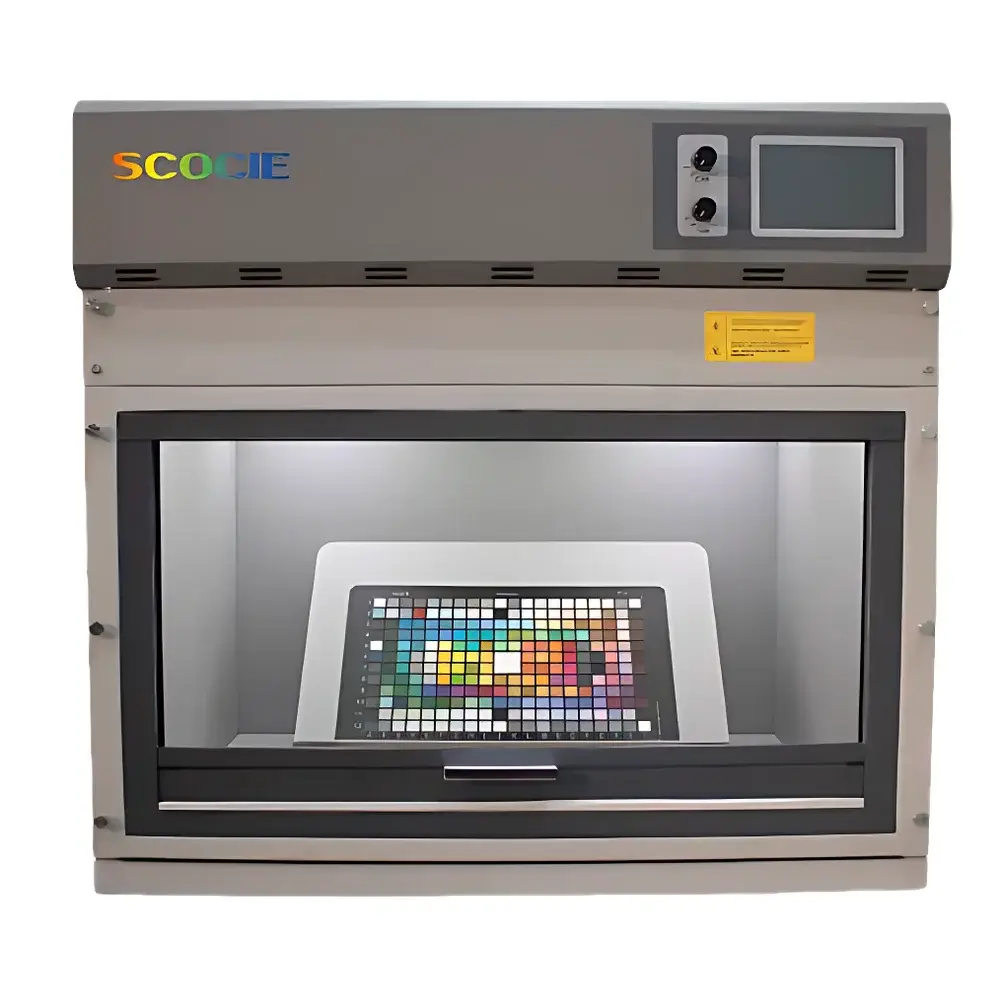
HunterLab FastnessGrade Digital Colorfastness Analyzer
| Brand | HunterLab |
|---|---|
| Origin | Shanghai, China |
| Model | FastnessGrade |
| Type | Benchtop Spectrophotometer |
| Optical Geometry | 0/45° Integrating Sphere |
| Light Source | LED Array |
| Spectral Range | 350–700 nm |
| Repeatability | ΔE*ab ≤ 0.03 |
| Product Category | Spectrophotometric Color Measurement Instrument |
| Compliance | ASTM D2244, ISO 105-A02, ISO 105-A03, ISO 105-B02, ISO 105-X12, AATCC Test Method 8, AATCC TM16, AATCC TM20, GB/T 3920, GB/T 8427, GB/T 4802.1 |
Overview
The HunterLab FastnessGrade Digital Colorfastness Analyzer is a benchtop spectrophotometric imaging system engineered for objective, repeatable, and standardized evaluation of textile colorfastness properties. Unlike conventional visual assessment under standard illuminants or single-point reflectance measurement, the FastnessGrade integrates high-fidelity RGB imaging with calibrated spectral acquisition (350–700 nm) within a 0/45° integrating sphere optical architecture. This enables simultaneous spatial and spectral analysis of sample surfaces—capturing both macroscopic appearance changes (e.g., pilling, abrasion patterns, staining distribution) and quantitative colorimetric shifts (ΔL*, Δa*, Δb*, ΔE*ab). Its core methodology aligns with internationally recognized color difference metrology principles defined in CIE 1976 L*a*b* and complies with critical test standards including ISO 105-A02 (gray scale for color change), ISO 105-A03 (gray scale for staining), ISO 105-B02 (blue wool scale for lightfastness), and AATCC TM16 (lightfastness testing). The instrument functions as a unified platform for color measurement, colorfastness grading, and appearance-based performance evaluation—eliminating reliance on subjective human panel assessments while maintaining full traceability to reference standards.
Key Features
- Integrated dual-mode operation: spectrophotometric color measurement (CIE L*a*b*, ΔE*ab, CMC, DE2000) and digital colorfastness grading (ISO/AATCC-compliant scales)
- 0/45° geometry with large-area LED illumination array ensures uniform, stable, and flicker-free illumination across the entire field of view—critical for consistent imaging of textured or irregular samples
- High-resolution RGB sensor coupled with spectral calibration enables pixel-level color mapping and region-of-interest (ROI) analysis for localized degradation assessment (e.g., edge abrasion, gradient fading)
- Built-in standard illuminant simulation (D65, A, F2, F7, F11) compliant with CIE S 002 and ISO/CIE 11664-2, supporting accurate visual correlation without external light booths
- Automated multi-sample imaging: up to 6 textile specimens can be analyzed simultaneously in a single capture cycle, reducing throughput time by >60% versus sequential single-specimen methods
- Embedded GLP-compliant audit trail: all image acquisitions, parameter settings, calibration events, and grading decisions are timestamped, user-logged, and exportable in CSV/PDF formats
Sample Compatibility & Compliance
The FastnessGrade accommodates flat, flexible, and moderately textured substrates—including woven/knitted fabrics, nonwovens, leather, coated papers, and polymer films—within its 120 mm × 120 mm field of view. Sample holders are designed to minimize shadowing and ensure planar registration during imaging. All grading algorithms are validated against ISO 105 reference standards (e.g., multi-fiber fabric M-2, blue wool standards 1–8, gray scales 1–5) and referenced to AATCC Evaluation Procedures 1 and 2. Data output meets requirements for regulatory submission under FDA 21 CFR Part 11 when deployed in GMP environments (e.g., medical textile validation, cosmetic packaging color consistency). Instrument calibration follows NIST-traceable procedures using certified ceramic tiles and spectral reflectance standards; annual verification is supported via optional HunterLab-certified service packages.
Software & Data Management
The FastnessGrade operates with HunterLab’s proprietary EasyMatch QC software (v5.3+), providing a secure, role-based interface for method configuration, result visualization, and report generation. Software modules include: (1) Fastness Grading Wizard—guides users through ISO/AATCC test selection, reference standard loading, and pass/fail threshold definition; (2) Image Overlay Mode—superimposes pre- and post-test images with color-difference heatmaps; (3) Batch Reporting Engine—exports graded results (including pilling grade, crocking score, lightfastness level) alongside raw spectral data and metadata to network drives or LIMS via configurable ODBC or REST API endpoints. All data files are stored in HDF5 format for long-term integrity and interoperability with MATLAB, Python (NumPy/Pandas), or statistical process control (SPC) platforms. Electronic signatures and 21 CFR Part 11 compliance features (audit trail, electronic records, user authentication) are enabled by default.
Applications
The FastnessGrade serves as a primary analytical tool across R&D, QC, and supplier qualification workflows in global textile supply chains. Key use cases include: accelerated development of reactive dye systems under simulated laundering cycles; validation of UV-resistant pigment formulations for outdoor awnings; objective quantification of crocking resistance in denim finishing processes; pilling assessment of technical sportswear fabrics per ISO 12945-1; and color stability monitoring of food-grade packaging films exposed to thermal/humidity stress. Beyond textiles, it supports appearance-based quality control in printed electronics (conductive ink adhesion), automotive interior trim (fading resistance), and pharmaceutical blister packaging (print legibility after accelerated aging). Its ability to generate machine-readable fastness reports reduces inter-laboratory variability and facilitates cross-site harmonization in multinational manufacturing networks.
FAQ
Does the FastnessGrade replace human grading entirely?
Yes—when configured with validated grading methods and trained reference libraries, it delivers ISO/AATCC-equivalent ratings without operator interpretation. However, initial method setup requires technical validation per ISO/IEC 17025.
Can it evaluate non-textile materials such as plastics or coatings?
Yes—provided the surface is opaque, flat, and within the 350–700 nm reflectance range. Applications include automotive paint fade testing and printed circuit board solder mask color consistency.
Is spectral data exportable for third-party analysis?
Yes—full 10-nm interval spectral reflectance curves (350–700 nm) are available in ASCII or CSV format, along with CIE XYZ, L*a*b*, and custom tolerance metrics.
What maintenance is required to sustain calibration accuracy?
Daily white tile verification is recommended; full recalibration is performed annually or after impact events, using HunterLab-certified service engineers.
How does it handle highly reflective or metallic finishes?
The 0/45° geometry inherently suppresses specular reflection artifacts; optional matte spray or neutral-gray backing may be applied for extreme gloss scenarios.






