
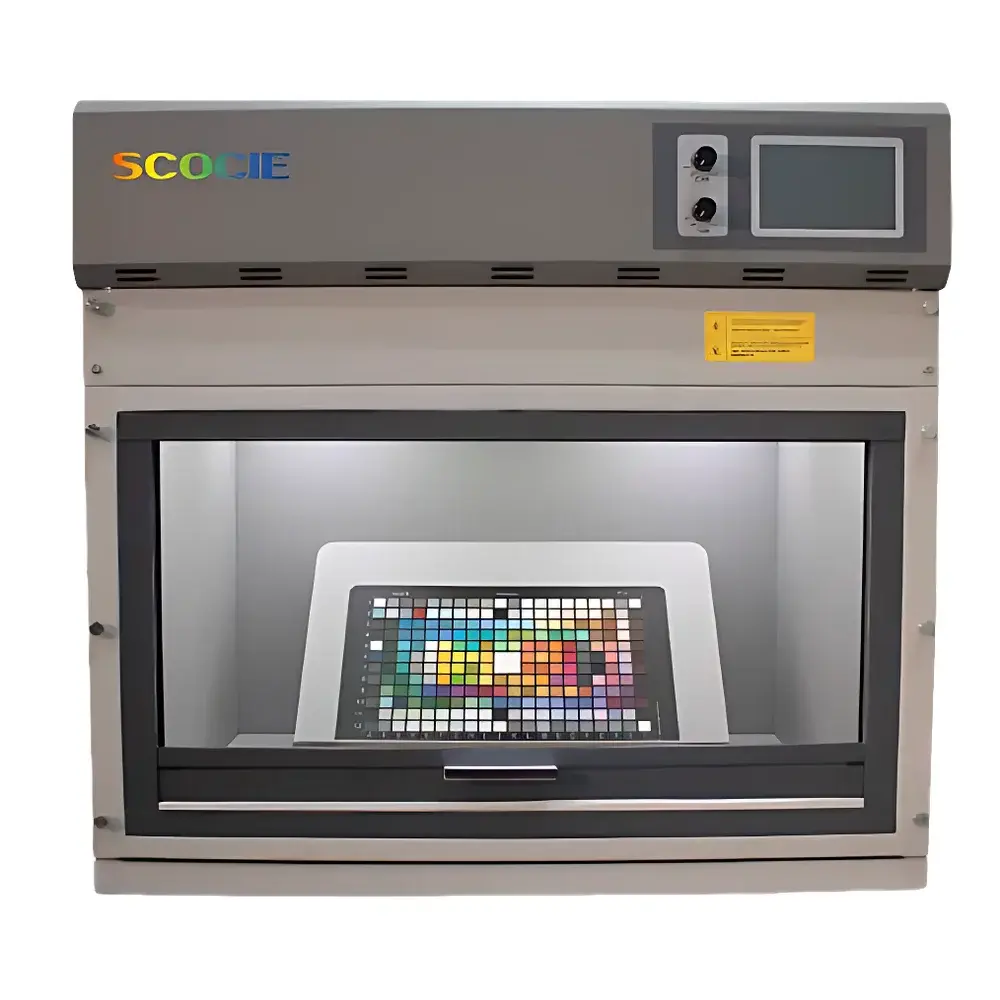
HunterLab FastnessGrade Digital Colorfastness Analyzer
| Brand | HunterLab |
|---|---|
| Origin | Shanghai, China |
| Model | FastnessGrade |
| Product Type | Spectrophotometric Color Difference Meter |
| Instrument Form Factor | Benchtop |
| Optical Geometry | 0/45° Integrating Sphere |
| Light Source | LED Array |
| Spectral Range | 350–700 nm |
| Repeatability | ΔE*ab ≤ 0.03 |
Overview
The HunterLab FastnessGrade Digital Colorfastness Analyzer is a benchtop spectrophotometric imaging system engineered for objective, repeatable, and standardized evaluation of textile colorfastness properties. Unlike conventional visual assessment methods relying on trained observers under controlled illumination, the FastnessGrade integrates high-fidelity RGB imaging with calibrated spectral measurement (350–700 nm) to quantify chromatic shifts across multiple fastness test protocols—including wash, rub, light, and perspiration exposure. Its 0/45° integrating sphere optical architecture ensures uniform illumination and diffuse reflectance capture, minimizing directional bias and enhancing inter-instrument agreement. The system is not a standalone colorimeter but a purpose-built metrology platform that bridges the gap between traditional gray-scale visual grading and ISO-compliant digital color difference analysis (per ISO 105-A02, ISO 105-A03, ISO 105-B02, and AATCC TM16, TM183). It supports full compliance with ASTM D2244 for color difference calculation and aligns with GLP-aligned data integrity requirements through traceable calibration and audit-ready reporting.
Key Features
- Dual-mode operation: Simultaneous spectral reflectance measurement (CIE L*a*b*, ΔE*ab, CMC, DE2000) and high-resolution RGB image acquisition for spatial texture and defect analysis
- Integrated standard illuminants: Programmable simulation of D65, A, F2, F7, and U30—fully compliant with ISO/CIE lighting standards for visual evaluation consistency
- Automated multi-sample imaging: Captures up to six textile specimens in a single frame, enabling batched fastness grading without repositioning or manual alignment
- LED-based stable illumination: Long-life, low-heat, flicker-free LED array with <±0.1% irradiance stability over 10,000 hours—eliminating lamp drift and reducing recalibration frequency
- Onboard colorfastness algorithms: Preloaded modules for ISO 105-C06 (wash), ISO 105-X12 (rub), ISO 105-B02 (light), and ISO 105-F09 (pilling), each applying standardized grayscale matching logic against digital reference libraries
- Traceable calibration: NIST-traceable white tile and black trap validation, with automated self-diagnostic routines logged in instrument history
Sample Compatibility & Compliance
The FastnessGrade accepts standard textile specimens per ISO 105-A02 (100 × 40 mm), AATCC 8 (150 × 50 mm), and ISO 105-F09 (pilling specimens). Its imaging field-of-view accommodates multi-fiber test fabrics (MFT), blue wool standards, and adjacent fabric swatches used in staining assessment. All measurement outputs conform to ISO/IEC 17025 documentation requirements when paired with validated SOPs. The system supports FDA 21 CFR Part 11-compliant user access control, electronic signatures, and immutable audit trails when deployed with HunterLab’s optional Enterprise Software Suite. It meets CE marking requirements for electromagnetic compatibility (EN 61326-1) and safety (EN 61010-1), and its spectral data output is compatible with QbD workflows in regulated textile dyeing and coating manufacturing.
Software & Data Management
The FastnessGrade operates with HunterLab’s Universal Software Platform (v5.3+), which provides role-based user permissions, customizable report templates (PDF/CSV/XLSX), and secure cloud synchronization via TLS 1.2–encrypted HTTPS. Raw spectral data, annotated images, and grade assignments are stored with embedded metadata—including operator ID, timestamp, environmental conditions (optional sensor integration), and calibration certificate ID. Batch reports include statistical summaries (mean ΔE, standard deviation, pass/fail thresholds per ISO 105-A05), and raw data exports support third-party statistical process control (SPC) tools. Audit logs record every data modification event, satisfying GLP/GMP traceability mandates for quality assurance departments in global supply chains.
Applications
- Textile & Apparel: Objective grading of ISO 105-C06 wash fastness, ISO 105-X12 dry/wet rub fastness, and ISO 105-B02 xenon-arc lightfastness using digital blue wool correlation
- Home Textiles & Carpets: Quantitative pilling assessment per ISO 105-F09 with automated comparison to ISO 105-F10 reference images
- Printing & Packaging: Evaluation of ink migration resistance on coated substrates and UV-curable pigment stability under accelerated aging
- Food & Agriculture: Non-destructive surface color monitoring of roasted coffee beans, dried fruits, and leafy greens—correlating L* value trends with moisture content and shelf life
- Coatings & Plastics: Measurement of weathering-induced chroma loss in automotive clearcoats and architectural PVC profiles under QUV exposure protocols
FAQ
Does the FastnessGrade replace human grading entirely?
It does not eliminate the need for trained personnel but replaces subjective visual interpretation with objective, reproducible metrics. Final certification may still require sign-off per internal QA policy, but the instrument removes inter-observer variability and enables remote expert review.
Can it be integrated into an existing LIMS or MES environment?
Yes—via HL-XML or RESTful API interfaces supporting HL-XML v2.1 schema; compatible with LabWare LIMS, Thermo Fisher SampleManager, and Siemens Opcenter Quality.
What calibration standards are required for routine verification?
A certified white reference tile (e.g., HunterLab CERAMIC-WS-01) and black trap must be used daily; full spectral calibration is recommended every 90 days or after major firmware updates.
Is the 0/45° geometry suitable for textured or napped fabrics?
Yes—the large-diameter integrating sphere and diffuse LED illumination minimize specular interference and provide robust results on velvet, fleece, and looped weaves where 45°/0° geometries often fail.
How is pilling grade determined digitally?
The system applies edge-enhanced segmentation to isolate pill clusters, computes density, size distribution, and contrast relative to ISO 105-F10 reference images, then assigns a grade (1–5) based on weighted algorithmic scoring—not pixel-count thresholds alone.





