
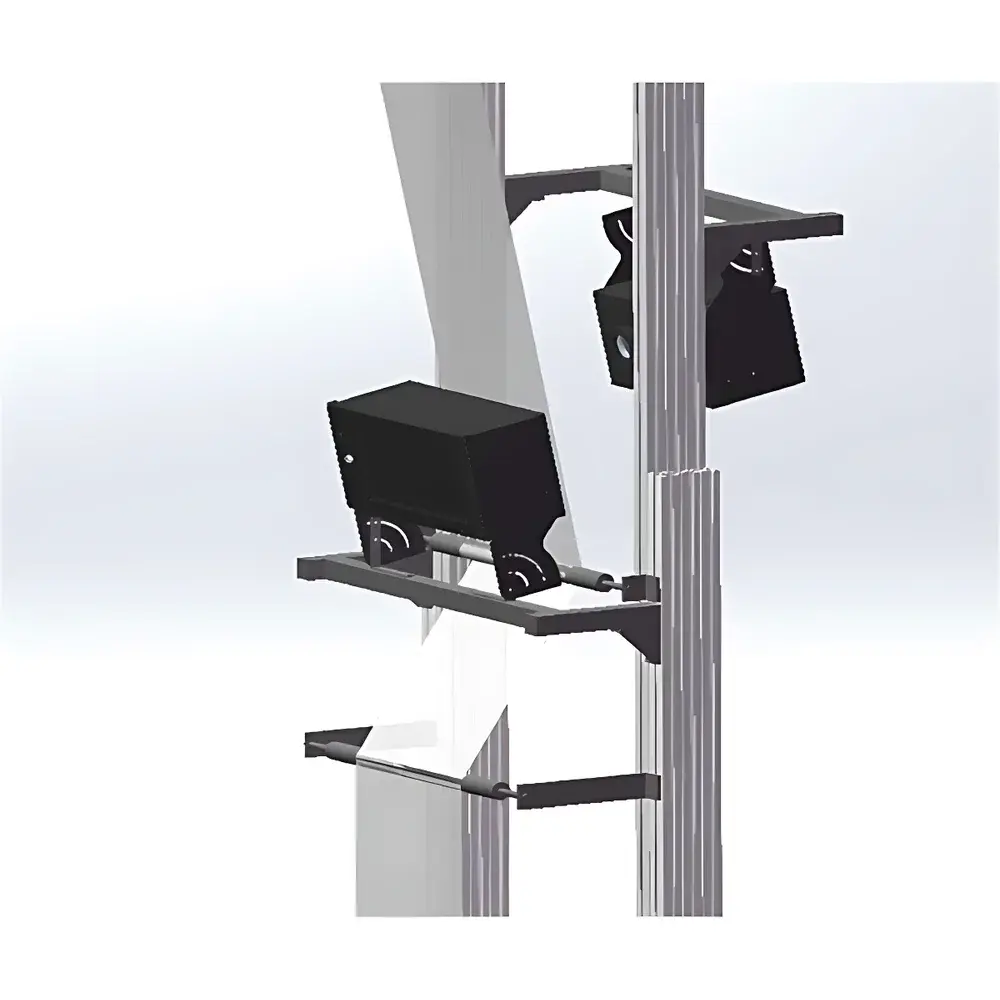
HunterLab FSD-300 Blow Film Surface Defect Inspection System
| Brand | HunterLab |
|---|---|
| Origin | Canada |
| Model | FSD-300 |
| Applicable Film Width | ≤340 mm |
| Minimum Detectable Feature Size | 0.05 mm |
| Maximum Spatial Resolution | 30 µm |
| Sensor Type | Area-Scan CCD |
| Maximum Web Speed | 18 m/min |
| Light Source | 30 W LED Cold Illumination |
| Power Supply | 220 VAC, 50 Hz |
| Communication Interfaces | RS232 / RS485 / Ethernet / USB |
| Upper Unit Dimensions (L×W×H) | 230 × 131 × 108 mm |
| Lower Unit Dimensions (L×W×H) | 272 × 160 × 252 mm |
| Compliance | GB 6595–1986, ASTM D3351–93, GB/T 4611–2008, GB/T 11115–2009 |
Overview
The HunterLab FSD-300 Blow Film Surface Defect Inspection System is an industrial-grade, vision-based inline quality monitoring solution engineered for continuous, non-contact detection and classification of surface anomalies on extruded polymeric films. Operating on high-contrast, multi-angle LED illumination coupled with a calibrated area-scan CCD imaging module, the system captures real-time monochromatic or grayscale imagery of moving film webs at speeds up to 18 m/min. Its optical architecture is optimized for both transparent and semi-opaque substrates—including polypropylene (PP), polyethylene (PE), polyvinyl chloride (PVC), and other resin-based cast or blown films—enabling reliable identification of sub-millimeter defects such as fisheyes, gel particles, contaminants, pinholes, streaks, haze clusters, and localized thickness variations. Unlike offline microscopy or manual sampling methods, the FSD-300 delivers deterministic, traceable defect mapping synchronized to production time stamps—supporting statistical process control (SPC) and root-cause analysis in extrusion lines.
Key Features
- Real-time defect localization, sizing, and classification (e.g., hole vs. contaminant vs. optical distortion) with configurable sensitivity thresholds
- Simultaneous measurement of film edge position and lateral dimension stability for width consistency monitoring
- Zoomable, high-fidelity image display with dynamic contrast enhancement for visual verification of marginal features
- Modular hardware design: compact upper unit (230 × 131 × 108 mm) mounts directly over the web; lower unit houses processing electronics and thermal management
- Multi-interface connectivity (RS232, RS485, Ethernet, USB) for integration into PLC-controlled extrusion lines and MES/SCADA platforms
- Configurable inspection reports including defect count per linear meter, size distribution histograms, positional heatmaps, and batch-level summary statistics
- Calibration-traceable spatial resolution down to 30 µm (0.03 mm) at standard configuration; optional higher-resolution CCD modules available for sub-20 µm feature detection
Sample Compatibility & Compliance
The FSD-300 is validated for use across common thermoplastic film formulations processed via mono- or co-extrusion blow molding. It accommodates films with nominal thicknesses from 12 µm to 250 µm and transmittance values ranging from >90% (clear LDPE) to <20% (pigmented or metallized PP). System performance adheres to internationally recognized test methodologies, including ASTM D3351–93 (Standard Test Method for Gel Content of Ethylene–Propylene Copolymers), GB/T 11115–2009 (Polyethylene Resins for Film), and GB/T 4611–2008 (Determination of Gel Particles in Polyolefin Films). All measurement data logs are timestamped and structured to support GLP-compliant audit trails. While not FDA 21 CFR Part 11–certified out-of-the-box, the system’s data export architecture (CSV, XML, TIFF) enables seamless integration with validated LIMS environments meeting pharmaceutical or food-contact packaging regulatory requirements.
Software & Data Management
The embedded inspection software provides a Windows-based GUI with intuitive navigation, real-time dashboard visualization, and role-based access control. Defect detection algorithms employ adaptive thresholding, morphological filtering, and blob analysis—parameters fully adjustable without code modification. Historical datasets are stored in a relational SQLite database with automatic daily archiving and configurable retention policies. Users may generate custom report templates using built-in field editors, embedding metadata such as shift ID, operator name, resin lot number, and extruder temperature setpoints. Trend charts (defect frequency vs. time, size distribution evolution) support proactive maintenance scheduling and raw material qualification. Raw image buffers and annotated frames can be exported losslessly for third-party metrology validation or AI model retraining.
Applications
- Quality assurance in high-speed blow film lines producing retail packaging, agricultural mulch, and medical barrier films
- In-process monitoring during pilot-scale resin development to quantify gel formation or additive dispersion homogeneity
- Supplier qualification audits where defect density (e.g., particles per m²) must meet contractual specifications per ISO 2591–1 or internal QMS criteria
- Root-cause troubleshooting of die lip contamination, screw wear, or melt filtration inefficiency through spatiotemporal defect clustering analysis
- Supporting IATF 16949 or ISO 9001 clause 8.6 compliance by providing objective, repeatable evidence of release testing for film batches
FAQ
Can the FSD-300 detect defects on colored or metallized films?
Yes—its LED cold-light illumination supports spectral tuning and polarization options to enhance contrast on reflective or low-transmission surfaces. Performance validation is recommended per specific substrate.
Is the system compatible with existing SCADA or ERP systems?
Yes—via Modbus TCP over Ethernet or ASCII protocol over RS485, enabling bidirectional communication of alarm states, defect counts, and operational status.
Does the FSD-300 require regular recalibration?
A full optical calibration is recommended annually or after mechanical shock; however, automated self-check routines verify sensor gain, exposure timing, and illumination uniformity at startup and hourly during operation.
What training and documentation are provided?
HunterLab supplies installation qualification (IQ) protocols, user manuals, SOP templates, and remote-assisted commissioning. Onsite technician training covers routine maintenance, report customization, and basic algorithm tuning.
Can defect classification rules be updated without vendor support?
Yes—classification logic is rule-based and editable via the GUI using logical operators (AND/OR), size ranges, aspect ratios, and intensity gradients. No programming skills are required.




