
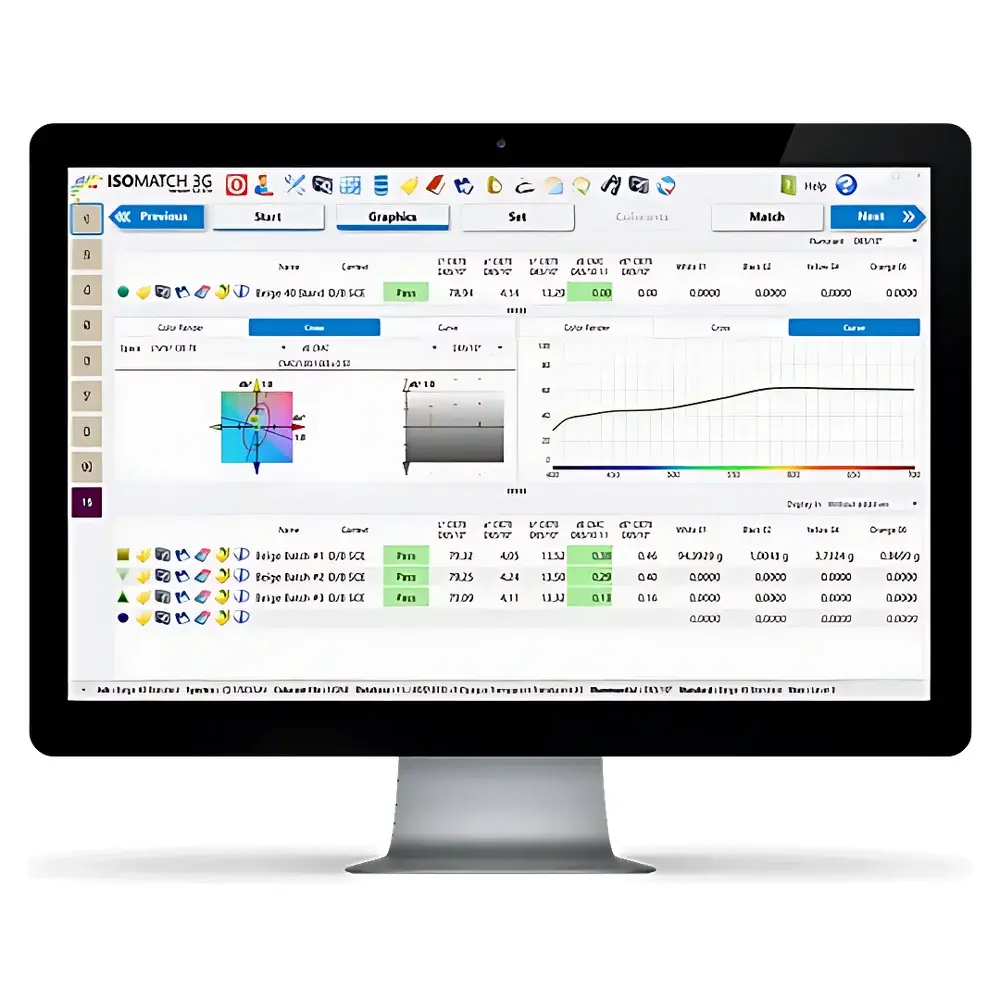
HunterLab ISOMATCH 3G Color Matching Software
| Brand | HunterLab |
|---|---|
| Origin | USA |
| Model | ISOMATCH 3G |
| Software Type | Cloud-Ready Color Formulation & Quality Control Suite |
| Compatibility | All HunterLab spectrophotometers (e.g., UltraScan VIS, MiniScan EZ, ColorFlex EZ, Agera) |
| Deployment | Windows-based client with optional SQL Server backend |
| Network Capability | Real-time LAN/WAN synchronization |
| Regulatory Support | FDA 21 CFR Part 11 compliant audit trail (with optional configuration), GLP/GMP-ready logging |
Overview
ISOMATCH 3G is a modular, enterprise-grade color formulation and quality control software platform developed by ISOCOLOR and fully integrated with HunterLab’s family of benchtop and portable spectrophotometers. Engineered for precision color management in R&D, production, and quality assurance environments, ISOMATCH 3G implements advanced multi-flux spectral modeling to compute accurate color matches across opaque, translucent, and transparent substrates—including plastics, coatings, textiles, inks, and clear resins. Unlike legacy matching algorithms that rely solely on tristimulus extrapolation, ISOMATCH 3G applies physics-based Kubelka–Munk theory augmented with empirical scattering/absorption coefficients—enabling robust prediction of metamerism, film thickness effects, and substrate-dependent hue shifts. The software operates as a centralized color data hub, supporting concurrent user access, version-controlled formula libraries, and bidirectional communication with laboratory instruments and manufacturing systems.
Key Features
- Multi-Flux Spectral Engine: Delivers formulation accuracy for complex optical systems—transparent films, pearlescent coatings, and pigment-dispersed polymers—by modeling wavelength-dependent scattering and absorption behavior beyond CIE L*a*b* interpolation.
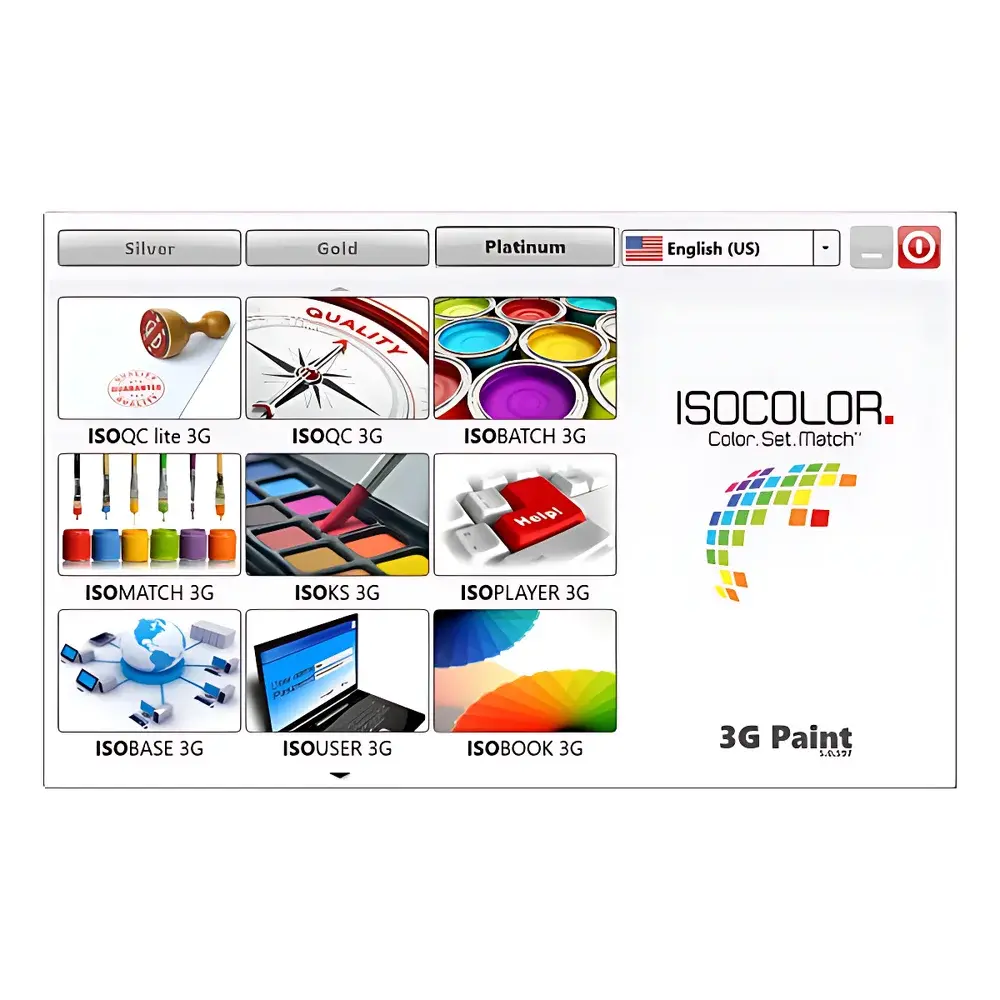
- Modular Architecture: Composed of interoperable components: ISOMATCH Core (base formulation), ISOMATCH FX (effect pigments including metallics and interference flakes), ISOQC (statistical process control with SPC charts and tolerance mapping), ISOBATCH (batch correction via delta-E feedback loops), ISOPIGMENT (curated, QC-validated pigment database with substitution logic), ISORESIN (resin/base polymer database with refractive index and yellowness index metadata), and ISOEXPERT (reaction kinetics and curing simulation for thermoset systems).
- Real-Time Network Synchronization: Built on Microsoft SQL Server architecture; supports distributed deployment across global sites with conflict-resolved replication, timestamped revision history, and role-based access control (RBAC) for formula editing, approval workflows, and audit log export.
- FDA 21 CFR Part 11 Readiness: Optional electronic signature module with biometric or token-based authentication, immutable audit trails, and electronic record retention compliant with pharmaceutical and medical device color validation requirements.
- Instrument Integration: Native drivers for all HunterLab spectrophotometers; automatic calibration verification, measurement metadata tagging (operator ID, sample ID, environmental conditions), and one-click spectral upload to formulation queues.
Sample Compatibility & Compliance
ISOMATCH 3G supports spectral data acquisition from solid, liquid, and powder samples measured using HunterLab’s d/8° sphere, 45°/0°, or directional geometry instruments. It accommodates ASTM D2244 (color difference), ASTM E308 (CIE colorimetry), ISO 11664 (CIE colorimetric standards), and ISO 18314-2 (spectral color measurement) methodologies. The software enables compliance with ISO 9001 color process documentation, ISO/IEC 17025 laboratory accreditation requirements, and automotive OEM specifications (e.g., GMW14872, Ford FLTM BN 108-01). All formula calculations are traceable to NIST-traceable reference standards measured on calibrated HunterLab hardware.
Software & Data Management
The system employs a tiered permission model—administrator, formulator, technician, and viewer—with customizable workflow stages (draft → review → approve → release). Formula databases support hierarchical categorization (by product line, customer, or application), full-text search across pigment names, CAS numbers, and spectral reflectance curves, and automated backup to network storage or cloud repositories (AWS S3 or Azure Blob). Raw spectral data (.qtx, .csv, .spc) and processed results (.xml, .pdf reports) are retained with SHA-256 checksum integrity verification. Batch records include instrument serial number, measurement date/time, ambient temperature/humidity, and operator digital signature—meeting GLP and GMP documentation rigor.
Applications
ISOMATCH 3G serves critical functions across regulated and high-precision industries: automotive OEMs managing multi-layer paint systems; packaging converters validating spot-color fidelity on flexible films; pharmaceutical manufacturers controlling capsule shell hue per USP ; cosmetic labs developing interference-based lipsticks; and industrial coating suppliers optimizing titanium dioxide replacement strategies under REACH and TSCA constraints. Its dynamic matching engine supports real-time recalibration against master standards during production runs, while ISOQC’s statistical analysis identifies drift trends before out-of-spec batches occur.
FAQ
Is ISOMATCH 3G compatible with non-HunterLab spectrophotometers?
Yes—via standardized CIE XYZ or spectral .txt/.csv import; however, full metrological traceability and automated calibration verification require native HunterLab hardware integration.
Can ISOMATCH 3G generate cost-optimized formulas?
Yes—users define material cost matrices per pigment/resin; the software computes lowest-cost formulations within specified ΔE₀₀ and spectral deviation tolerances.
Does ISOMATCH 3G support pigment substitution across global supply chains?
Yes—ISOPIGMENT and ISORESIN modules include geo-referenced equivalency tables validated per regional regulatory limits (e.g., EU Annex XIV, China RoHS).
How is software validation performed for regulated environments?
HunterLab provides IQ/OQ documentation templates; installation qualification includes cryptographic hash verification of binaries, while operational qualification validates spectral math engines against NIST SRM 2009 reference data.
What database options are available for enterprise deployment?
Microsoft SQL Server (on-premise or Azure SQL Managed Instance) is required for multi-user concurrency, audit logging, and disaster recovery—SQL Express is supported for single-seat evaluation only.





