
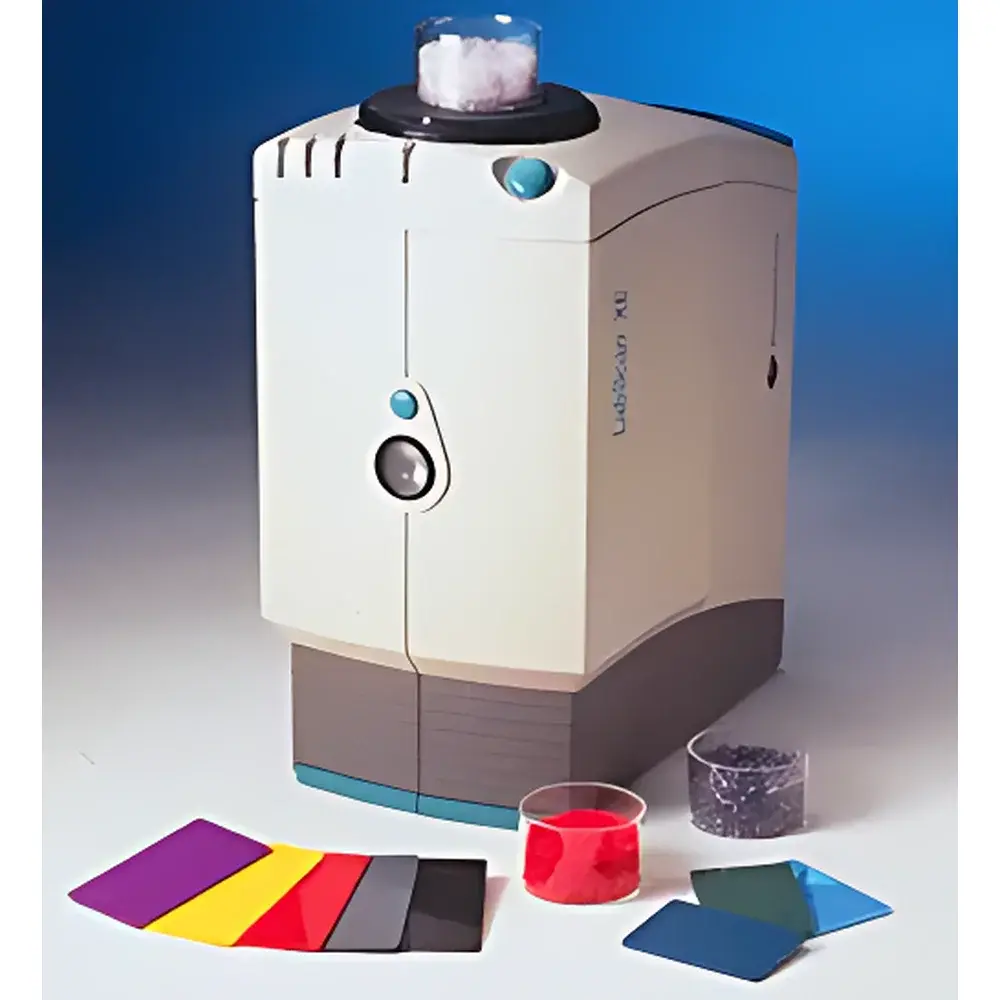
HunterLab LabScan XE 0/45 Benchtop Colorimeter
| Origin | USA |
|---|---|
| Manufacturer Type | Authorized Distributor |
| Origin Category | Imported |
| Model | LabScan XE 0/45 |
| Pricing | Available Upon Request |
Overview
The HunterLab LabScan XE 0/45 is a high-precision benchtop spectrophotometer engineered for repeatable, traceable color measurement across diverse industrial materials. It employs a true 0°/45° optical geometry—compliant with CIE and ASTM D2244, ISO 7724, and ISO 11664 standards—to replicate human visual perception of color under standardized illumination. Unlike bidirectional or diffuse geometries, the 0°/45° configuration isolates surface reflectance while minimizing interference from specular highlights, gloss, texture, and microstructural variations. The instrument utilizes a pulsed xenon lamp calibrated to simulate D65 illuminant (CIE Standard Illuminant D65), with optional UV-filtering capability (420 nm cutoff) for fluorescence control in optically brightened samples. Its 256-element silicon photodiode array coupled with a holographic diffraction grating delivers full spectral data from 400–700 nm at <3 nm resolution and ±0.1 nm wavelength accuracy—enabling robust calculation of CIELAB, CIELCh, ΔE*00, Yellowness Index (YI), Whiteness Index (WI), and other industry-standard color metrics.
Key Features
- True 0° illumination / 45° annular detection geometry using a 15-fiber optic ring for spatially averaged reflectance measurement—reducing bias from surface texture, weave, or finish.
- Large 44 mm (1.75″) standard aperture—the largest in its class—optimized for heterogeneous or irregularly shaped samples including textiles, molded plastics, coated panels, and coarse powders.
- Variable Sample Illumination (VSI) with five selectable apertures (44 mm, 25 mm, 13 mm, 6 mm, and optional 3 mm) for precise targeting of small features or localized regions.
- Pulsed xenon light source with >1 billion flash lifetime—no lamp replacement required; maintains stable D65 spectral output without thermal drift or aging-related calibration drift.
- Fanless, filterless design ensures silent operation, minimal maintenance, and long-term stability in QC labs and production environments.
- Integrated NIST-traceable calibration standards with automated reference correction—supporting GLP/GMP compliance and audit-ready calibration history.
- Dual optical path architecture enhances signal-to-noise ratio, improves photometric linearity (0–150% reflectance), and extends instrument longevity.
- Ergonomic front- or top-facing sample port with tactile test button—enabling rapid, hands-on measurement without keyboard dependency.
Sample Compatibility & Compliance
The LabScan XE 0/45 accommodates solids, liquids, pastes, granules, fibers, films, and textured surfaces—including translucent, glossy, matte, and anisotropic materials. Its flexible port orientation (top-, front-, or optional bottom-facing via accessory stand) supports vertical liquid cells, horizontal solid plates, and inverted powder cups. All measurements comply with ASTM E308 (computing tristimulus values), ASTM D6290 (plastics), ASTM D2244 (color difference), ISO 11664-4 (CIE colorimetry), and USP (pharmaceutical packaging color verification). Instrument inter-instrument agreement meets ΔE* ≤ 0.15 (average) and ≤ 0.36 (max) across a 44 mm aperture—validating suitability for multi-site color harmonization programs subject to ICH Q5E comparability requirements.
Software & Data Management
Controlled via HunterLab’s EasyMatch QC software (Windows-based), the LabScan XE supports full spectral data export (CSV, XML, .qtx), real-time pass/fail tolerancing, statistical process control (SPC) charting, and customizable report generation. Software modules include Spectral Match (for formulation support), Color Quality Manager (CQM), and Enterprise Integration Toolkit for ERP/MES connectivity. Audit trail functionality complies with FDA 21 CFR Part 11 requirements—including electronic signatures, user access controls, and immutable change logs. Raw spectral data retention enables retrospective reprocessing using updated color formulas or updated illuminants without re-measurement.
Applications
This instrument serves as a primary color measurement platform in regulated and non-regulated manufacturing settings: pigment and resin formulation in coatings and inks; batch release testing of pharmaceutical tablets and capsules; whiteness/yellowness assessment in paper and pulp; color consistency validation in automotive interior trim and textile dye lots; quality control of food-grade packaging films and confectionery coatings; and raw material qualification in polymer compounding and ceramic glaze production. Its ability to resolve subtle metamerism and quantify texture-induced color shifts makes it especially valuable in R&D labs developing novel finishes, nanocomposites, and bio-based substrates.
FAQ
What does “0°/45°” mean in color measurement geometry?
It denotes illumination at 0° normal incidence and detection at 45° off-axis—mimicking how the human eye views colored objects under directional lighting, while excluding mirror-like reflections.
Can the LabScan XE measure transparent or translucent samples?
Yes—when used with optional transmission accessories (e.g., liquid cell holders or transmittance ports), though its primary design focuses on reflectance measurement per ISO 11664-4.
Is NIST traceability provided with the instrument?
Yes—each unit ships with factory-calibrated, NIST-traceable white and black standards; calibration certificates include uncertainty budgets per ISO/IEC 17025 guidelines.
Does the instrument support Good Manufacturing Practice (GMP) documentation?
Yes—EasyMatch QC provides full 21 CFR Part 11 compliance, including role-based permissions, electronic signatures, and secure audit trails for regulated industries.
How often must the instrument be recalibrated?
Daily verification with supplied standards is recommended; full recalibration is typically required only after physical shock, extended storage, or environmental extremes—supported by built-in diagnostic routines and performance validation protocols.





