
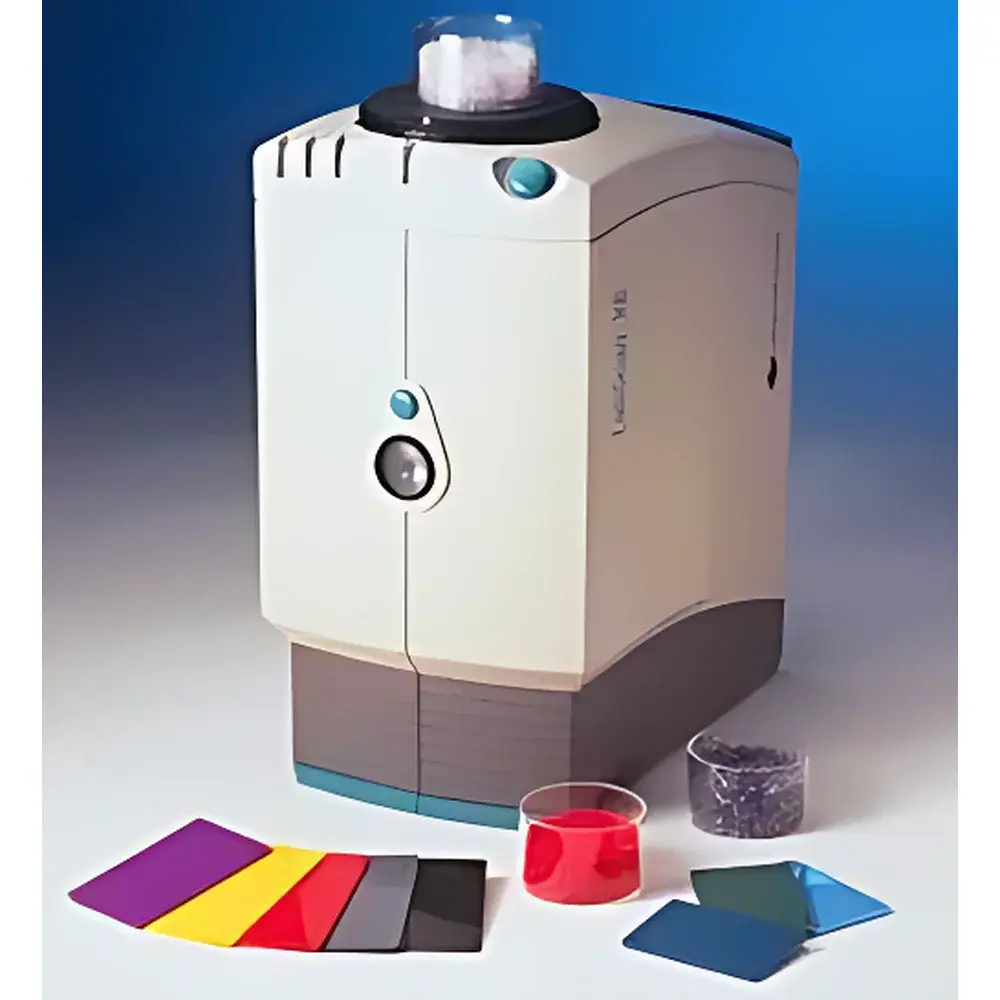
HunterLab LabScan XE 0/45° Desktop Color Measurement Instrument
| Brand | HunterLab |
|---|---|
| Origin | USA |
| Model | LabScan XE |
| Optical Geometry | 0°/45° (15-point fiber optic ring) |
| Light Source | Pulsed Xenon Lamp |
| Spectral Range | 400–700 nm |
| Wavelength Interval | 10 nm |
| Repeatability | ΔE*ab ≤ 0.09 |
| Detector | 256-element Silicon Photodiode Array |
| Illumination Area Options | 44 mm (standard), 25 mm, 13 mm, 6 mm, 3 mm (VSI optional) |
| Spectral Bandwidth | <10 nm FWHM |
| Photometric Range | 0–150% reflectance |
| Power Supply | 100–240 VAC, 47–63 Hz |
| Operating Temperature | 10–40 °C |
| Storage Temperature | −20–70 °C |
| Relative Humidity | 10–90% RH (non-condensing) |
| Interface | RS-232C DB9 |
Overview
The HunterLab LabScan XE is a high-precision desktop color measurement instrument engineered for industrial color quality control in research, manufacturing, and regulatory environments. It implements a true 0°/45° optical geometry—distinct from integrating sphere or diffuse d/8 systems—designed to replicate human visual perception of color under standardized viewing conditions. This geometry employs a 15-point circumferential fiber optic ring to collect reflected light at precisely 45° from 15 discrete azimuthal positions around the 0° illumination axis. By averaging signals across all 15 detectors, the system inherently compensates for directional surface effects—including gloss variation, texture anisotropy, and micro-roughness—that otherwise distort color readings in conventional single-angle instruments. The pulsed xenon lamp provides full-spectrum illumination with spectral stability traceable to CIE standard illuminants (D65 default), and integrated UV-filtering enables controlled UV content management—critical for fluorescent or optically brightened samples common in plastics, textiles, and pharmaceutical packaging.
Key Features
- True 0°/45° multi-angle reflectance geometry with 15-point fiber optic sampling for robust surface-invariant color assessment
- Pulsed xenon light source with >1 billion flash lifetime and automatic UV-absorbing filter (420 nm cutoff) for stable, reproducible spectral output
- 256-element silicon photodiode array spectrometer with 10 nm wavelength resolution across 400–700 nm visible range
- Variable Sample Illumination (VSI) option supporting five selectable aperture sizes (3 mm to 44 mm) to accommodate diverse sample formats—from granules and pellets to films, fibers, and irregular solids
- Large-area 44 mm measurement port with unrestricted sample height tolerance, enabling direct analysis of molded plastic parts, extruded profiles, and textured sheets without repositioning
- Compliance-ready architecture: supports audit trails, user access levels, and data integrity protocols aligned with FDA 21 CFR Part 11 and ISO/IEC 17025 requirements when used with QualiColor Software Suite
Sample Compatibility & Compliance
The LabScan XE accommodates heterogeneous sample types encountered in polymer processing and quality assurance workflows: opaque and translucent thermoplastics (e.g., PP, ABS, PC), pigment-loaded masterbatches, injection-molded components, extruded films, and powder blends. Its 0°/45° geometry eliminates specular component exclusion artifacts that plague sphere-based instruments on glossy surfaces—making it especially suitable for high-gloss automotive plastics, coated packaging, and electroplated polymers. The instrument meets ASTM D2244 (Standard Practice for Calculation of Color Tolerances), ASTM E308 (Standard Practice for Computing the Colors of Objects by Using the CIE System), and ISO 11664-4 (CIE colorimetry – Part 4: CIE 1976 L*a*b* colour space). All firmware and calibration routines are validated per HunterLab’s internal GLP-compliant procedures, with NIST-traceable calibration standards available for routine verification.
Software & Data Management
Controlled via QualiColor Software (v8.x or later), the LabScan XE delivers structured color data management compatible with enterprise QC systems. The software supports method-driven workflows—including custom tolerancing (ΔE*ab, ΔE00, CMC, DIN99), batch reporting, statistical process control (SPC) charting, and spectral database archiving. Audit trail functionality logs all user actions, parameter changes, and calibration events with timestamps and operator IDs—satisfying GMP documentation requirements for regulated industries. Raw spectral data (31-point or full 256-channel) is exportable in CSV, XML, or ASTM E2815-compliant formats for integration into LIMS or MES platforms. Remote diagnostics and firmware updates are supported over RS-232; Ethernet and USB interfaces are available as factory-installed options.
Applications
- Plastics manufacturing: color consistency validation across injection molding cycles, extrusion lines, and compounding batches
- Recycled polymer sorting: discrimination of pigment families and degradation-induced hue shifts in post-consumer PET or HDPE streams
- Automotive interior trim: measurement of textured polypropylene dashboards and leather-grain PVC under production lighting conditions
- Medical device coloring: verification of USP Class VI-compliant colorants in silicone tubing and polycarbonate housings
- Food contact packaging: quantification of migration-induced color drift in multilayer PE/PA laminates
- Paint & coating R&D: correlation of lab-scale color matches to production spray-applied finishes on ABS substrates
FAQ
How does the 0°/45° geometry differ from d/8° sphere instruments?
The LabScan XE measures only the directional reflectance component—excluding diffuse scatter—mimicking how the human eye perceives color on non-Lambertian surfaces. Sphere-based d/8° systems include both specular and diffuse components unless configured with SPIV (Specular Component Included/Excluded) mode, which introduces measurement uncertainty on textured or glossy plastics.
Can the LabScan XE measure transparent or translucent plastic sheets?
Yes—when used with the optional transmission stand and backlit white reference, it supports CIE transmittance measurements (Y, x, y, CIE L*a*b*) for clear films, bottles, and lenses. Standard configuration is optimized for reflectance; transmission capability requires hardware add-on.
Is spectral data export supported for third-party analysis?
Yes—full 256-channel spectral reflectance data (3.5 nm resolution interpolated to 10 nm intervals) is exportable in ASCII format with wavelength headers, enabling advanced analysis in MATLAB, Python (NumPy/Pandas), or proprietary spectral modeling tools.
What calibration standards are required for daily verification?
HunterLab certifies ceramic tile standards (white, black, green) traceable to NIST SRM 2021 and SRM 2035. Daily verification uses the included white calibration tile; annual recalibration is recommended per ISO/IEC 17025 clause 6.5.2.



