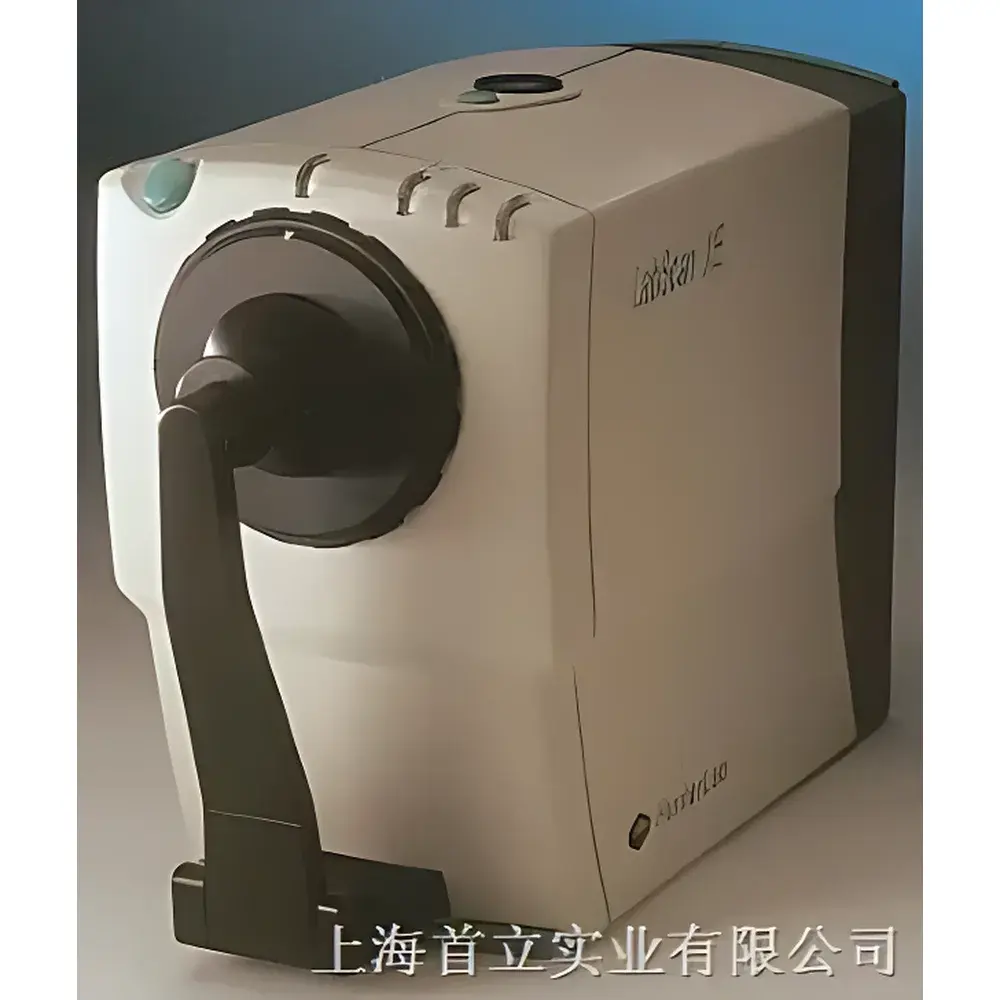
HunterLab LabScan XE Color Management System Desktop Colorimeter
| Origin | Japan |
|---|---|
| Manufacturer Type | Authorized Distributor |
| Origin Category | Imported |
| Model | Desktop Colorimeter |
| Pricing | Upon Request |
| Product Type | Colorimeter |
Overview
The HunterLab LabScan XE Color Management System is a high-precision desktop colorimeter engineered for industrial and laboratory-grade color measurement across diverse material forms—including powders, granules, liquids, films, yarns, textiles, paper, plastics, coatings, pharmaceuticals, foodstuffs, and construction materials. It employs a standardized 0°/45° optical geometry compliant with CIE and ASTM D2244, ISO 7724, and ISO 11664 standards, replicating human visual perception by decoupling color appearance from surface gloss and texture effects. Unlike diffuse 8°/d or d/8° instruments, the LabScan XE utilizes a ring-shaped 15-point fiber-optic collector positioned at precisely 45° relative to the 0° illuminating axis—capturing reflected light from multiple spatial locations simultaneously and computing an averaged spectral response. This design inherently compensates for microstructural heterogeneity, surface roughness, directional orientation (e.g., brushed metal or woven fabric), and preparation-induced variations (e.g., compression of powders or calendering of paper), delivering measurement repeatability ≤0.08 ΔE*ab (SRM 2009) under controlled conditions.
Key Features
- 0°/45° Ring Geometry: 15-point fiber-optic detection array ensures spatial averaging of reflectance, minimizing bias from sample topography and directional reflectivity.
- D65-Compliant Illumination: Pulsed xenon lamp with integrated UV-absorbing filter (cutoff at 420 nm) delivers stable, daylight-simulating spectra without lamp aging drift; rated for ≥1 billion flashes.
- Large-Area Measurement Aperture: Standard 44 mm (1.75 in) viewing port—the largest in its class—accommodates irregular, textured, or oversized samples without cropping or repositioning.
- Variable Sample Illumination (VSI): Optional five-step aperture selection (44 mm, 25 mm, 13 mm, 6 mm, 3 mm) enables targeted analysis of small features, inclusions, or heterogeneous regions.
- Double-Beam Spectral Architecture: Dual optical paths provide real-time reference compensation, enhancing long-term stability and reducing calibration frequency.
- Integrated Reference Tile & Auto-Calibration: Built-in ceramic standard tile enables on-board verification and automatic correction for instrument drift between user calibrations.
- Fan-Free Thermal Design: Passive cooling eliminates airflow-induced vibration, dust accumulation, and acoustic interference—critical for cleanroom and QC lab environments.
- Single-Unit Form Factor: All electronics, optics, and power conditioning housed within the main chassis; no external power supply or auxiliary modules required.
Sample Compatibility & Compliance
The LabScan XE supports non-destructive, contact-free measurement of opaque solids, translucent gels, viscous slurries, free-flowing powders, and liquid suspensions. Its dual-port configuration allows both top-down (aperture facing upward) and front-access (aperture facing forward) loading—enabling direct placement of Petri dishes, cuvettes, sample cups, or rigid panels. The system complies with ISO/IEC 17025 requirements for measurement uncertainty estimation and supports audit-ready documentation per FDA 21 CFR Part 11 when paired with HunterLab’s EasyMatch QC software. Routine operation meets GLP/GMP traceability protocols through timestamped calibration logs, operator ID tagging, and electronic signature capability.
Software & Data Management
Controlled via HunterLab’s EasyMatch QC v5.x platform, the LabScan XE supports full spectral data capture (400–700 nm at 10 nm intervals), CIELAB, CMC, DIN99, and Hunter L,a,b color space reporting, and statistical process control (SPC) charting. The software enforces role-based access control, versioned method templates, and automated pass/fail tolerancing against master standards. Raw spectral files (.qtx) are exportable in ASCII format for third-party analysis (e.g., MATLAB, Python pandas). Audit trails record all instrument parameter changes, calibration events, and result modifications—including user identity, timestamp, and pre-/post-change values—ensuring full compliance with ISO 9001 and ICH Q7 quality systems.
Applications
- Plastics: Batch-to-batch color consistency validation for injection-molded parts, extruded profiles, and recycled resin blends.
- Pharmaceuticals: Solid dosage form color uniformity testing per USP <1061>; excipient compatibility screening.
- Food & Beverage: Objective assessment of fruit pulp, dairy powders, confectionery coatings, and beverage concentrates.
- Textiles & Apparel: Shade matching across dye lots, finishing treatments, and fiber blends under standardized illuminants.
- Paper & Packaging: Whiteness, brightness, and yellowness index quantification per TAPPI T452 and ISO 2470.
- Coatings & Inks: Metallic flake orientation impact evaluation, pearlescent effect quantification, and weathering degradation tracking.
FAQ
What does “0°/45°” mean in color measurement geometry?
It specifies illumination at 0° normal incidence and detection at 45° off-axis—mimicking how the human eye views objects under typical lighting, while excluding specular reflection to isolate inherent color properties.
Can the LabScan XE measure transparent or translucent liquids?
Yes—using the optional transmission cell holder and front-access configuration, it measures absorbance-based color in clear or hazy liquids per ASTM D1209 and D5386.
Is UV calibration included in routine maintenance?
The built-in UV filter is fixed and non-adjustable; however, the instrument performs automatic UV component normalization during each measurement using its internal reference channel.
How often must the white calibration tile be replaced?
HunterLab-certified ceramic tiles retain stability for ≥5 years under normal lab handling; annual verification against NIST-traceable standards is recommended.
Does the system support networked deployment in multi-user labs?
Yes—via RS-232 serial interface or optional Ethernet adapter, enabling centralized fleet management, remote diagnostics, and integration with LIMS or MES platforms.