
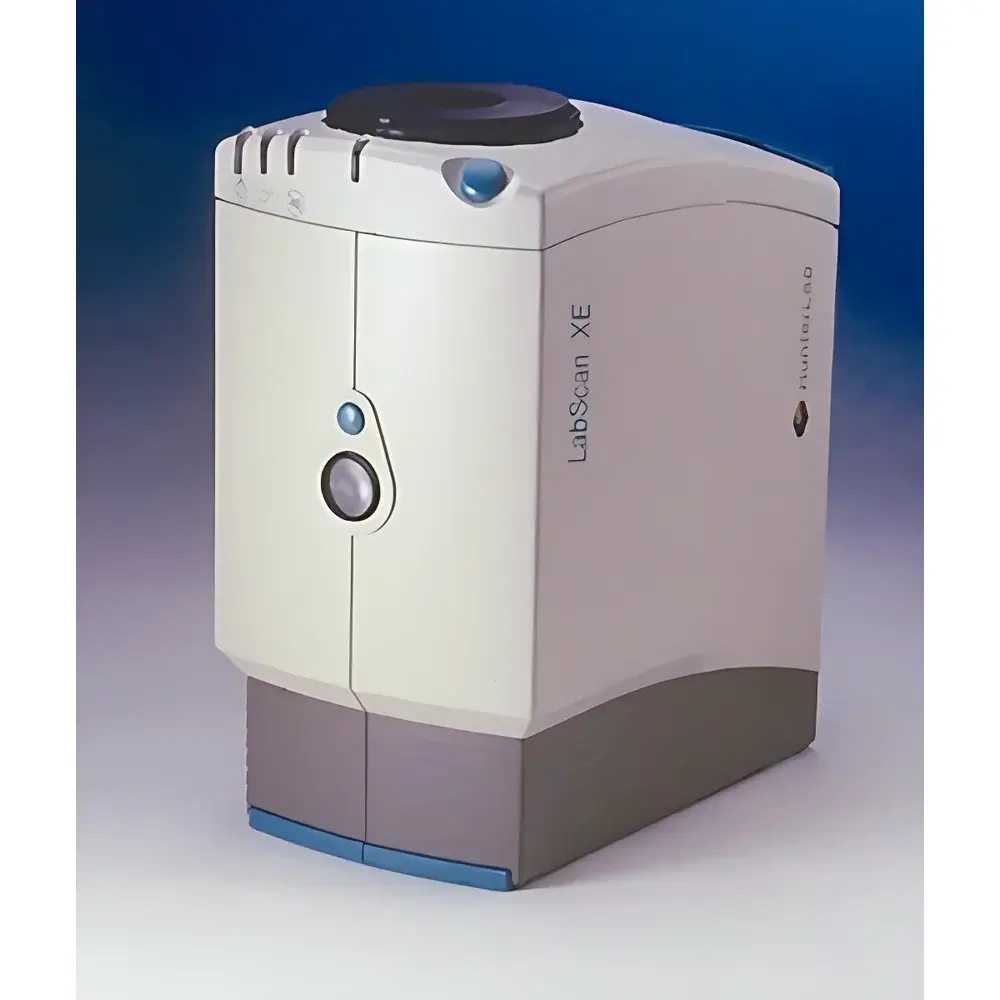
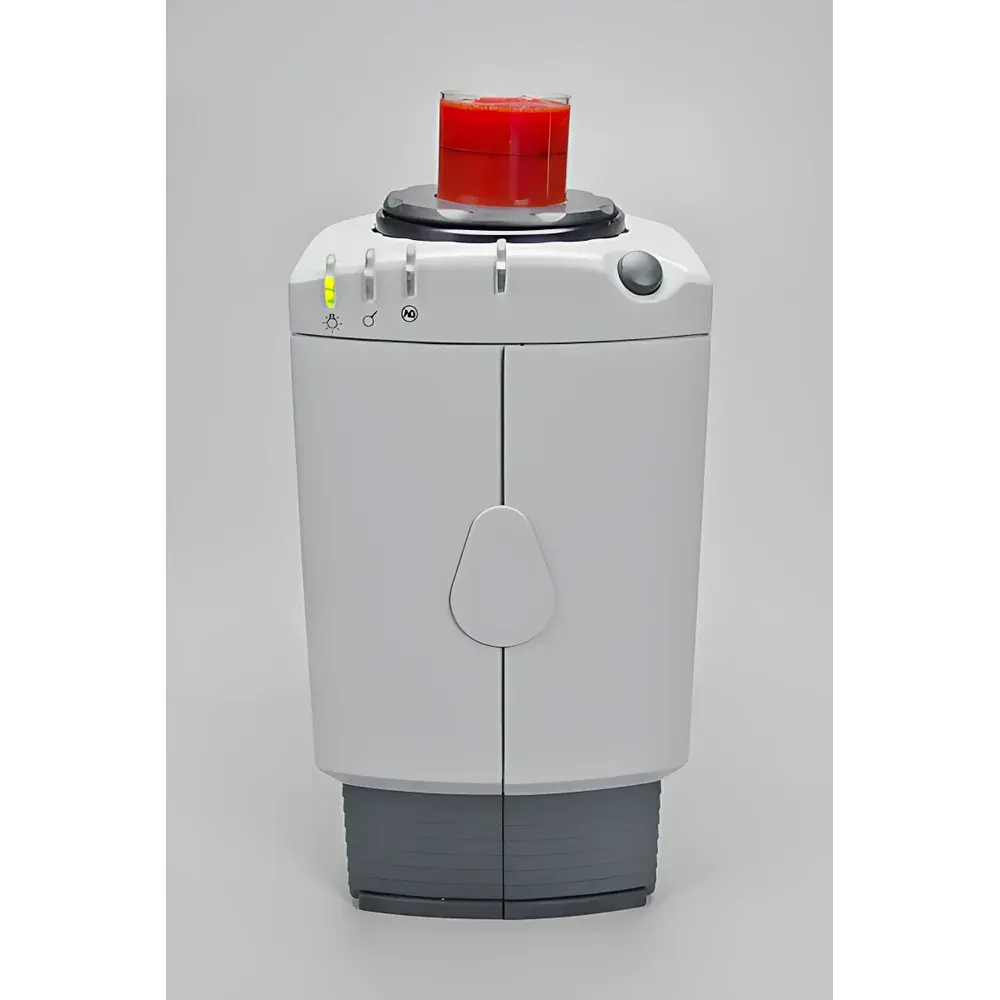
HunterLab LabScan XE Spectrophotometer
| Brand | HunterLab |
|---|---|
| Origin | USA |
| Model | LabScan XE |
| Product Type | Benchtop Spectrophotometric Colorimeter |
| Optical Geometry | 0°/45° (annular, non-contact) |
| Light Source | Pulsed Xenon Lamp with D65 Illuminant Simulation |
| Spectral Range | 400–700 nm |
| Wavelength Interval | 10 nm |
| Detector | 256-element Silicon Photodiode Array with Diffraction Grating |
| Aperture Options | 3 mm, 8 mm, 15 mm, 25 mm, and 44 mm (LAV) |
| Repeatability | ΔE* < 0.09 |
| Measurement Time | ≤ 3 s |
| Reflectance Range | 0–150% |
| Compliance | CIE No. 15, ISO 7724-1, ASTM E308, DIN 5033, JIS Z 8722 |
| Software Compatibility | HunterLab EasyMatch QC (21 CFR Part 11 compliant audit trail option available) |
Overview
The HunterLab LabScan XE is a benchtop spectrophotometer engineered for high-precision color measurement across diverse industrial materials—including opaque solids, translucent films, powders, liquids, fibers, and textured surfaces. It operates on the CIE-recommended 0°/45° annular illumination and viewing geometry, which replicates human visual assessment more closely than integrating sphere (d/8°) configurations—particularly for structured, directional, or polarized samples such as woven textiles, extruded plastics, coated papers, and anisotropic films. Unlike sphere-based instruments, the LabScan XE eliminates inter-instrument variability caused by diffuse scattering artifacts and minimizes metamerism-related discrepancies in quality control environments where visual match remains the ultimate benchmark. Its pulsed xenon light source delivers stable, high-intensity output across the full visible spectrum (400–700 nm), with optical filtering to closely approximate the CIE Standard Illuminant D65. This spectral fidelity supports accurate evaluation of fluorescent whitening agents (FWAs), UV-reactive pigments, and daylight-dependent color shifts—critical in pharmaceutical tablet coating, food surface grading, and polymer stabilization validation.
Key Features
- Annular 0°/45° optical geometry optimized for surface-sensitive color assessment—reducing angular dependency and specular exclusion errors common in sphere-based systems
- Five interchangeable apertures (3 mm to 44 mm LAV) enabling consistent measurement across heterogeneous sample types without re-calibration
- Automatically adjustable focus optics minimize stray light influence and improve signal-to-noise ratio—especially critical for low-reflectance or highly scattering materials
- Pulsed xenon lamp with >1 million flash cycles lifetime; D65-spectrum matching validated per CIE Publication 15 and ISO/CIE 11664-2
- 256-channel diode array detector with diffraction grating monochromator ensures high wavelength accuracy (±0.5 nm) and photometric linearity (0–150% reflectance)
- Onboard status LEDs and front-panel trigger button support rapid, operator-guided measurement workflows in production-line environments
- RS232C serial interface for integration into automated QC stations; optional Ethernet and USB connectivity via firmware upgrade
Sample Compatibility & Compliance
The LabScan XE accommodates flat, curved, granular, and semi-solid specimens without requiring custom fixtures—leveraging its large 44 mm LAV aperture and variable-focus lens system to maintain geometric fidelity across irregular topographies. It complies with international colorimetric standards including ISO 7724-1 (general principles), ASTM E308 (computation of CIE tristimulus values), DIN 5033 (colorimetry in industry), and JIS Z 8722 (method for color measurement of reflecting objects). For regulated industries, optional EasyMatch QC software supports 21 CFR Part 11-compliant user authentication, electronic signatures, and immutable audit trails—meeting GLP and GMP documentation requirements in pharmaceutical, medical device, and food manufacturing settings.
Software & Data Management
HunterLab EasyMatch QC provides comprehensive color data management, statistical process control (SPC), pass/fail tolerancing (ΔE*, ΔL*, Δa*, Δb*, WI, YI, K/S), and spectral comparison tools. Users can define custom indices—including ASTM E313 Yellowness Index (YI), CIE Whiteness Index (WI), and Kubelka-Munk absorption/scattering ratios—for material-specific quality gates. The software supports instrument calibration traceability to NIST-traceable standards, automatic drift compensation, and export to CSV, XML, or L*a*b*-formatted reports compatible with enterprise MES/QMS platforms. Batch reporting, trend analysis, and multi-instrument synchronization are natively supported—enabling centralized color governance across global manufacturing sites.
Applications
The LabScan XE serves as a reference-grade color measurement platform in R&D labs and production QA environments across multiple sectors: polypropylene (PP) pellet and film producers rely on its YI and WI repeatability for thermal degradation monitoring; textile mills use its polarization-insensitive annular optics to assess dye uniformity in knitted fabrics; paper manufacturers apply its LAV mode to quantify brightness and fluorescence response under D65; and pharmaceutical firms deploy it for tablet coating consistency verification per USP . Additional applications include paint formulation validation, food surface browning assessment (e.g., Maillard reaction tracking), and ceramic glaze batch control—where surface texture, gloss, and pigment dispersion directly affect perceived color.
FAQ
What distinguishes the LabScan XE’s 0°/45° geometry from d/8° sphere instruments?
The 0°/45° configuration isolates surface reflectance behavior, eliminating diffuse inter-reflection effects inherent in integrating spheres—making it ideal for evaluating directional appearance attributes like grain, weave, or brush marks.
Can the LabScan XE measure fluorescent or optically brightened samples accurately?
Yes—the xenon source provides broad UV output, and its D65-filtered spectrum meets CIE requirements for FWA evaluation; spectral data enables calculation of fluorescence-corrected tristimulus values.
Is the instrument suitable for regulatory submissions in FDA-regulated industries?
With EasyMatch QC configured for 21 CFR Part 11 compliance (user roles, audit trails, electronic signatures), raw spectral data and measurement metadata meet FDA and EMA data integrity expectations.
How is calibration maintained across multiple units in a multi-site operation?
Each unit ships with NIST-traceable calibration tiles; inter-instrument agreement (IIA) protocols and delta-check routines ensure <0.15 ΔE* variation across fleets—validated per ASTM D2244.
Does the LabScan XE support custom color metrics beyond CIE L*a*b*?
Yes—users may define proprietary indices (e.g., polymer-specific yellowness equations, substrate-normalized K/S ratios) and embed them directly into measurement workflows via EasyMatch QC scripting.





