
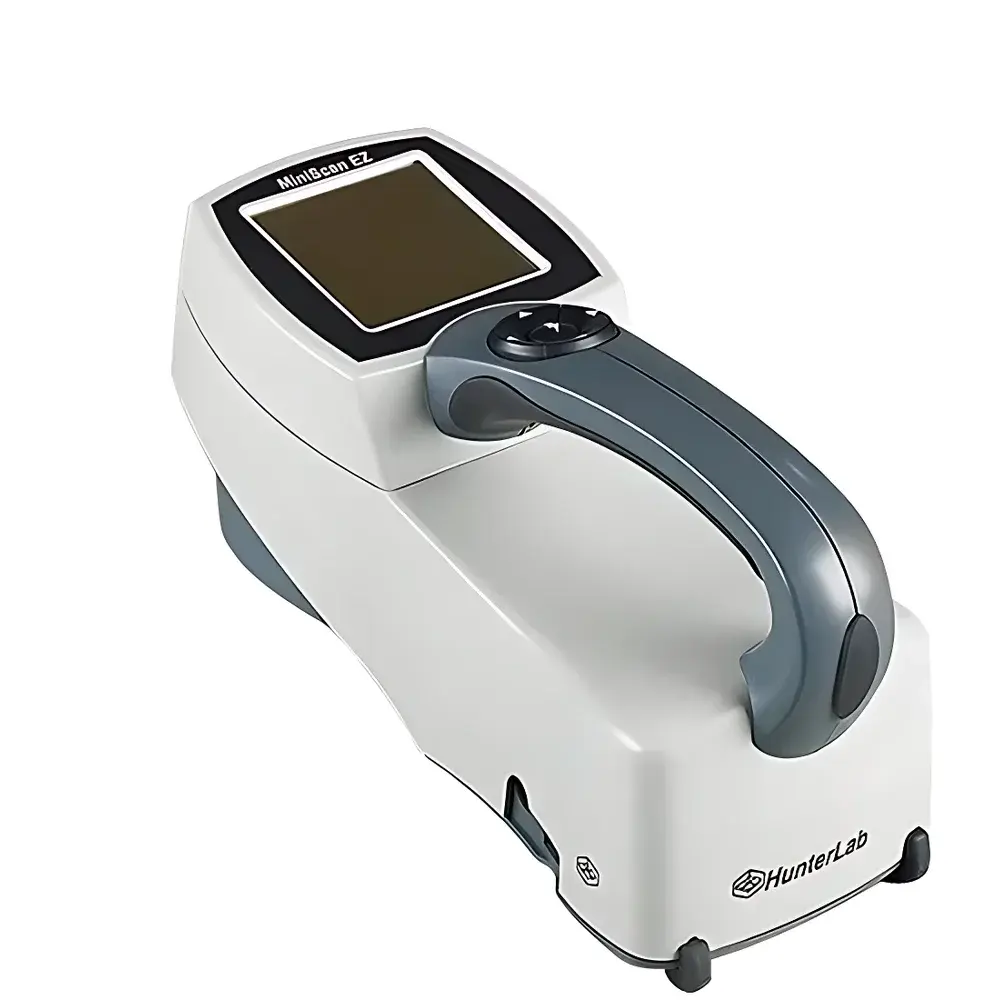
HunterLab MiniScan EZ D/8 Portable Spectrophotometer
| Brand | HunterLab |
|---|---|
| Origin | USA |
| Model | MSEZ D/8 |
| Instrument Type | Portable |
| Optical Geometry | d/8° integrating sphere |
| Light Source | Pulsed Xenon Lamp |
| Spectral Range | 400–700 nm |
| Spectral Resolution | <3 nm |
| FWHM Bandwidth | 10 nm |
| Repeatability | ΔE* ≤ 0.05 (CIE L*a*b* on certified white tile) |
| Aperture Sizes | 14.3 mm (SAV), 25.0 mm (LAV) |
| Photometric Range | 0–150% |
| Detector | 256-element silicon photodiode array with precision grating spectrometer |
| Display | Backlit LCD matrix, rotatable orientation |
| Data Storage | 100 standards (with tolerance limits), 800 measurements |
| Interface | USB |
| Power | Rechargeable lithium-ion battery pack (optional AC adapter) |
Overview
The HunterLab MiniScan EZ D/8 is a portable, high-precision spectrophotometer engineered for reliable color measurement in industrial and quality control environments. Utilizing the CIE-compliant d/8° optical geometry with an integrating sphere, it captures diffuse reflectance across the full visible spectrum (400–700 nm) while minimizing directional bias from surface texture or gloss. Its pulsed xenon lamp provides stable, flash-based illumination with minimal thermal drift—critical for consistent inter-instrument agreement and long-term calibration stability. Unlike filter-based colorimeters, the MiniScan EZ D/8 employs a grating-based monochromator and a 256-element silicon photodiode array to deliver true spectral data at <3 nm resolution (FWHM 10 nm), enabling accurate computation of CIE L*a*b*, CIE XYZ, and other color spaces per ISO 11664 and ASTM E308. Designed for field-deployable operation, it delivers laboratory-grade repeatability (ΔE* ≤ 0.05 on NIST-traceable white tile) without requiring benchtop infrastructure.
Key Features
- Robust single-body housing rated for industrial use—IP54 dust and splash resistance with shock-absorbing elastomer overmold
- Dual aperture configuration: 14.3 mm SAV (small area view) and 25.0 mm LAV (large area view), both compliant with ISO 7724-1 and CIE 15:2004
- Rotatable backlit LCD display supporting landscape/portrait orientation for ergonomic viewing in varied lighting conditions
- Onboard memory stores up to 100 reference standards with user-defined tolerances and 800 measurement records—no external device required for basic pass/fail evaluation
- Integrated “555 Color Tone Coding” algorithm optimized for textile and apparel applications, enabling rapid visual grouping of hue, value, and chroma families
- USB 2.0 interface compatible with Windows-based EasyMatch QC software (optional) for advanced color difference analysis, statistical process control (SPC), and audit-ready reporting
Sample Compatibility & Compliance
The MiniScan EZ D/8 accommodates flat, curved, textured, and semi-gloss surfaces—including coated metals, molded plastics, woven fabrics, paper stocks, food packaging films, and architectural coatings. Its d/8° geometry with specular component included (SCI) mode supports measurement of materials where gloss variability impacts perceived color; optional software toggle enables specular component excluded (SCE) mode for appearance-matching applications. All hardware and firmware comply with IEC 61000-6-3 (EMC emissions) and IEC 61000-6-2 (immunity). Measurement protocols align with ISO 13655 (spectral measurement of reflective materials), ASTM D2244 (color difference calculation), and ISO 9001–certified manufacturing processes. Device firmware supports GLP/GMP traceability via timestamped measurement logs and operator ID fields when used with EasyMatch QC.
Software & Data Management
When connected via USB to a Windows PC, the MiniScan EZ D/8 interfaces seamlessly with HunterLab’s EasyMatch QC software—a validated application supporting 21 CFR Part 11 compliance through electronic signatures, audit trails, and role-based access control. The software enables creation of multi-standard color tolerancing (ellipsoidal, rectangular, or custom), real-time SPC charting (X-bar/R, Cp/Cpk), batch comparison reports, and automated PDF/Excel export. Spectral data is stored in industry-standard .qtx format, ensuring interoperability with third-party color management systems (CMS) and enterprise resource planning (ERP) platforms. Firmware updates are delivered via signed .hex files with cryptographic verification to maintain integrity during field servicing.
Applications
This instrument serves as a primary color verification tool across regulated and non-regulated sectors: incoming raw material inspection in automotive trim suppliers (per GMW14872); shade matching in textile dye houses (aligned with AATCC Evaluation Procedure 1); batch-to-batch consistency checks in plastic injection molding (per ISO 2813 gloss correlation); and packaging color release in FDA-regulated food and pharmaceutical manufacturing. Its portability enables direct measurement on production lines, warehouse staging areas, and supplier audits—reducing reliance on lab-submitted samples and accelerating root-cause analysis of color excursions.
FAQ
Does the MiniScan EZ D/8 support both SCI and SCE measurement modes?
Yes—SCI (specular component included) is the default d/8° mode for total reflectance; SCE (specular component excluded) is enabled via software selection to simulate visual assessment under diffuse lighting.
Is the device suitable for measuring transparent or translucent samples?
No—it is designed exclusively for opaque and diffusely reflecting surfaces. Transmission or haze measurements require dedicated transmission accessories not supported by this model.
Can measurement data be exported in CSV or XML format for integration with LIMS?
Yes—EasyMatch QC supports configurable export templates for CSV, XML, and .qtx formats, including metadata such as date/time, operator ID, standard name, and ΔE values.
What is the recommended calibration frequency and traceability path?
HunterLab recommends annual recalibration using NIST-traceable ceramic tiles; onboard calibration verification is performed automatically at startup using internal reference standards.
Is firmware update capability available in the field without sending the unit to service?
Yes—updates are delivered as signed firmware packages via USB connection and require no disassembly or special tools.




