
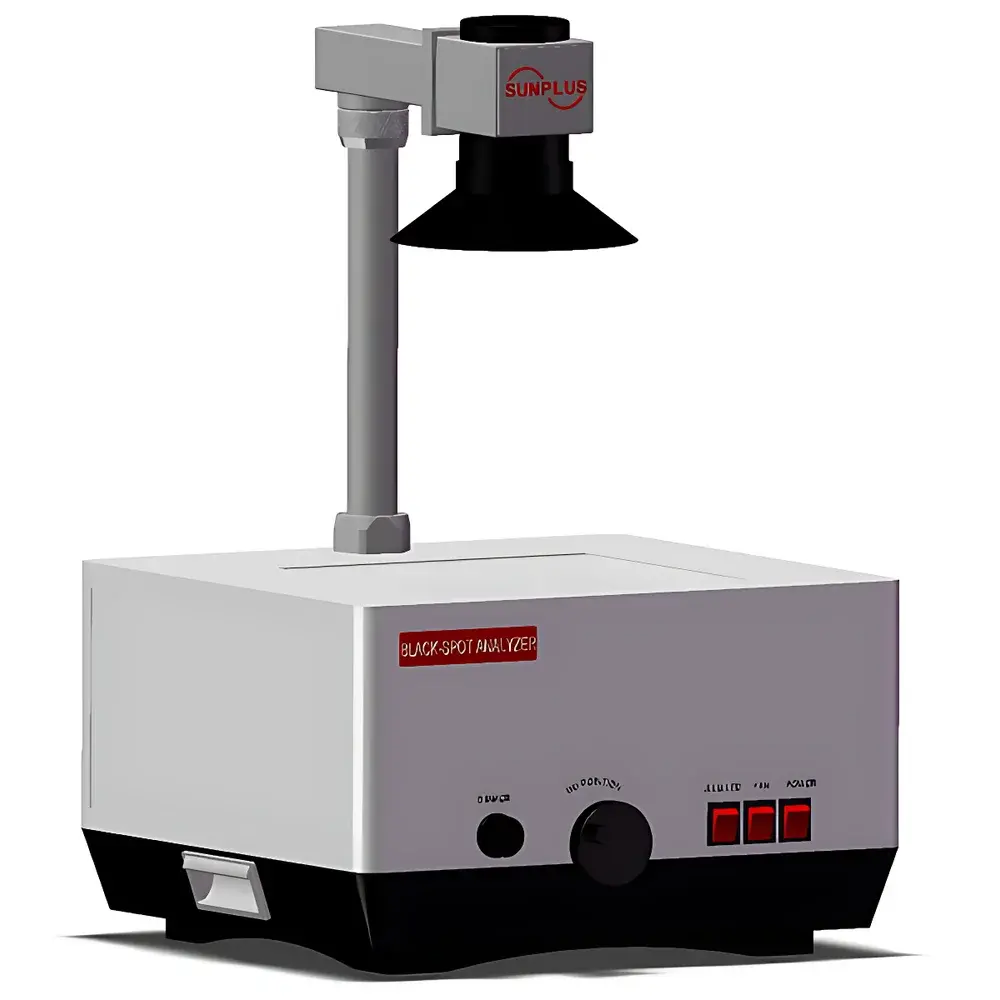
HunterLab SP-BS-1908 Powder Particle Contaminant Scanner
| Brand | HunterLab |
|---|---|
| Origin | Canada |
| Model | SP-BS-1908 Powder Particle |
| Minimum Detectable Size | 0.1 mm |
| Detection Accuracy | < 0.035 mm |
| Scanning Area | ≥ 200 × 200 mm |
| Optical Magnification | >20× |
| Light Source | 24 V / 60 W |
| Illuminance | ≥ 6000 lm |
| Power Supply | 220 V, 50 Hz |
| Dimensions | ~459 × 426 × (276 + 380) mm |
Overview
The HunterLab SP-BS-1908 Powder Particle Contaminant Scanner is a high-precision optical inspection system engineered for quantitative analysis of foreign particulate contaminants—particularly black specks, carbonized residues, and intrinsic defects—in polymer-based granular and film materials. Operating on the principle of high-contrast transmitted-light imaging combined with calibrated digital image analysis, the instrument enables objective, repeatable assessment of contaminant morphology, spatial distribution, and area-weighted concentration in accordance with internationally recognized quality control protocols. Designed specifically for resin pellets (e.g., PP, PE, PVC, PPS), thin films, and opaque or semi-transparent sheets, the SP-BS-1908 eliminates subjective visual grading by replacing human judgment with traceable, metrologically anchored measurements. Its optical architecture features uniform, high-luminance (≥6000 lm) illumination at 24 V / 60 W, ensuring consistent contrast across diverse material thicknesses and optical densities without requiring pre-treatment such as backing or dyeing—a critical advantage for inline QC in extrusion and compounding facilities.
Key Features
- Automated detection and classification of black specks, charred particles, and internal structural anomalies based on user-defined size thresholds (0.1 mm to ≥1.2 mm, selectable via software interface)
- High-fidelity imaging at >20× effective magnification with sub-0.035 mm measurement accuracy and ≥0.1 mm minimum resolvable feature size
- Full-field scanning over a ≥200 × 200 mm active area, accommodating standard 200 mm × 200 mm transparent trays for batch pellet inspection
- Real-time zoom-in/out functionality for detailed morphological evaluation of individual defects and surface striations
- Integrated mapping algorithm that generates spatial distribution heatmaps for both contaminant count density and area coverage ratio
- Batch-mode analysis with automatic sample orientation alignment—feeding direction synchronized with display motion vector for intuitive operator interaction
- Zero-prep inspection of transparent films: direct placement on the illuminated platform without black backing, adhesive tapes, or chemical treatment
Sample Compatibility & Compliance
The SP-BS-1908 supports rigorous inspection of thermoplastic and thermoset polymer forms including virgin and regrind pellets, blown or cast films (up to 500 µm thickness), and rigid sheets. It complies with measurement principles referenced in ASTM D7209 (Standard Guide for Evaluation of Plastics for Use in Packaging), ISO 18064 (Plastics — Polyolefin resins — Specification), and USP (Plastic Packaging Systems for Pharmaceutical Use). While not certified to GLP or GMP out-of-the-box, its audit-ready data export, timestamped reports, and calibration traceability (via included NIST-traceable standard plate) support validation under FDA 21 CFR Part 11 when deployed with appropriate IT governance controls. All measurement parameters—including threshold definitions, pixel-to-mm conversion factors, and illumination settings—are fully configurable and logged per analysis session.
Software & Data Management
The proprietary application software provides a validated Windows-based environment for acquisition, segmentation, quantification, and reporting. Each scan generates a structured dataset containing total particle count, size-frequency histogram (binned per user-specified intervals), cumulative area fraction (%), and XY coordinate map. Reports are exportable in PDF (print-ready) and CSV (for statistical process control integration) formats. Audit trails record operator ID, date/time stamp, calibration status, and all parameter modifications. Software supports multi-standard configuration—preloaded templates align with common industry specifications (e.g., ISO 22088-3 for polymer contamination, JIS K 6758 for polypropylene pellets)—and allows custom rule sets for internal QC limits. Data storage is local (SSD-equipped workstation) with optional network backup via SMB or FTP.
Applications
- Quality assurance of polymer feedstock in compounding and injection molding facilities
- Root-cause analysis of black speck formation during extrusion—correlating defect morphology with screw wear, thermal degradation, or contamination ingress points
- Supplier qualification testing per contractual impurity limits (e.g., ≤5 black specks >0.3 mm per 100 g)
- Process capability studies (Cpk/Ppk) for contaminant metrics across production shifts
- Regulatory documentation for pharmaceutical packaging polymers requiring low-particulate certification
- R&D screening of stabilizer packages and antioxidant efficacy against thermal discoloration
FAQ
Does the SP-BS-1908 require sample preparation for opaque pellets?
No—pellets are placed directly into the supplied 200 mm × 200 mm transparent tray; no grinding, slicing, or mounting is needed.
Can the system distinguish between surface and subsurface defects in films?
Yes—the high-intensity transmitted illumination combined with adjustable focus enables differentiation of surface-adherent particles from embedded or laminar defects based on edge sharpness and contrast gradient.
Is calibration traceable to national standards?
Yes—the included standard plate is certified with NIST-traceable dimension markings and is used for daily verification of pixel-to-mm scaling and illumination uniformity.
What file formats does the software support for raw image export?
TIFF (16-bit grayscale) and PNG (lossless compression) are supported for third-party image analysis or archival purposes.
How is measurement repeatability ensured across operators?
Through standardized SOP-driven workflows, locked parameter templates, and mandatory login authentication—each report embeds operator ID, session timestamp, and full configuration metadata.



