
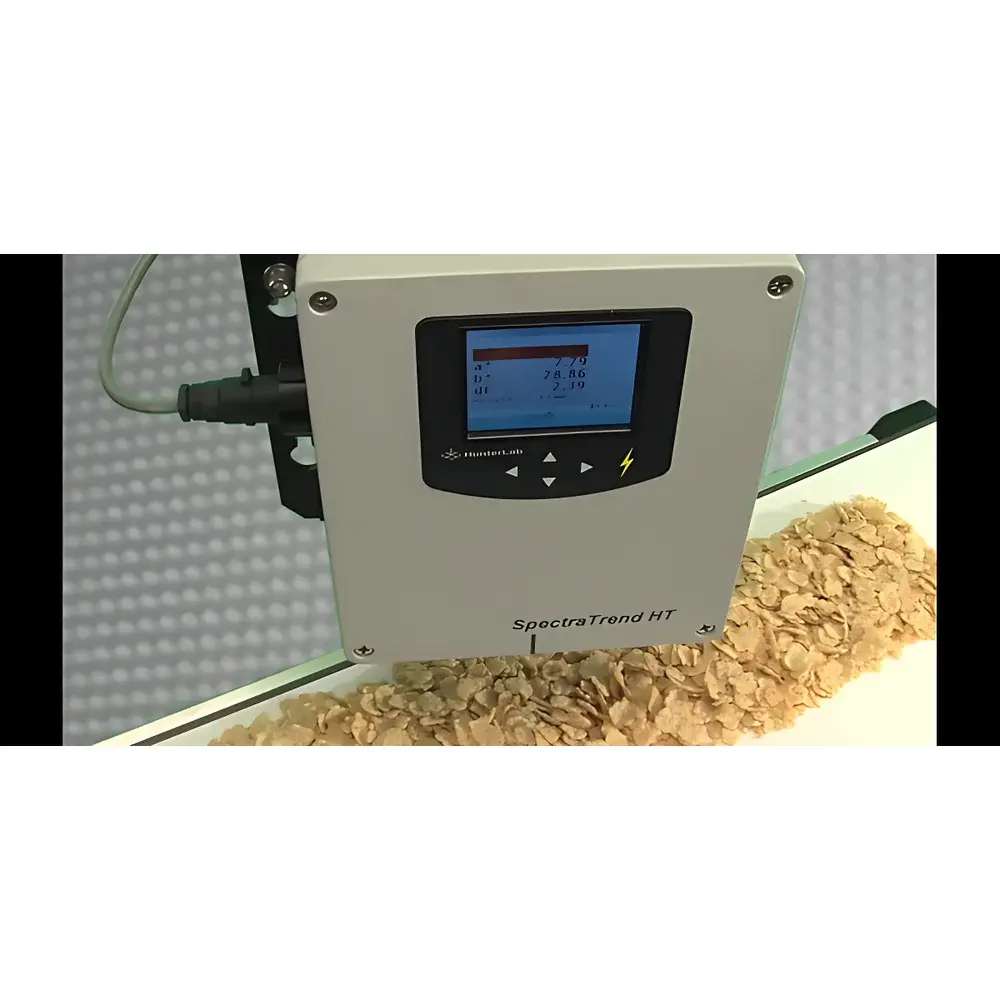
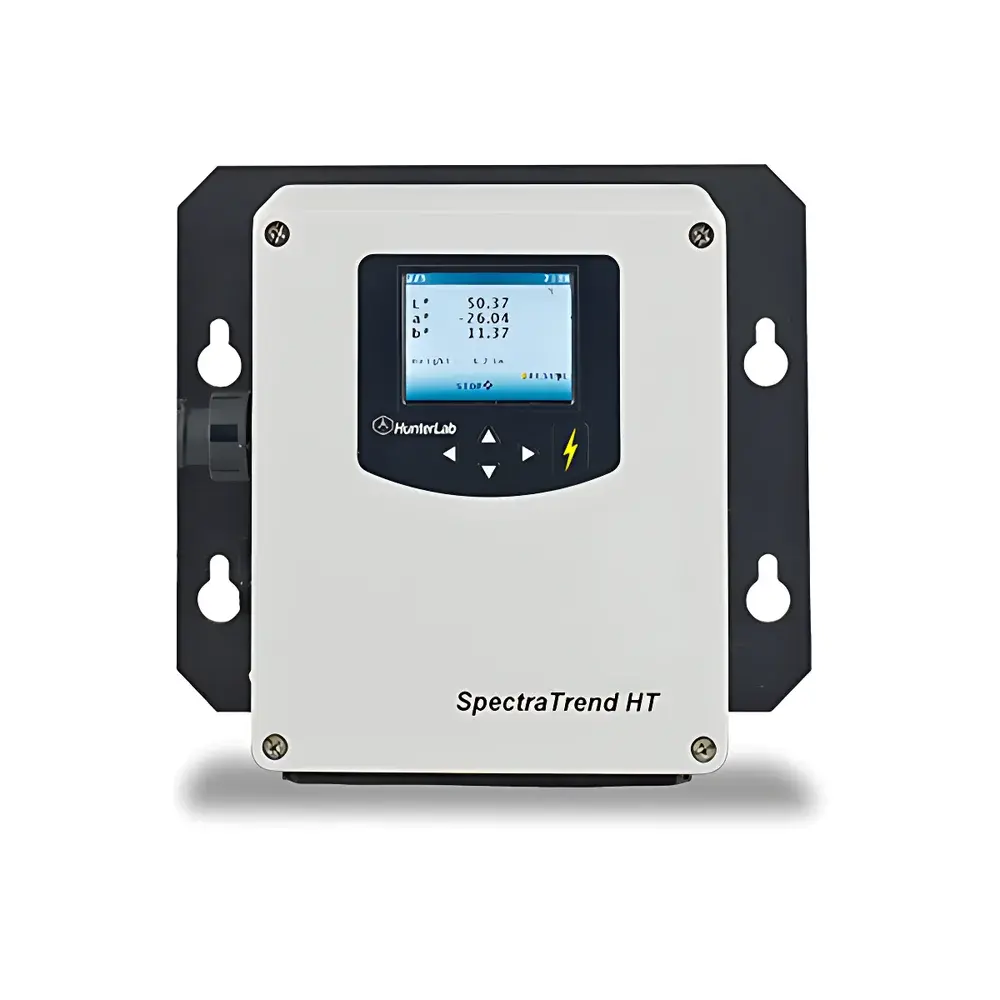
HunterLab SpectraTrend HT In-Line Leather Color Measurement System
| Brand | HunterLab |
|---|---|
| Origin | USA |
| Product Type | Spectrophotometric Colorimeter |
| Instrument Type | In-Line |
| Optical Geometry | 0/45° Integrating Sphere |
| Light Source | Full-Spectrum Balanced Solid-State LED System |
| Spectral Range | 400–700 nm |
| Repeatability | ΔE*ab ≤ 0.03 |
| Compliance | LQM, PAT, Six Sigma, DMAIC, GMP-aligned |
| Data Synchronization | Lab-Grade Color Consistency with HunterLab Benchtop Instruments |
Overview
The HunterLab SpectraTrend HT is a purpose-engineered in-line spectrophotometric color measurement system designed exclusively for continuous, non-contact color monitoring of leather during wet-blue, crust, and finished tanning stages. Operating on the principle of diffuse reflectance spectroscopy within the CIE standard visible spectrum (400–700 nm), it employs a high-stability 0/45° integrating sphere optical architecture to deliver metrologically traceable color data under dynamic production conditions. Unlike legacy spot-check or manual sampling approaches, the SpectraTrend HT integrates directly into conveyor-based leather processing lines—enabling real-time spectral acquisition at up to 10 Hz sampling frequency across full-width web movement. Its solid-state LED illumination ensures spectral stability over time and temperature, eliminating lamp drift and reducing calibration dependency. The system is engineered for ISO/IEC 17025-aligned traceability and supports seamless integration into enterprise-level quality management systems (QMS) through standardized OPC UA and Modbus TCP protocols.
Key Features
- Full-width automated traverse mechanism with programmable lateral scanning range (up to 1,200 mm), enabling representative cross-web color profiling without mechanical interruption.
- Integrated height-sensing capability via dual-wavelength triangulation, allowing simultaneous measurement of surface topography and color—critical for corrugated, embossed, or uneven leather substrates.
- Self-calibrating optical path with user-definable auto-correction intervals (from 1 minute to 24 hours), eliminating manual intervention and associated safety exposure risks in high-moisture tannery environments.
- Acoustic-optical alarm system with zone-specific threshold triggers, providing immediate visual and audible alerts upon detection of out-of-specification ΔE*ab deviations exceeding configurable limits.
- Robust IP65-rated enclosure with corrosion-resistant stainless-steel housing and sealed optical windows, rated for continuous operation in ambient humidity >90% RH and ambient temperatures from 5°C to 45°C.
- Embedded spectral data logging with onboard 32 GB industrial-grade flash storage, retaining raw spectra, metadata, and timestamped event logs for ≥12 months at default 1 Hz capture rate.
Sample Compatibility & Compliance
The SpectraTrend HT accommodates natural and synthetic leathers across all major tanning processes—including chrome, vegetable, aldehyde, and combination tanned materials—with variable thickness (0.5–5.0 mm), surface finish (aniline, semi-aniline, pigmented, nubuck), and moisture content (12–35% w/w). It conforms to ASTM D2244 (Standard Practice for Calculation of Color Tolerances), ISO 11664-4 (CIE colorimetric observers), and USP guidelines for instrumental color assessment. All firmware and data handling modules comply with FDA 21 CFR Part 11 requirements for electronic records and signatures, including audit trail generation, role-based access control, and immutable data archiving. System validation documentation (IQ/OQ/PQ protocols) is provided per GMP and ICH Q7 standards for regulated pharmaceutical and medical device contract manufacturing facilities utilizing leather-derived components.
Software & Data Management
SpectraTrend HT operates with HunterLab’s EnterpriseColor™ v5.2 software suite, supporting both local HMI and remote SCADA integration. The platform delivers real-time CIELAB (L*, a*, b*), CMC(2:1), and DIN99d color difference metrics alongside spectral reflectance curves (10 nm resolution). Batch-level statistical process control (SPC) charts—including X-bar/R, Cpk, and multivariate PCA—are generated automatically and exported in CSV, XML, or PDF formats compliant with ASQ/ANSI Z1.4 sampling standards. Raw spectral data is encrypted using AES-256 and synchronized bidirectionally with laboratory-grade HunterLab UltraScan VIS instruments—ensuring <±0.02 ΔE*ab inter-instrument agreement across site-wide networks. All data transactions are logged with NIST-traceable timestamps and support GLP-compliant electronic signature workflows.
Applications
- Real-time correction of dye bath chemistry during drum dyeing and spray finishing operations.
- Automated rejection of off-shade hides prior to splitting or finishing—reducing scrap rates by up to 37% in pilot deployments.
- Quantitative validation of color consistency across multi-shift production runs under varying ambient lighting and operator conditions.
- Support for Process Analytical Technology (PAT) initiatives in FDA-regulated cosmetic ingredient supply chains where leather-derived collagen matrices are employed.
- Long-term trend analysis of chromophore degradation in automotive upholstery exposed to UV-accelerated aging cycles.
FAQ
How does the SpectraTrend HT maintain color accuracy across varying leather surface textures?
It utilizes synchronized height mapping and adaptive gain control to normalize reflectance signals against local surface geometry—eliminating specular interference and compensating for micro-roughness-induced scattering variance.
Can the system interface with existing MES or ERP platforms?
Yes—via native OPC UA server implementation with preconfigured tags for L*, a*, b*, ΔE*ab, pass/fail status, and timestamped anomaly events; custom API wrappers available for SAP S/4HANA and Siemens Opcenter.
What is the recommended calibration verification schedule for GMP compliance?
Daily verification using NIST-traceable ceramic tile standards (certified SRM 2036) is required; full recalibration every 6 months by HunterLab-certified field service engineers with documented uncertainty budgets.
Is spectral data export compatible with third-party chemometric modeling tools?
Yes—raw .jdx and .csv spectral files include wavelength-indexed reflectance values with embedded instrument metadata, fully importable into Unscrambler®, MATLAB®, and Python-based scikit-learn pipelines.



