
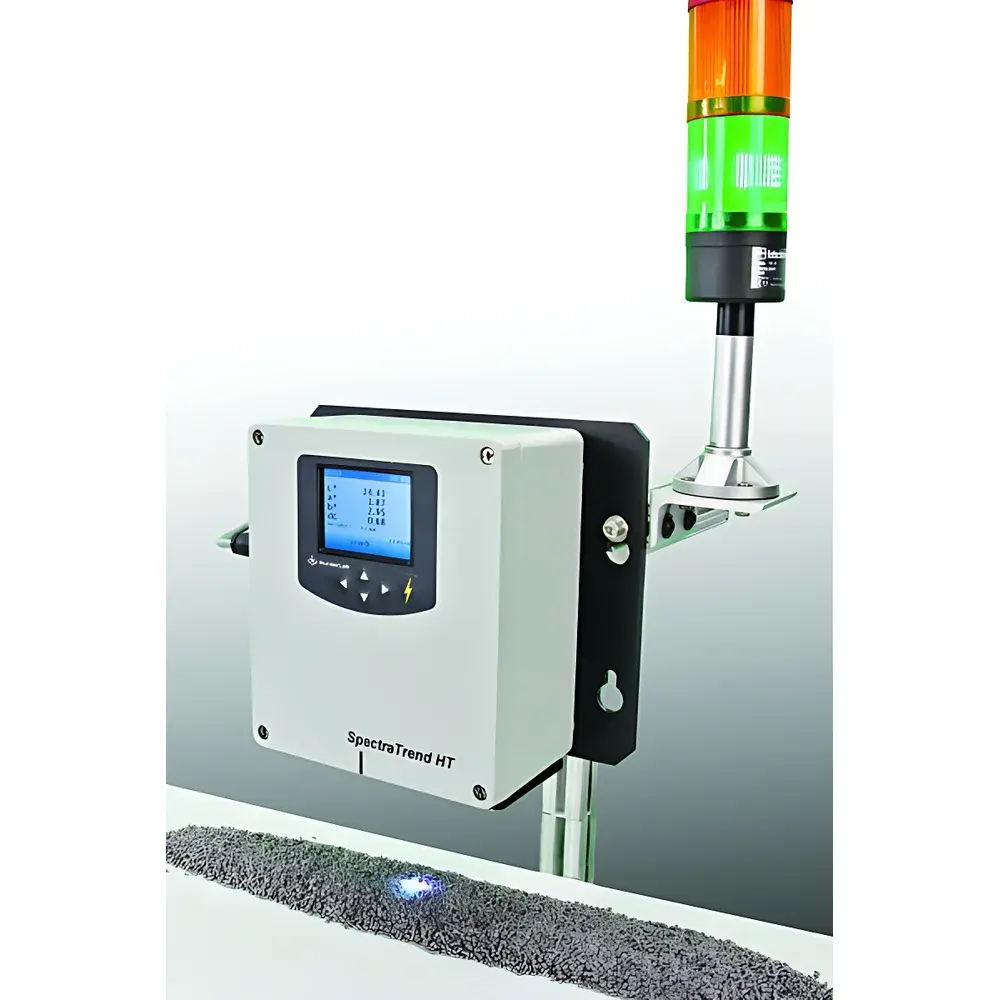
HunterLab SpectraTrend-HT Online Paper Color & Height Measurement System
| Brand | HunterLab |
|---|---|
| Origin | USA |
| Manufacturer Type | Authorized Distributor |
| Origin Category | Imported |
| Model | SpectraTrend-HT Online Paper Color & Height Measurement System |
| Price Range | USD 26,000 – 39,000 (FOB) |
| Measurement Principle | Reflectance-based spectrophotometry (CIE-compliant, D65/10°) |
| Optical Geometry | 45°/0° (annular illumination, directional viewing) |
| Spectral Bandwidth | 10 nm |
| Wavelength Range | 400–700 nm |
| Measurement Distance | Up to 100 mm (4 in) |
| Sampling Rate | 5 Hz |
| IP Rating | NEMA 4 / IP56 |
| Interface | Ethernet (TCP/IP), PLC-compatible digital I/O |
| Software Platform | HunterLab EasyMatch QC v5.0+ (FDA 21 CFR Part 11 compliant audit trail option) |
Overview
The HunterLab SpectraTrend-HT Online Paper Color & Height Measurement System is an industrial-grade, non-contact spectrophotometric sensor engineered for real-time, in-line color and topographic height monitoring of paper, board, tissue, and coated substrate webs during high-speed converting, coating, and finishing operations. Operating on CIE-compliant reflectance spectrophotometry with 45°/0° optical geometry, the system delivers laboratory-grade colorimetric accuracy (ΔE*ab < 0.15 on standard white tiles, per ASTM E308 and ISO 11664-4) under dynamic production conditions. Its dual-sensor architecture simultaneously captures spectral reflectance data (400–700 nm, 10 nm FWHM) and precise vertical displacement—enabling automatic height compensation for variable web lift, caliper variation, or misalignment-induced measurement drift. Unlike conventional color sensors, the SpectraTrend-HT does not require physical contact, mechanical calibration fixtures, or operator intervention; it maintains traceable color fidelity across shifts, batches, and multi-site installations.
Key Features
- Simultaneous color + height measurement at 5 Hz sampling rate—enabling synchronized process feedback for closed-loop control
- Non-contact 45°/0° optical design with stable LED illumination (lifetime > 50,000 hours), eliminating lamp drift and thermal instability
- Automatic height compensation algorithm corrects CIELAB values in real time for sample distance variations up to ±25 mm from nominal 100 mm standoff
- NEMA 4 / IP56-rated aluminum housing suitable for humid, dusty, or washdown-prone environments common in paper mills and packaging lines
- Integrated height detection logic enables conditional triggering: measurements occur only when a valid sample is present within user-defined height tolerance bands
- Background suppression capability discriminates target substrate color from conveyor belt, carrier plate, or ambient surface reflectance
- Ethernet-native communication (TCP/IP stack) supports direct integration with SCADA, MES, and PLC systems without serial adapters or distance-limited RS-232 cabling
Sample Compatibility & Compliance
The SpectraTrend-HT is validated for continuous monitoring of uncoated and coated paper grades (e.g., kraft, bleached sulfate, LWC, MFC), corrugated board, nonwovens, and thin-film laminates with gloss levels ranging from matte to semi-gloss. It complies with ISO 2470-1 (brightness), ISO 2471 (opacity), TAPPI T485 (color), and ASTM D2244 (color difference). When configured with GLP/GMP mode in EasyMatch QC software, the system supports full 21 CFR Part 11 compliance—including electronic signatures, audit trails, role-based access control, and immutable data archiving—making it suitable for regulated quality systems in food-contact paper manufacturing (e.g., FDA 21 CFR 176.170 compliant packaging).
Software & Data Management
HunterLab EasyMatch QC v5.0+ provides a browser-accessible, role-secured interface for configuration, visualization, and reporting. Real-time dashboards display L*a*b*, ΔE*ab, whiteness (CIE/ISO), yellowness (ASTM E313), and absolute height (mm) per measurement cycle. Trend charts support SPC analysis (X-bar/R, Cpk/Ppk) with configurable control limits and automated pass/fail flagging against AQL-based tolerances. Raw spectral data (31-point or 100-point), reflectance curves, and CSV exports are stored locally or pushed via FTP/SFTP to central LIMS or ERP platforms. Custom report templates—exportable to PDF or Microsoft Excel—include batch summaries, shift logs, deviation heatmaps, and spectral overlay comparisons across master standards.
Applications
- Real-time color consistency verification during paper machine reel-up and coating line start-up
- Web-to-web color matching in multi-layer laminating processes (e.g., food wrap composites)
- Height-guided thickness uniformity assessment for caliper-sensitive grades (e.g., tissue, label stock)
- Automated rejection triggering in vision-guided sorting of printed board blanks
- Statistical process control of optical brightener dosage in deinked pulp blends
- Validation of post-conversion treatments (e.g., corona discharge, plasma activation) via surface reflectance shift tracking
FAQ
Does the SpectraTrend-HT require periodic recalibration with physical standards?
No—its solid-state LED source and thermally stabilized diffraction grating eliminate routine recalibration. Annual verification using NIST-traceable ceramic tiles is recommended for ISO/IEC 17025 accreditation.
Can it measure through transparent or semi-transparent films?
Yes, when used with optional back-illumination or black backing reference, provided the film’s transmission profile falls within the 400–700 nm range and exhibits minimal scattering.
How is height data integrated into color correction?
Height-derived distance offset feeds into a proprietary BRDF compensation model that adjusts spectral weighting per CIE 15:2018 guidelines—ensuring consistent L*a*b* under variable measurement geometry.
Is OPC UA or MQTT protocol support available?
Native support is Ethernet TCP/IP and Modbus TCP; OPC UA and MQTT gateways are supported via third-party industrial middleware (e.g., Kepware, Ignition) certified by HunterLab Integration Partners.
What is the minimum detectable height change?
Resolution is ±0.1 mm at 100 mm standoff, with repeatability of ±0.05 mm over 24-hour continuous operation under stable ambient temperature (±2°C).





