
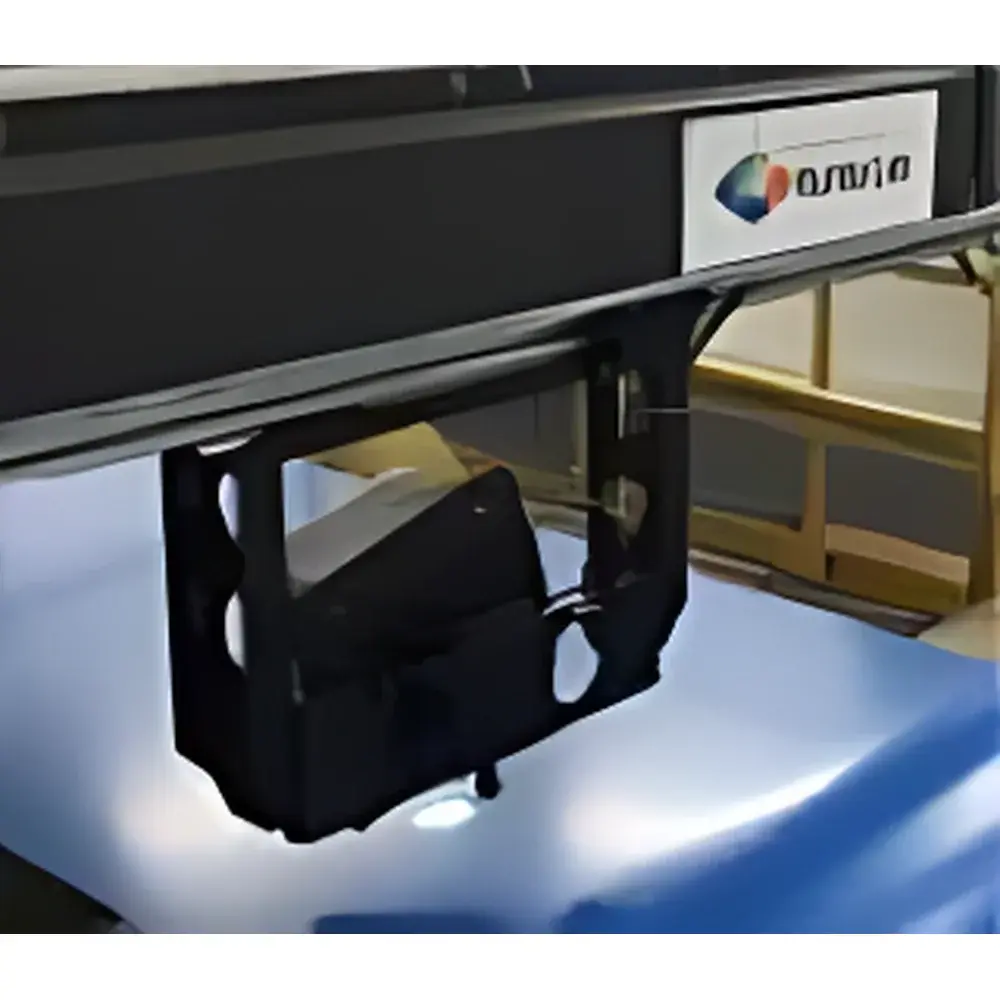
HunterLab STOL-M Online Color Measurement System for Plastics
| Brand | HunterLab |
|---|---|
| Origin | USA |
| Manufacturer Type | Authorized Distributor |
| Product Category | Imported |
| Model | STOL-M |
| Product Type | Spectrophotometric Colorimeter |
| Instrument Type | In-Line |
| Optical Geometry | 0°/45° Integrating Sphere |
| Light Source | Full-Spectrum LED |
| Spectral Range | 400–700 nm |
| Repeatability | ΔE*ab ≤ 0.03 |
Overview
The HunterLab STOL-M Online Color Measurement System is an industrial-grade, in-line spectrophotometer engineered specifically for real-time color monitoring and control in thermoplastic extrusion, injection molding, film casting, and compounding production lines. Unlike benchtop or handheld colorimeters, the STOL-M integrates directly into the manufacturing environment—mounted adjacent to or above the extrudate, melt stream, or conveyed sheet—to perform non-contact, continuous spectral acquisition at process speed. Its measurement principle is based on diffuse reflectance spectroscopy under standardized 0°/45° illumination geometry (per ASTM E308 and ISO/CIE 15:2004), ensuring metrological traceability to NIST-traceable standards. The full-spectrum LED source delivers stable, flicker-free irradiance across the visible range (400–700 nm) with minimal thermal drift, enabling high-fidelity spectral data capture even under variable ambient lighting or elevated plant temperatures. Designed for 24/7 operation in Class III industrial environments, the STOL-M provides objective, quantitative color data—expressed in CIE L*a*b*, ΔE*ab, Yellowness Index (YI), Whiteness Index (WI), and custom user-defined metrics—to support closed-loop color correction and statistical process control (SPC).
Key Features
- In-line, non-contact measurement architecture with IP65-rated housing for dust- and splash-resistant operation in demanding plastic processing environments.
- Automated full-width traverse mechanism enables consistent scanning across wide extrudates (up to 2 m width), with programmable scan speed and dwell time per position.
- Self-calibrating optical path: integrated ceramic reference tile and motorized calibration shutter enable scheduled or event-triggered recalibration without manual intervention—reducing operator exposure risk and eliminating downtime associated with manual standardization.
- Acoustic-optical alarm system triggers visual (strobe) and audible alerts upon detection of color deviation beyond user-defined thresholds, supporting immediate operator response or automated line intervention.
- Embedded memory logs all out-of-spec events—including timestamp, spatial coordinates, spectral reflectance curves, and derived color indices—with exportable CSV and XML metadata for root-cause analysis.
- Optical design conforms to CIE 15:2004 and ASTM D2244, ensuring cross-platform comparability with laboratory-grade HunterLab instruments (e.g., UltraScan VIS, MiniScan EZ) and compliance with internal QC protocols.
Sample Compatibility & Compliance
The STOL-M accommodates a broad range of plastic forms—including molten strands, pellets, films, sheets, profiles, and molded parts—regardless of surface texture (glossy, matte, textured) or translucency (within practical limits for 0°/45° geometry). It supports both opaque and semi-opaque substrates; for highly translucent or backlit materials, optional auxiliary masking or background plates may be deployed. All firmware and data handling comply with FDA 21 CFR Part 11 requirements for electronic records and signatures when configured with audit trail logging and user access controls. The system meets CE marking directives (EMC 2014/30/EU, RoHS 2011/65/EU) and operates within industrial temperature/humidity ranges (0–50 °C, 10–90% RH non-condensing). Calibration traceability is maintained through annual verification against NIST-traceable ceramic standards.
Software & Data Management
The STOL-M operates via HunterLab’s proprietary EasyMatch QC Enterprise software platform, deployable on local industrial PCs or integrated into existing MES/SCADA infrastructures via OPC UA or Modbus TCP. Real-time dashboards display live spectral plots, trending charts (X-bar/R, Cpk), and spatial heatmaps overlaid on production line schematics. Historical datasets are stored in a secure SQL database with configurable retention policies and role-based access (administrator, operator, QA reviewer). All color measurements include embedded metadata: instrument ID, calibration timestamp, environmental sensor readings (optional ambient light/temperature), and operator logon credentials. Audit trails record every configuration change, calibration event, and data export—fully compliant with GLP and GMP documentation requirements.
Applications
- Real-time color consistency validation during polyolefin (PP, PE), engineering resin (PC, ABS, PA), and masterbatch extrusion.
- End-point detection in color concentrate blending operations to minimize over-addition and raw material waste.
- Quality gate enforcement prior to packaging or shipment—automated pass/fail decisions based on multi-parameter tolerancing (e.g., L* ±0.5, a* ±0.2, b* ±0.2, YI < 2.5).
- Correlation studies between in-line STOL-M data and lab-based spectrophotometry to validate method equivalence per ASTM D6290.
- Troubleshooting pigment dispersion issues, thermal degradation (e.g., yellowing onset), or batch-to-batch resin variability.
FAQ
How does the STOL-M ensure measurement consistency with lab-based HunterLab instruments?
It uses identical optical geometry (0°/45°), spectral bandpass (<5 nm FWHM), and CIE colorimetric computation algorithms as benchtop models—validated through inter-instrument agreement studies per ASTM E2539.
Can the STOL-M be integrated with PLC-controlled production lines?
Yes—native support for EtherNet/IP, PROFINET, and Modbus TCP enables direct communication with major PLC platforms (Siemens, Rockwell, Beckhoff) for triggering measurements, receiving alarms, or feeding color feedback into PID controllers.
What maintenance is required beyond scheduled calibration?
Annual verification of optical alignment and LED output stability is recommended; no consumables or lamp replacements are needed due to solid-state LED lifetime exceeding 50,000 hours.
Is remote diagnostics supported?
Yes—via secure TLS-encrypted VNC or TeamViewer sessions with pre-authorized access levels, enabling HunterLab-certified engineers to perform firmware updates, spectral diagnostics, and configuration audits without on-site visits.




