
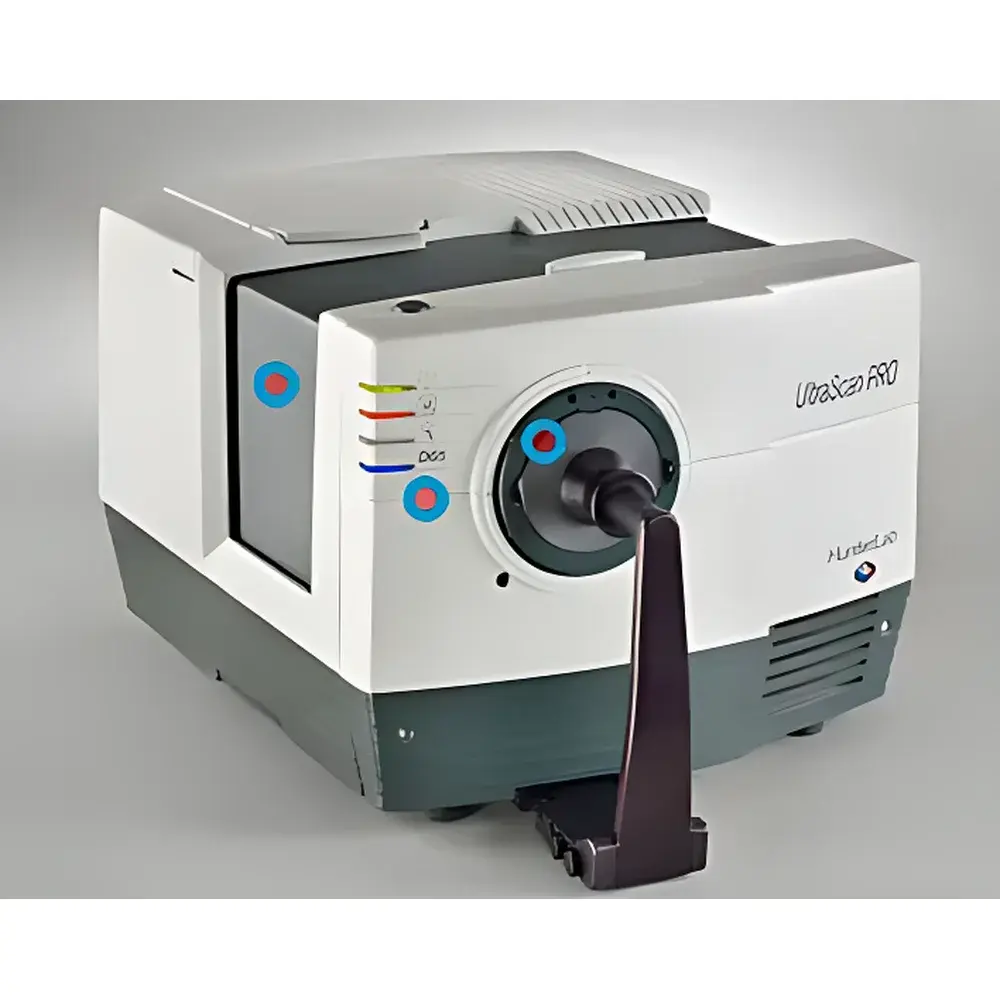
HunterLab UltraScan PRO Spectrophotometer
| Brand | HunterLab |
|---|---|
| Origin | USA |
| Model | UltraScan PRO |
| Product Type | Color Measurement Spectrophotometer |
| Instrument Type | Benchtop (Not Online) |
| Optical Geometry | d/8° integrating sphere with specular component included/excluded (SCI/ SCE) |
| Wavelength Range | 360–1050 nm |
| Optical Resolution | 5 nm (2 nm data acquisition interval, reported at 5 nm) |
| Repeatability | < 0.08 ΔE*₀₀ (typical, based on CIE standard conditions) |
| Light Source | Pulsed Xenon Arc Lamp (triple-lamp system) |
| UV Calibration | D65 illuminant with UV control for fluorescent whitening agent (FWA) measurement |
| Software | EasyMatch QC (21 CFR Part 11 compliant version available) |
| Compliance | ASTM E308, ASTM D2244, ISO 7724, ISO 11664, CIE No. 15, USP <631>, FDA-compliant audit trail capability |
Overview
The HunterLab UltraScan PRO Spectrophotometer is a high-precision, benchtop color measurement instrument engineered for rigorous scientific research and industrial quality control. It operates on the principle of diffuse d/8° geometry with an integrating sphere—compliant with CIE, ASTM, and ISO definitions for colorimetric measurement—and supports both SCI (Specular Component Included) and SCE (Specular Component Excluded) modes via automated port configuration. Its optical architecture employs a triple-pulsed xenon arc lamp system, eliminating thermal drift, minimizing ambient light interference, and requiring no warm-up time. The instrument acquires spectral data at 2 nm intervals across a broad 360–1050 nm range and reports results at standardized 5 nm intervals, delivering high-fidelity reflectance, transmittance, and haze measurements. Designed to meet regulatory requirements for pharmaceutical, food, paint, plastics, and optical coating industries, the UltraScan PRO is validated for compliance with USP , ASTM E308 (for color difference calculation), and ISO 11664 (CIE colorimetry standards). Its robust mechanical construction—including a vibration-damped stainless-steel optical platform, precision-machined sphere coating, and thermally stable electronics—ensures long-term measurement stability and inter-instrument agreement.
Key Features
- Triple-pulsed xenon lamp system: Provides consistent spectral output without heat generation or warm-up delay; enables rapid (<2 s) full-spectrum measurement from 360 to 1050 nm
- Automated SCI/SCE mode switching: Enables seamless evaluation of surface texture and gloss effects in reflectance measurements
- Three selectable aperture sizes: Large Area View (LAV, 25 mm), Small Area View (SAV, 13 mm), and Extra-Small Area View (XSAV, 7 mm) for flexible sample targeting
- D65 illuminant with active UV calibration: Precisely controls ultraviolet energy to quantify fluorescence from optical brighteners and UV-absorbing materials
- Expanded spectral coverage: Extends into near-UV (360 nm) and near-IR (1050 nm) regions for characterization of UV-blocking films, solar lenses, and NIR-responsive pigments
- High-accuracy transmittance chamber: Fully openable three-sided design accommodates oversized, irregular, or containerized samples—including cuvettes as small as 0.4 mL
- Integrated hardware indicators and ergonomic sample stage: Visual status feedback and adjustable support ensure operator consistency and reproducible positioning
Sample Compatibility & Compliance
The UltraScan PRO measures opaque solids, translucent gels, clear liquids, thin films, coated glass, and powdered materials without modification. Its large transmittance compartment accepts bottles, panels, and molded parts up to 50 mm thick. For reflectance, it handles textured surfaces (e.g., carpet, fabric, tiles), glossy finishes (e.g., automotive paint, lacquered wood), and low-reflectance substrates (e.g., black plastics, carbon composites). All optical components—including sphere interior coating and detector optics—are traceably calibrated against NIST-traceable standards. The system supports GLP/GMP workflows through optional 21 CFR Part 11–compliant software modules, including electronic signatures, audit trails, and user-access controls. It meets ASTM D1003 for haze measurement, ISO 13655 for spectral reflectance, and USP for pharmaceutical color assessment.
Software & Data Management
EasyMatch QC software provides full instrument control, spectral analysis, pass/fail tolerancing, and statistical process monitoring. It supports multi-instrument network synchronization, custom metric definition (e.g., ΔE*₀₀, ΔEcmc, Yellowness Index), and export to LIMS or ERP systems via CSV, XML, or ODBC. Version 5.0+ includes built-in 21 CFR Part 11 functionality: role-based permissions, electronic signatures, immutable audit logs, and secure data archiving. Raw spectral data (360–1050 nm @ 2 nm) and calculated colorimetric values (CIELAB, CMC, DIN99, etc.) are stored with full metadata—including date/time stamp, operator ID, calibration history, and measurement geometry settings.
Applications
- Pharmaceuticals: Quantification of tablet color uniformity, capsule shell tint, and excipient batch variation per USP
- Optics & Coatings: Measurement of anti-reflective, UV-filtering, and IR-reflective performance on lenses, solar films, and architectural glass
- Plastics & Polymers: Evaluation of pigment dispersion, thermal degradation, and weathering-induced hue shift in injection-molded parts and extruded sheets
- Food & Beverage: Objective assessment of fruit juice clarity, dairy product whiteness, and confectionery coating consistency
- Textiles & Automotive: Color matching of dyed fabrics, leather trims, and painted body panels under multiple illuminants (D65, A, F2)
- Chemicals & Inks: Spectral fingerprinting of dyes, pigments, and fluorescent additives for formulation QC and regulatory documentation
FAQ
Is the UltraScan PRO suitable for measuring fluorescent samples?
Yes—the instrument uses a D65 illuminant with programmable UV energy control and real-time spectral correction, enabling accurate quantification of fluorescent whitening agents (FWAs) and optically brightened materials.
Does it support regulatory compliance for pharmaceutical manufacturing?
Yes—when configured with EasyMatch QC v5.0+, it delivers full 21 CFR Part 11 compliance, including electronic signatures, audit trails, and secure user authentication.
Can it measure haze in transparent materials?
Yes—it complies with ASTM D1003 and ISO 14782 for total transmittance and haze measurement, reporting both %T and %Haze simultaneously with spectral transmittance curves.
What is the smallest liquid volume it can analyze?
The transmittance cell holder accepts standard 10 mm pathlength cuvettes; with optional micro-cuvette adapters, measurements can be performed on as little as 0.4 mL of liquid.
How is inter-instrument agreement maintained across a fleet of UltraScan PRO units?
HunterLab provides NIST-traceable calibration tiles, routine verification protocols, and inter-instrument comparison reports; typical inter-instrument agreement is ≤0.08 ΔE*₀₀ for BCRA II tiles under controlled conditions.




