
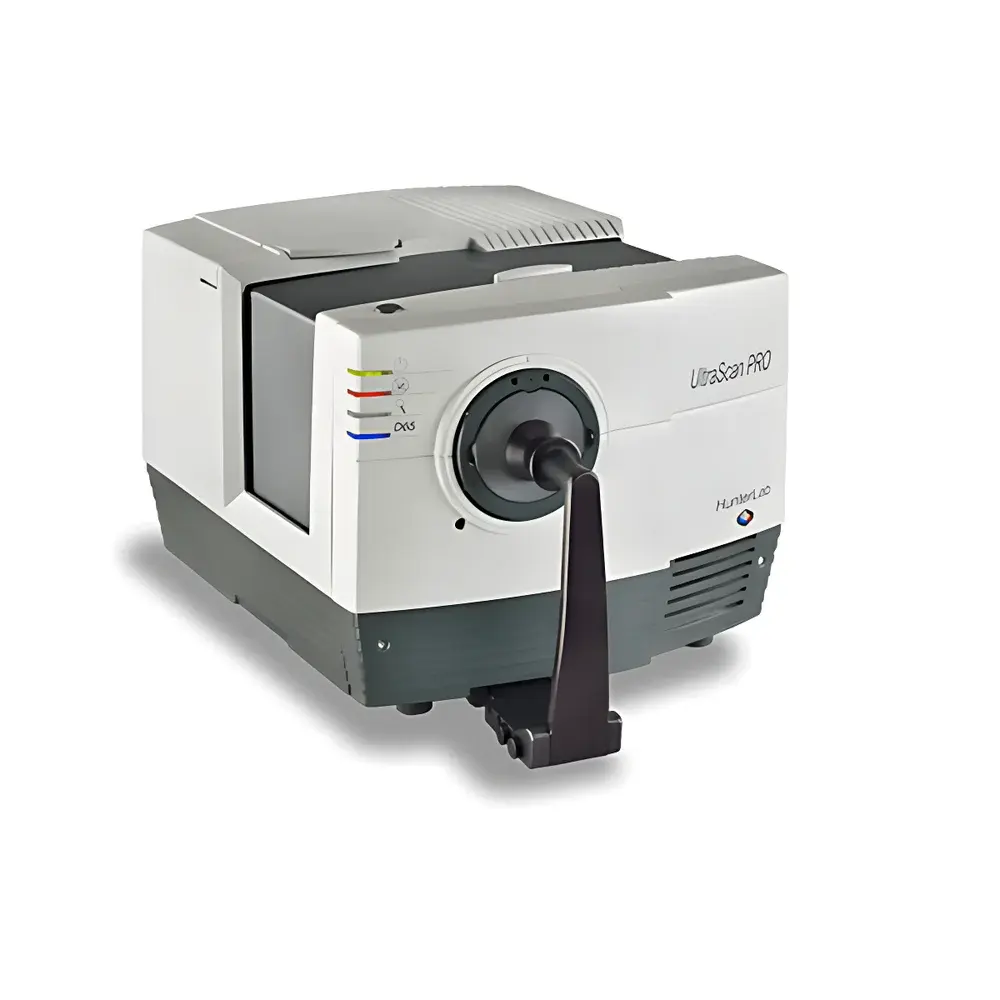
HunterLab Ultrascan PRO-USPRO Benchtop Spectrophotometer
| Brand | HunterLab |
|---|---|
| Origin | USA |
| Model | Ultrascan PRO-USPRO |
| Product Type | Benchtop Spectrophotometer |
| Optical Geometry | d/8° integrating sphere with specular component included/excluded |
| Light Source | Pulsed Xenon Lamp |
| Spectral Range | 350–1050 nm |
| Wavelength Reporting Interval | 5 nm |
| Spectral Resolution | <2 nm (1.37 nm FWHM) |
| Wavelength Accuracy | ±0.1 nm |
| Photometric Range | 0–200% |
| Photometric Resolution | 0.003% (display resolution: 0.01%) |
| Repeatability | ΔE*ab ≤ 0.02 (average, CIE Lab) |
| Measurement Time | ≤2 s |
| Aperture Options | 19 mm (LAV), 9 mm (MAV), 4 mm (SAV) |
| Compliance | ASTM E308, ASTM D2244, ISO 11664, CIE No. 15, DIN 5033, JIS Z 8722, USP <1061>, FDA 21 CFR Part 11 (with EasyMatch-QC software) |
Overview
The HunterLab Ultrascan PRO-USPRO is a high-precision benchtop spectrophotometer engineered for absolute color measurement integrity across the full ultraviolet–visible–near-infrared (UV-VIS-NIR) spectrum. Utilizing a dual-beam, dual-grating optical architecture and pulsed xenon lamp illumination, it delivers exceptional photometric stability and spectral fidelity from 350 nm to 1050 nm — the widest calibrated spectral range available in commercial color measurement instrumentation. Its d/8° integrating sphere geometry conforms to CIE, ASTM, ISO, DIN, and JIS standards for diffuse reflectance and transmittance measurements, with automatic selection of specular component inclusion or exclusion (SCI/SCE) to accommodate both surface-appearance-critical and bulk-color applications. The instrument’s core function is the quantitative determination of tristimulus values (X, Y, Z) and derived color spaces — most notably CIE L*a*b*, L*C*h°, and CMC — with metrological traceability to NIST-certified standards. This enables rigorous inter-laboratory comparability and long-term instrument stability essential for quality control in regulated industries.
Key Features
- Dual-beam, dual-grating optical design ensures real-time compensation for source drift and detector sensitivity variation, delivering superior photometric reproducibility.
- Pulsed xenon lamp provides intense, flash-based illumination across UV-VIS-NIR — eliminating thermal load on samples and enabling stable calibration without warm-up time.
- 512-element silicon photodiode array with 5 nm effective bandwidth and <2 nm spectral resolution (FWHM = 1.37 nm) supports high-fidelity spectral acquisition and robust derivative analysis (e.g., K/S, absorption/scatter ratios).
- 15.2 cm (6″) Spectraflect®-coated integrating sphere optimized for uniform diffuse illumination and high signal-to-noise ratio, especially critical for low-reflectance black, deep-colored, or highly scattering materials.
- Three selectable measurement apertures (4 mm SAV, 9 mm MAV, 19 mm LAV) allow precise adaptation to sample heterogeneity, texture, and size constraints — from small textile swatches to large architectural glass panels.
- Integrated transmission chamber accommodates cuvettes up to 80 mm path length, supporting quantitative analysis of liquids, gels, and transparent films under standardized geometries.
- Compliant with FDA 21 CFR Part 11 requirements when used with HunterLab EasyMatch-QC software, including electronic signatures, audit trails, and user-access controls for GxP environments.
Sample Compatibility & Compliance
The Ultrascan PRO-USPRO measures opaque, translucent, transparent, and liquid samples without modification — including plastics, coated metals, textiles, pharmaceutical tablets, cosmetic emulsions, architectural glass (including Low-E), camouflage fabrics, and optical filters. Its extended NIR capability (up to 1050 nm) enables characterization of NIR-absorbing pigments, photovoltaic coatings, and security inks where conventional VIS-only instruments fail. The system meets ASTM D2244 (color difference), ASTM E308 (computing tristimulus values), ISO 11664 (colorimetry), and USP (color assessment of pharmaceuticals). For food and cosmetics, it supports APHA, Gardner, Saybolt, and Pt-Co indices per ASTM D1209, D1500, D156, and D5386. All calibrations are traceable to NIST SRM 2035 (diffuse reflectance) and SRM 930e (luminous transmittance).
Software & Data Management
HunterLab EasyMatch-QC is the validated, industry-standard software platform for instrument control, method development, statistical process control (SPC), and compliance reporting. It supports multi-user role-based access, full electronic audit trail (including parameter changes, calibration events, and result modifications), and secure data export in CSV, XML, and PDF formats. The software includes preconfigured methods for ASTM, ISO, and industry-specific protocols (e.g., AATCC TM173 for textiles, TAPPI T485 for paper), as well as custom formula builders for specialized indices (Yellowness Index ASTM E313, Whiteness Index CIE/ISO 11475, Haze per ASTM D1003). Data can be integrated into LIMS or MES systems via ODBC or REST API. Optional modules include Spectral Match, Batch Color Matching, and Regulatory Report Packs aligned with ICH Q5, Q7, and 21 CFR Part 11 Annex 11 requirements.
Applications
- Plastics & Polymers: Quantification of batch-to-batch color consistency, pigment dispersion analysis, and weathering-induced chromatic shift in automotive and medical-grade resins.
- Pharmaceuticals: Solid-dose tablet color verification per USP , excipient compatibility screening, and stability-indicating assays for photo-degradation.
- Architectural & Automotive Glass: Measurement of solar heat gain coefficient (SHGC)-relevant NIR reflectance/transmittance and visible light transmittance (VLT) for Low-E coatings.
- Textiles & Camouflage: Multispectral evaluation under D65, A, F2, and custom illuminants to assess metamerism and NIR signature matching for military applications.
- Food & Beverages: Objective quantification of browning (HMF), turbidity (juices), and color stability during shelf-life studies using CIELAB ΔE and hue angle tracking.
- Coatings & Inks: K/S value calculation for opacity prediction, hiding power assessment, and spectral similarity analysis for formulation matching.
FAQ
Does the Ultrascan PRO-USPRO support both reflectance and transmittance measurements?
Yes — it performs bidirectional measurements using interchangeable ports and a dedicated transmission chamber accommodating path lengths up to 80 mm.
Is the instrument compliant with FDA 21 CFR Part 11 for regulated laboratories?
Yes — when operated with EasyMatch-QC v5.0 or later, it provides full Part 11 functionality including electronic signatures, audit trails, and role-based permissions.
What is the significance of the 350–1050 nm spectral range?
This range covers UV-A (315–400 nm), full visible (380–780 nm), and near-infrared (780–1050 nm), enabling detection of UV stabilizers, fluorescent whitening agents, and NIR-absorbing functional pigments not visible to standard VIS instruments.
How does the dual-beam architecture improve measurement reliability?
It continuously references the light source against a stable internal standard during each scan, compensating for lamp intensity fluctuations and detector aging — resulting in <0.02 ΔE*ab repeatability over time.
Can the instrument measure metamerism?
Yes — its high-resolution spectral data (512 points, 5 nm intervals) allows full spectral comparison under multiple illuminants (D65, A, F2, etc.) and calculation of metameric index (MI) per CIE TN 001:2014.






