
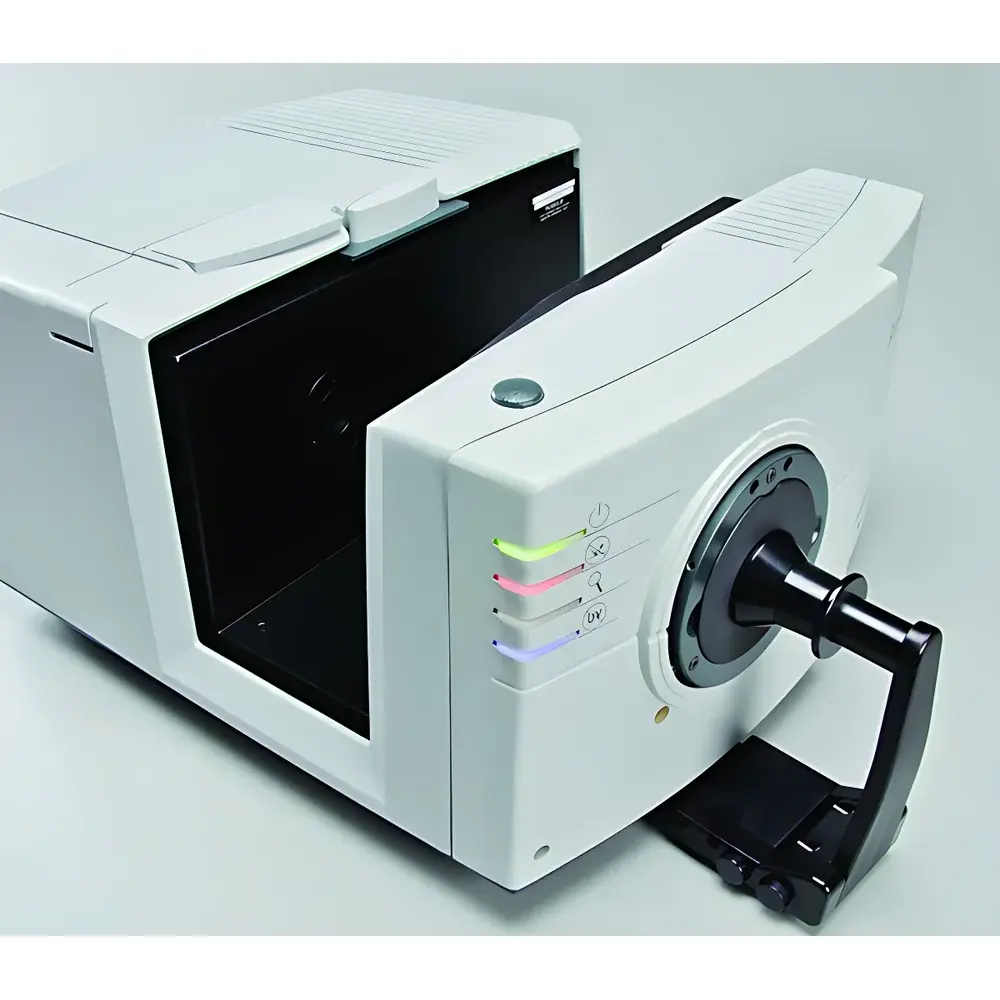
HunterLab UltraScan VIS Benchtop Spectrophotometer
| Brand | HunterLab |
|---|---|
| Origin | USA |
| Model | UltraScan VIS |
| Instrument Type | Benchtop |
| Optical Geometry | d/8° integrating sphere |
| Light Source | Pulsed xenon lamp with D65 simulation |
| Spectral Range | 360 nm – 780 nm |
| Repeatability | ΔE* ≤ 0.03 |
| Sample Measurement Modes | Specular Component Included (SCI) and Specular Component Excluded (SCE) |
| Aperture Sizes | 25 mm and 9.5 mm |
| Measurement Time | < 2 seconds per reading |
| Detector | Dual-beam silicon photodiode array |
| Compliance | CIE 15:2018, ISO 7724-1, ASTM E308, USP <1061>, FDA 21 CFR Part 11 (via EasyMatch QC software) |
Overview
The HunterLab UltraScan VIS is a high-precision benchtop spectrophotometer engineered for absolute color measurement fidelity across the full CIE-recommended visible spectrum (360 nm to 780 nm). It operates on the principle of double-beam spectral reflectance and transmittance measurement using an integrating sphere with d/8° geometry — a configuration standardized for diffuse illumination and hemispherical collection, ensuring robustness against surface texture, gloss, and sample heterogeneity. Its pulsed xenon light source delivers stable, flash-based D65 illumination without thermal drift or lamp aging artifacts, enabling accurate quantification of both fluorescent and non-fluorescent materials — including those exhibiting UV-induced fluorescence below 360 nm. The instrument’s optical architecture features a rigid stainless-steel mechanical platform, vibration-damped optical bench, and internally coated port surfaces to minimize stray light and maximize signal-to-noise ratio. Designed for laboratory-grade reproducibility (ΔE* ≤ 0.03), it serves as a reference-grade instrument in R&D, quality control, and regulatory-compliant environments where traceable, repeatable color data is mandatory.
Key Features
- Dual-beam silicon photodiode array detector with real-time reference beam correction for enhanced photometric stability and reduced noise.
- Two user-selectable aperture sizes (25 mm and 9.5 mm) optimized for large-area solids and small-volume liquids or powders respectively.
- Automated SCI/SCE mode switching via motorized baffle — eliminating manual reconfiguration and minimizing operator-induced variability.
- Ergonomic, height-adjustable sample stand accommodating irregular geometries: bottles, tablets, films, fibers, granules, and viscous liquids.
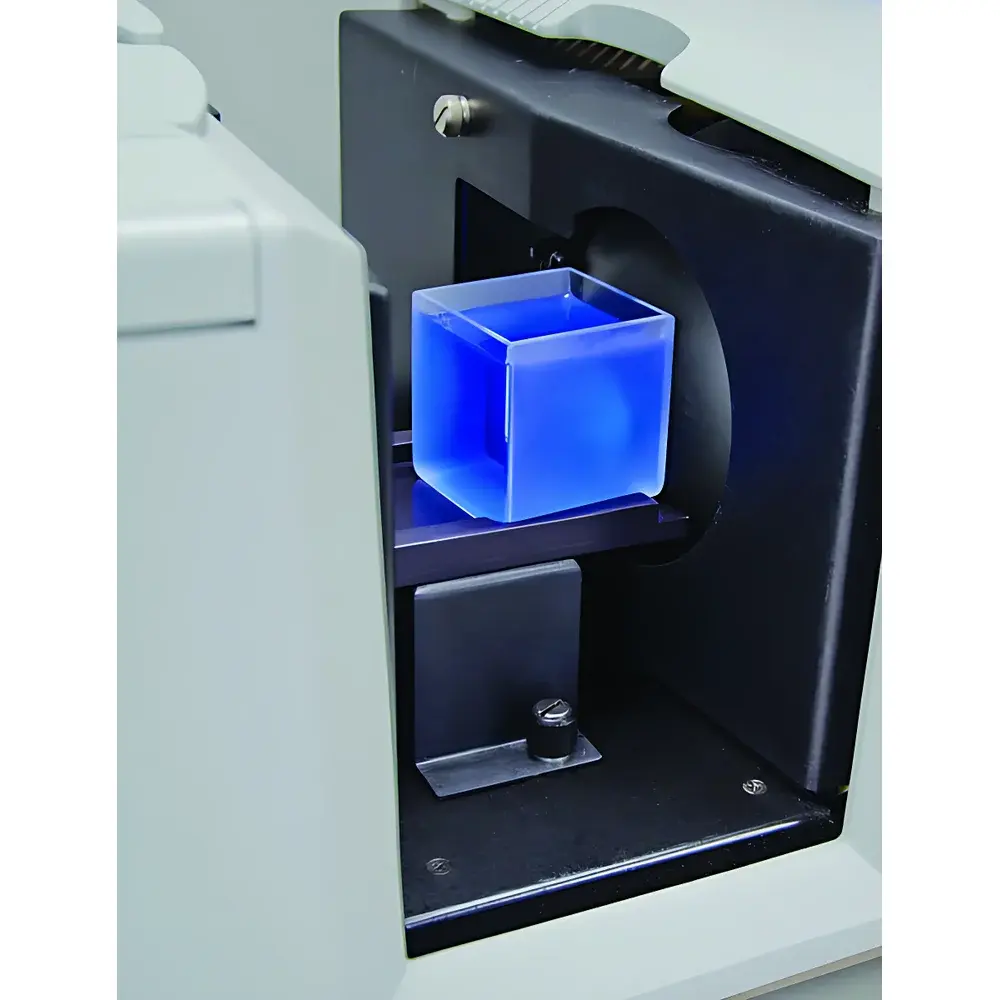
- Open three-sided transmission compartment with ample clearance for oversized samples (e.g., automotive glass, architectural panels).
- Integrated status indicator LEDs for immediate visual confirmation of selected measurement mode, aperture, and calibration state.
- Factory-installed wavelength calibration standards (ceramic tile + interference filter set) traceable to NIST-certified references.
Sample Compatibility & Compliance
The UltraScan VIS supports reflectance measurements of opaque, translucent, and transparent solids — including plastics, textiles, ceramics, metals, coatings, and pharmaceutical tablets — as well as transmittance analysis of clear and hazy liquids (e.g., beverages, solvents, dairy products) and semi-solid dispersions. Its d/8° sphere geometry meets ISO 7724-1 and ASTM E308 requirements for diffuse/total reflectance, while its spectral bandwidth and photometric linearity comply with CIE 15:2018 recommendations for tristimulus computation. For regulated industries, the system — when paired with EasyMatch QC software — supports audit trails, electronic signatures, and data integrity controls aligned with FDA 21 CFR Part 11 and EU Annex 11. Routine verification follows USP guidelines for colorimetric instrumentation used in pharmaceutical development and release testing.
Software & Data Management
EasyMatch QC is the native, validated software platform for the UltraScan VIS, providing full spectral data acquisition, CIELAB/CIELCh/DIN99 color space reporting, tolerance setting (ellipsoidal or rectangular), batch trending, and statistical process control (SPC) charting. All raw spectra are stored in vendor-neutral .qtx format with embedded metadata (instrument ID, date/time stamp, operator ID, calibration history). The software enforces role-based access control, supports GLP/GMP-compliant electronic lab notebook (ELN) integration, and generates PDF reports with digital signatures and revision-controlled templates. Optional modules include Multi-Product Manager for cross-formulation comparison and Color Quality Manager for metamerism index calculation and illuminant dependency analysis.
Applications
The UltraScan VIS is deployed across global manufacturing and research laboratories for objective color specification, formulation matching, and conformance verification. Typical use cases include: pigment dispersion consistency in automotive OEM paint lines; whiteness and yellowness index tracking in paper and textile mills; haze and clarity quantification in PET bottle preforms and pharmaceutical vials; batch-to-batch color uniformity assessment of cosmetic lipsticks and nail polishes; spectral fingerprinting of dyed fibers and carpet tiles; quantitative evaluation of milk fat content via chromaticity shifts; and optical quality assurance of ophthalmic lenses and smartphone display filters. Its ability to resolve subtle hue differences in saturated reds and deep blacks makes it indispensable in display calibration, food science, and advanced material characterization.
FAQ
What is the difference between SCI and SCE measurement modes?
SCI includes specular reflectance and measures total reflectance — ideal for evaluating intrinsic color regardless of surface finish. SCE excludes specular reflectance and simulates human visual perception under typical viewing conditions — preferred for appearance-critical applications such as packaging and consumer goods.
Can the UltraScan VIS measure fluorescent whitening agents (FWAs)?
Yes — its pulsed xenon source emits broad-spectrum UV energy, and its 360 nm lower limit enables detection of fluorescence emission peaks up to ~750 nm. Built-in UV-filtering options allow controlled excitation for FWA quantification.
Is the instrument compliant with pharmaceutical color specifications?
Yes — when operated with EasyMatch QC in 21 CFR Part 11 mode, it satisfies USP , EP 2.2.57, and ICH Q5E requirements for analytical instrument qualification and data integrity in drug product development and release.
How often does the instrument require recalibration?
A daily zero and white calibration is recommended before routine operation. Full wavelength and photometric calibration using certified standards is advised every 6–12 months or after physical relocation or impact event.
Does it support custom illuminants or observer angles beyond D65/10°?
Yes — EasyMatch QC provides over 30 built-in illuminants (including A, C, D50, F2, F7, F11) and observer functions (2° and 10°), with capacity for user-defined spectral power distributions and observer data.




