
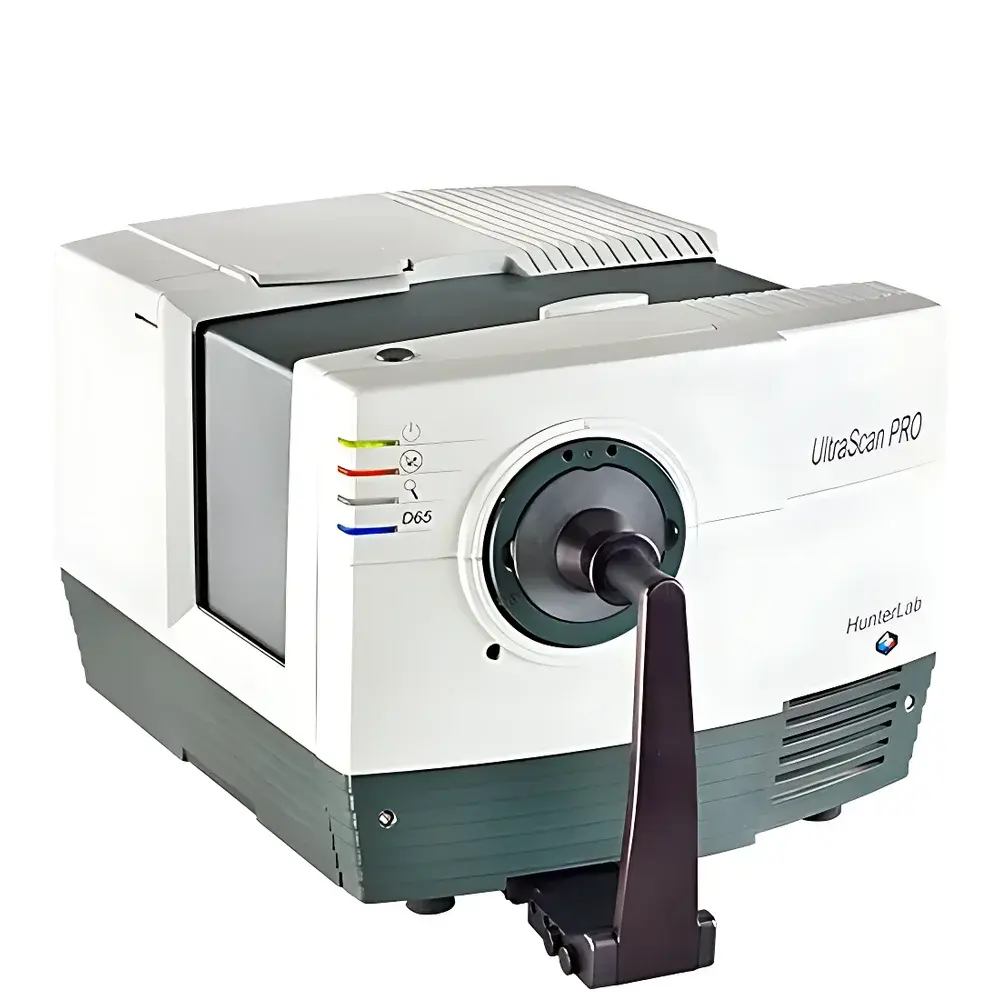
HunterLab USPRO D/8° Integrating Sphere Spectrophotometer
| Brand | HunterLab |
|---|---|
| Origin | USA |
| Model | USPRO |
| Instrument Type | Benchtop |
| Optical Geometry | d/8° integrating sphere |
| Light Source | Pulsed Xenon Lamp (CIE Illuminant D65) |
| Spectral Range | 350–1050 nm |
| Spectral Resolution | <2 nm |
| Bandwidth | 5 nm |
| Reflectance/Transmittance Range | 0–150% |
| Repeatability | ΔE* < 0.03 in CIE L*a*b* on certified white tile |
| Aperture Sizes | 25 mm (LAV), 13 mm (MAV), 7 mm (SAV) with auto-switching and dual-focus lens |
| UV Control | 400 nm cut-off filter, automatic UV calibration and status tracking |
| Measurement Chamber | Large transmission compartment (35.6 × 16.5 × 10.2 cm), tri-directional sliding door |
| Sample Viewing Window | Illuminated |
| Detector | 512-element silicon photodiode array with precision double-layer diffraction grating |
| Sphere Diameter | 6-inch |
| Internal Coating | Spectraflect® patented non-yellowing, abrasion-resistant coating |
| Software | EasyMatch QC (Windows-compatible) |
| Compliance | Fully supports ASTM E308, ISO 11664, CIE No. 15, USP <1061>, and GLP/GMP audit trail requirements |
Overview
The HunterLab USPRO is a high-precision benchtop spectrophotometer engineered for rigorous color measurement across reflective, transmissive, and translucent materials—including plastics, coatings, textiles, pharmaceuticals, food, and optical glass. Its d/8° integrating sphere optical geometry conforms to ISO 11664-4 and ASTM E308, enabling accurate, geometry-independent color data under standardized CIE illuminants. The instrument employs a pulsed xenon lamp calibrated to CIE Standard Illuminant D65, delivering stable spectral output from 350 nm to 1050 nm—covering full UV-VIS-NIR spectral domains critical for fluorescence correction, whiteness index quantification, and near-infrared pigment analysis. Unlike filtered LED-based systems, the broadband xenon source ensures traceable spectral fidelity without interpolation artifacts. The 6-inch integrating sphere is internally coated with Spectraflect®, a proprietary barium sulfate–based material engineered for long-term reflectance stability (>98% diffuse reflectance at 400–1000 nm), resistance to yellowing, and mechanical durability—essential for laboratories requiring multi-year calibration integrity.
Key Features
- Dual-aperture optical path with auto-switching between 25 mm (LAV), 13 mm (MAV), and 7 mm (SAV) measurement ports—each paired with a motorized dual-focus lens to eliminate stray light and ensure optimal signal-to-noise ratio across sample sizes and surface topographies.
- UV control system featuring a mechanically actuated 400 nm cut-off filter, real-time UV status monitoring, and automated UV calibration routines—enabling reproducible measurement of fluorescent brighteners, optical brightening agents (OBAs), and UV-reactive pigments per ISO 105-J03 and AATCC Test Method 183.
- Large-format transmission chamber (35.6 × 16.5 × 10.2 cm) with three-axis sliding access doors (left/right/top) and integrated sample illumination window—facilitating rapid positioning and visual verification of large or irregular samples such as display panels, laminated films, or molded lenses.
- Zero-fan, solid-state thermal design eliminates airflow-induced vibration and acoustic noise (<25 dB(A)), ensuring mechanical stability during extended spectral scans and eliminating maintenance associated with cooling fans or air filters.
- High-resolution spectral acquisition using a 512-element silicon photodiode array coupled with a double-layer holographic diffraction grating—delivering <2 nm spectral resolution and 5 nm FWHM bandwidth for robust peak identification in NIR pigment analysis and spectral derivative applications.
Sample Compatibility & Compliance
The USPRO accommodates opaque solids, transparent liquids, translucent gels, frosted polymers, and optically anisotropic substrates—including LCD cover glasses and anti-reflective coated optics. Its configurable specular component included/excluded (SCI/SCE) mode supports both total color appearance evaluation (e.g., paint gloss influence) and material-intrinsic color assessment (e.g., pharmaceutical tablet formulation). The system complies with FDA 21 CFR Part 11 requirements via optional electronic signature and audit trail modules in EasyMatch QC software. It meets ISO/IEC 17025 documentation standards for accredited testing labs and supports validation protocols aligned with ASTM D2244, ISO 11664-6, and USP for color consistency in regulated manufacturing environments.
Software & Data Management
EasyMatch QC v5.x provides a validated, Windows-native platform supporting method-driven workflows, statistical process control (SPC), and automated pass/fail reporting against user-defined tolerances. All spectral data are stored in vendor-neutral .qtx format with embedded metadata (instrument ID, operator, timestamp, aperture, UV status, calibration history). The software includes GLP-compliant audit trails, role-based user permissions, and electronic signature capability. Optional network deployment enables centralized database management, remote calibration monitoring, and integration with LIMS via ODBC or RESTful API. Spectral libraries can be exported in ASTM E2534-compliant CSV or XML formats for third-party chemometric modeling.
Applications
The USPRO serves as a reference-grade platform for R&D and QC in industries where spectral fidelity and regulatory traceability are mandatory: formulation development of OBA-containing detergents; NIR-based pigment concentration mapping in automotive clearcoats; spectral whiteness quantification in medical device packaging per ISO 11475; color consistency verification of OLED display filters; and excipient-level color monitoring in solid-dose pharmaceuticals under ICH Q5C guidelines. Its extended 1050 nm range supports emerging applications in silicon photonics substrate characterization and agricultural product quality screening via chlorophyll absorption profiling.
FAQ
What spectral standards does the USPRO support?
It fully implements CIE 15:2018, ISO 11664-1 through -6, ASTM E308-23, and USP , including all standard observers (2° and 10°), illuminants (D65, A, F2, F7, F11), and color spaces (CIE L*a*b*, L*C*h°, Yellowness Index, Whiteness Index, ΔE00).
Can the USPRO measure fluorescence-corrected color?
Yes—the integrated UV control system, combined with its continuous 350–1050 nm spectral acquisition and xenon source’s native UV output, enables quantitative fluorescence correction per ISO 11664-7 and ASTM E308 Annex A3.
Is the instrument suitable for GMP-regulated environments?
With optional 21 CFR Part 11 compliance packages (electronic signatures, audit trail, user access controls), the USPRO meets baseline requirements for pharmaceutical, biotech, and medical device color release testing under FDA and EMA guidance.
How often does the instrument require recalibration?
Factory calibration is NIST-traceable and remains valid for 12 months under normal operating conditions; annual verification using HunterLab-certified calibration tiles (white, green, black) is recommended per ISO/IEC 17025 Clause 6.5.2.
Does the USPRO support custom spectral math operations?
Yes—EasyMatch QC includes built-in spectral subtraction, ratio, derivative, and band-integration functions, with export capability for external MATLAB or Python-based chemometric analysis.



