
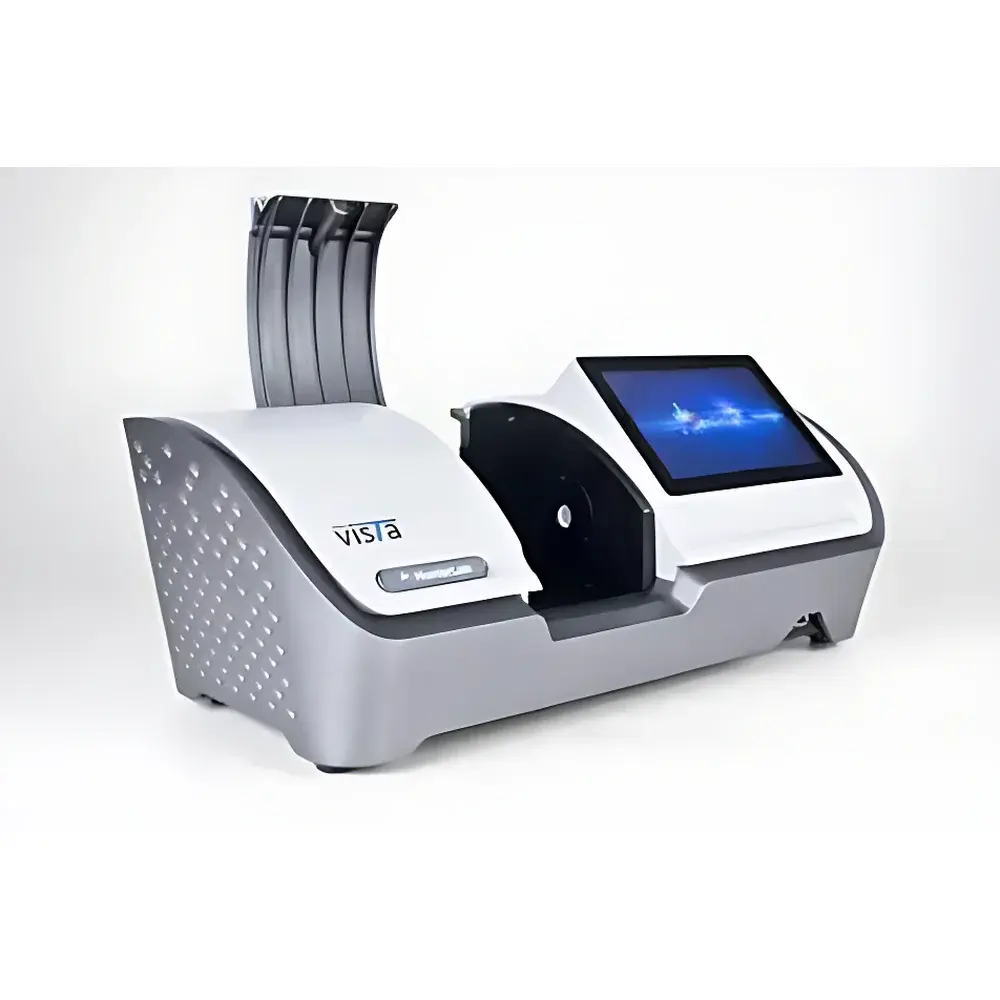
HunterLab Vista Film Color and Haze Spectrophotometer (ASTM D1003 Compliant)
| Brand | HunterLab |
|---|---|
| Origin | USA |
| Model | Vista Film Color and Haze Spectrophotometer |
| Instrument Type | Benchtop |
| Optical Geometry | 0/45° Integrating Sphere |
| Light Source | Full-Spectrum LED Array |
| Spectral Range | 400 nm – 700 nm |
| Repeatability | < 0.02 ΔE* |
| Compliance | ASTM D1003, ASTM E1164, CIE 15:2004, DIN 5033-7 |
Overview
The HunterLab Vista Film Color and Haze Spectrophotometer is a dual-function benchtop spectrophotometer engineered for simultaneous, traceable measurement of color and haze in transparent and translucent film, sheet, and liquid samples. Based on dual-beam optical architecture with a 101.6 mm integrating sphere and 256-element diode array detector coupled to a high-resolution concave holographic grating, the Vista delivers high photometric stability and spectral fidelity across the visible spectrum (400–700 nm). Its 0/45° illumination/viewing geometry conforms to ISO 5–4 and ASTM E308 requirements for colorimetric measurement of non-diffusing materials, while its dedicated haze module implements the collimated transmission methodology specified in ASTM D1003—Type A (parallel-beam) —to quantify percent haze as defined by the ratio of diffusely transmitted light to total transmitted light. Designed specifically for quality control laboratories in polymer, pharmaceutical, food packaging, and specialty chemical manufacturing, the Vista provides NIST-traceable spectral data under both transmission modes: Total Transmittance (TTRAN) and Direct Transmittance (RTRAN), enabling rigorous assessment of optical clarity, yellowness index (YI), whiteness (CIE/ASTM E313), and haze-corrected color values.
Key Features
- Compact benchtop footprint (W × D × H: 305 × 356 × 254 mm) optimized for space-constrained QC labs
- Dual-mode optical chamber with three-sided open transmission port accommodating samples up to 300 mm × 300 mm
- Sealed sample compartment with inert gas purge option (N₂ or dry air) to prevent condensation or oxidation during extended measurement sequences
- Integrated neodymium-praseodymium (NdPr) wavelength calibration filter for daily verification of spectral accuracy per ASTM E259
- Full-spectrum LED source with >50,000-hour lifetime and stable output over time—no warm-up required
- Automated shutter and reference calibration routine ensuring long-term photometric repeatability (< 0.02 ΔE* at CR-10 standard)
- Optical path length configurable at 100 mm for standardized film thickness evaluation per ASTM D1003 Section 7.2
Sample Compatibility & Compliance
The Vista supports rigid and flexible films (PET, PP, PE, PC, cellulose acetate), molded thermoplastics, glass substrates, clear liquids (solvents, syrups, APIs), and coated foils. Sample holders include fixed-aperture clips for 10–100 µm thin films, adjustable slide trays for irregular shapes, and optional liquid cuvette adapters (10 mm, 20 mm, 50 mm path lengths). All haze measurements comply strictly with ASTM D1003–22 Annex A1 (Method A), including beam collimation, detector field-of-view limitation (±2.5°), and stray-light suppression via baffling and black-anodized interior surfaces. Color data generation adheres to CIE 15:2004 spectral weighting functions and illuminant/observer combinations (D65/10°, A/2°, F2/10°), with full compliance to ASTM E1164–22 for spectral data reporting and DIN 5033-7 for industrial color specification.
Software & Data Management
Vista operates via Vision Pro™ 5.0 software—a validated platform supporting 21 CFR Part 11-compliant user access controls, electronic signatures, and full audit trail logging (including instrument parameters, calibration history, raw spectra, and haze calculation metadata). The software enables automated batch reporting per IQ/OQ/PQ protocols, generates ASTM D1003-compliant haze certificates, and exports spectral data in ASTM E2534-compliant .jdx format. Integration with LIMS via HL7 or OPC UA is supported; raw reflectance/transmittance spectra (1 nm intervals, interpolated) are stored with timestamp, operator ID, and environmental sensor readings (temperature/humidity from optional integrated probe).
Applications
- Quantifying haze growth in PET bottle preforms during thermal aging (ASTM D1003 + ISO 14782)
- Monitoring yellowing in UV-stabilized polyolefin films used in agricultural mulch
- Verifying optical clarity of ophthalmic lens coatings per ISO 8980-3
- Release testing of sterile pharmaceutical blister packaging (USP , EP 3.2.1)
- Color consistency validation for food-grade laminated pouches (FDA 21 CFR 177.1520)
- Correlating haze with crystallinity in semi-crystalline polymers via DSC–Haze mapping studies
FAQ
Does the Vista meet FDA requirements for color and haze testing in regulated pharmaceutical packaging?
Yes—the instrument’s hardware design, calibration traceability to NIST SRM 2035, and Vision Pro™ 5.0 software support full 21 CFR Part 11 compliance, including role-based access, electronic signatures, and immutable audit trails required for GMP environments.
Can haze be measured on curved or textured film surfaces?
Haze per ASTM D1003 requires flat, parallel surfaces. For non-planar samples, the Vista includes a plano-convex press fixture (optional) to normalize surface geometry prior to measurement; results must be annotated per ASTM D1003 Section 9.3.
Is spectral data export compatible with third-party chemometric tools like Unscrambler or MATLAB?
Yes—raw transmittance/reflectance spectra are exportable as CSV or ASTM E2534-compliant JCAMP-DX files, preserving wavelength, intensity, and metadata headers required for multivariate analysis.
How often is wavelength calibration required?
The NdPr filter enables daily verification; full wavelength recalibration is recommended annually or after mechanical shock, per HunterLab Service Bulletin VISTA-CL-2023.
What is the minimum film thickness measurable without signal saturation?
With default 100 mm path length and TTRAN mode, the lower detection limit is ~12 µm for low-absorbing polymers (e.g., virgin LDPE); thinner films require optional 10 mm path-length adapter.





