
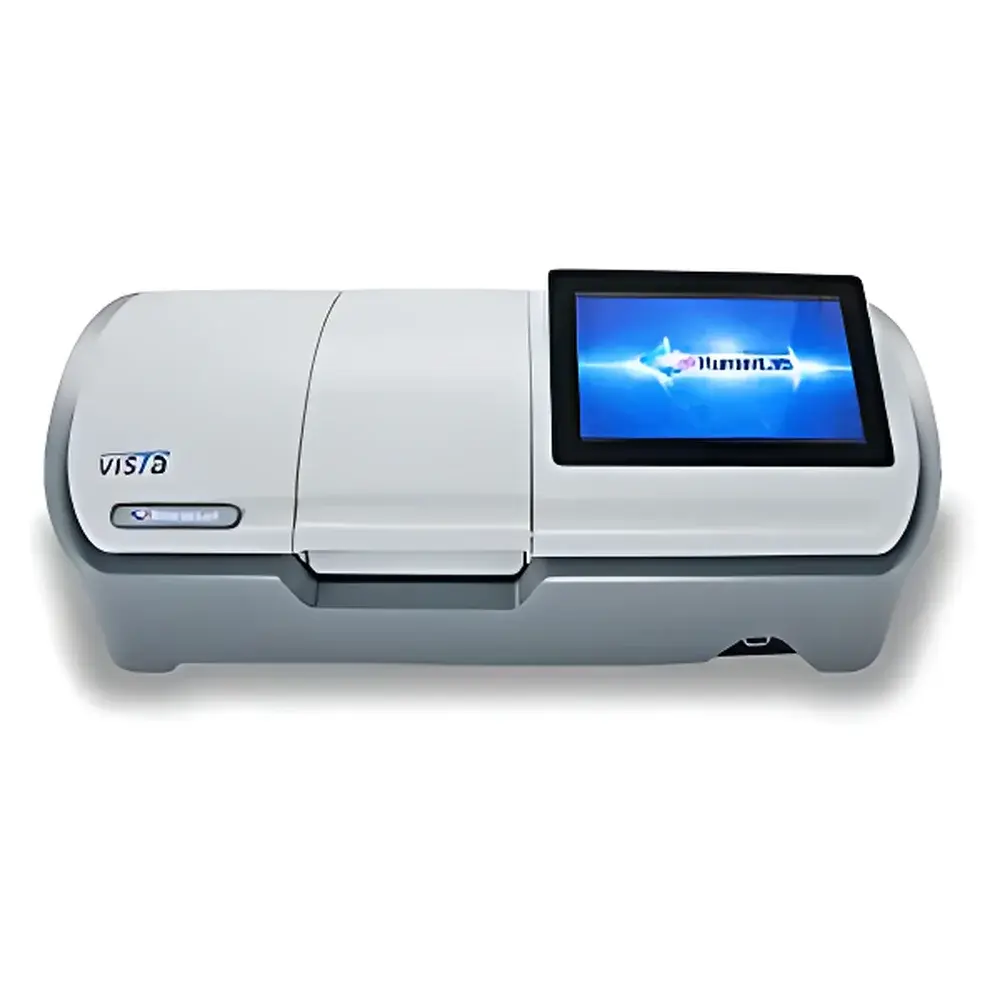
HunterLab Vista Spectrophotometer for Melt Color Measurement
| Brand | HunterLab |
|---|---|
| Origin | USA |
| Model | Vista |
| Instrument Type | Benchtop |
| Optical Geometry | d/8° Integrating Sphere |
| Light Source | Full-Spectrum LED Array |
| Spectral Range | 400 nm – 700 nm |
| Repeatability | < 0.025 ΔE* (30 measurements) |
| Compliance | ASTM E1164, CIE 15:2004, ASTM D1003, DIN 5033-7, JIS Z 8722 Condition E, ISO 7724 |
| Color Scales | CIE L*a*b*, Hunter Lab, CIE LCh, Yxy, XYZ |
| Color Difference Indices | ΔE*, ΔE₀₀ (CIE DE2000), ΔE CMC (l:c) |
| Haze Measurement | Yes |
| Measurement Time | < 2.5 s (color), < 5 s (haze) |
| Illuminant/Observer | D65/10°, C/2° |
| Portability | Fixed benchtop configuration |
| Software Interface | Touchscreen (1280×800), USB & Ethernet connectivity |
| Power Supply | 100–240 VAC, 47–63 Hz, 60 W |
Overview
The HunterLab Vista Spectrophotometer for Melt Color Measurement is a precision-engineered benchtop instrument designed specifically for quantitative color and haze assessment of organic chemical products in their molten state. It operates on the principle of double-beam spectrophotometry with a high-fidelity d/8° integrating sphere optical geometry, enabling accurate capture of total transmittance (TTRAN), regular transmittance (RTRAN), and haze—critical parameters for evaluating clarity and chromatic purity in thermally liquefied materials. The system employs a full-spectrum LED array calibrated to CIE standard illuminants (D65/10° and C/2°), delivering stable, drift-free spectral output across the visible range (400–700 nm) with <3 nm wavelength resolution and 10 nm effective bandwidth. Unlike conventional colorimeters, the Vista acquires full spectral data at 10 nm intervals—enabling traceable, multi-metric evaluation aligned with international standards including ASTM E1164 (for color measurement), ASTM D1003 (for haze), and ISO 7724. Its application scope targets industrially relevant melt-phase organics—such as bisphenol-A, phthalic anhydride, maleic anhydride, terephthalic acid dimethyl ester, and di-octyl phthalate—where color deviation directly correlates with oxidative degradation, trace metal contamination, or incomplete purification.
Key Features
- Integrated dual-mode measurement: Simultaneous acquisition of CIE-compliant color coordinates (L*a*b*, LCh, Yxy, XYZ) and ASTM D1003-compliant haze in a single scan cycle (<5 seconds total)
- Robust optical architecture: 76 mm integrating sphere with 256-element diode array detector and holographic concave grating ensures high photometric linearity (0–150% transmittance) and spectral fidelity
- Thermally stabilized sample compartment: Designed for controlled melt-state analysis; accommodates standardized 100 mm pathlength cuvettes with anti-spill geometry and thermal shielding for operator safety
- Factory-calibrated LED source: Rated for >5 years of continuous operation without recalibration; eliminates lamp replacement downtime and spectral drift associated with tungsten-halogen sources
- Self-validating calibration: Automated internal reference tile verification prior to each measurement sequence, ensuring long-term repeatability (<0.025 ΔE* over 30 replicates)
- Compact footprint and plug-and-play operation: Includes integrated 1280×800 touchscreen interface, onboard data storage, and direct export to CSV, PDF, or networked LIMS via Ethernet/USB
Sample Compatibility & Compliance
The Vista is validated for use with transparent-to-translucent molten organic compounds exhibiting no visible turbidity at processing temperature—consistent with ASTM D1209 (APHA), ASTM D6166 (Gardner), and ISO 6271 (Saybolt) liquid color standards. Sample compatibility extends to high-melting-point aromatics and anhydrides requiring pre-heated cell handling (not included). All reported color and haze values are traceable to NIST-traceable standards and conform to regulatory frameworks governing quality control in fine chemical, polymer precursor, and pharmaceutical intermediate manufacturing. Instrument performance meets GLP audit requirements: full electronic audit trail, user-access logging, and 21 CFR Part 11–compliant software options (available upon request). Certified conformance includes CIE 15:2004 (instrumental colorimetry), DIN 5033-7 (spectral evaluation), and JIS Z 8722 Condition E (transmission geometry).
Software & Data Management
Vista’s embedded ColorQC software provides real-time spectral visualization, batch statistical reporting (mean, SD, CPK), and pass/fail thresholding against user-defined limits—including APHA, Gardner, YI E313, Lovibond Red/Yellow, and ADMI indices. Raw spectral data (.spc) and processed reports (.csv, .pdf) are exportable without proprietary codec dependencies. Optional cloud-sync and API integration support enterprise-level deployment within SAP QM, LabWare LIMS, or TrackWise QMS environments. All measurement metadata—including date/time stamp, operator ID, instrument serial number, calibration status, and environmental sensor logs (ambient temperature/humidity)—are embedded in every exported file to satisfy ISO/IEC 17025 documentation requirements.
Applications
- Raw material release testing for bisphenol-A, phenol, and phthalic anhydride per ASTM D1209 and ISO 6271
- In-process monitoring of melt-color drift during distillation or crystallization of terephthalic acid derivatives
- Stability assessment of heat-sensitive intermediates under accelerated aging protocols (e.g., 120°C/2 hr hold)
- Supplier qualification against color tolerance bands defined in contractual technical specifications (e.g., ΔE* < 0.3 vs. master standard)
- Root-cause analysis of yellowing in polycondensation feedstocks linked to iron-catalyzed oxidation pathways
- Regulatory submission support for FDA IND filings requiring documented color consistency across synthesis batches
FAQ
Does the Vista require external heating accessories for melt-state analysis?
No—the Vista itself is not heated; it is designed for use with externally pre-conditioned samples loaded into thermostatically stabilized cuvettes (e.g., heated sample holders or hot-stage adapters sold separately).
Can haze and color be measured independently?
Yes—measurement mode is configurable: users may select TTRAN-only, RTRAN-only, haze-only, or combined acquisition depending on analytical objective.
Is the instrument compliant with FDA 21 CFR Part 11?
The base firmware supports audit trail and electronic signature functionality; full Part 11 compliance requires installation of optional validated software modules and site-specific validation documentation.
What is the recommended calibration frequency?
Daily verification using the supplied white tile is advised; full recalibration against NIST-traceable standards is recommended every 6 months or after mechanical shock, lamp replacement (not applicable), or significant ambient temperature shifts (>10°C).
How does the Vista handle highly viscous melts that may coat cuvette walls?
The instrument’s 18.5 mm illumination area and 9.1 mm measurement port minimize edge effects; users should employ solvent-rinsed, low-adhesion quartz cells and validate cleaning protocols to prevent residue-induced spectral artifacts.




