
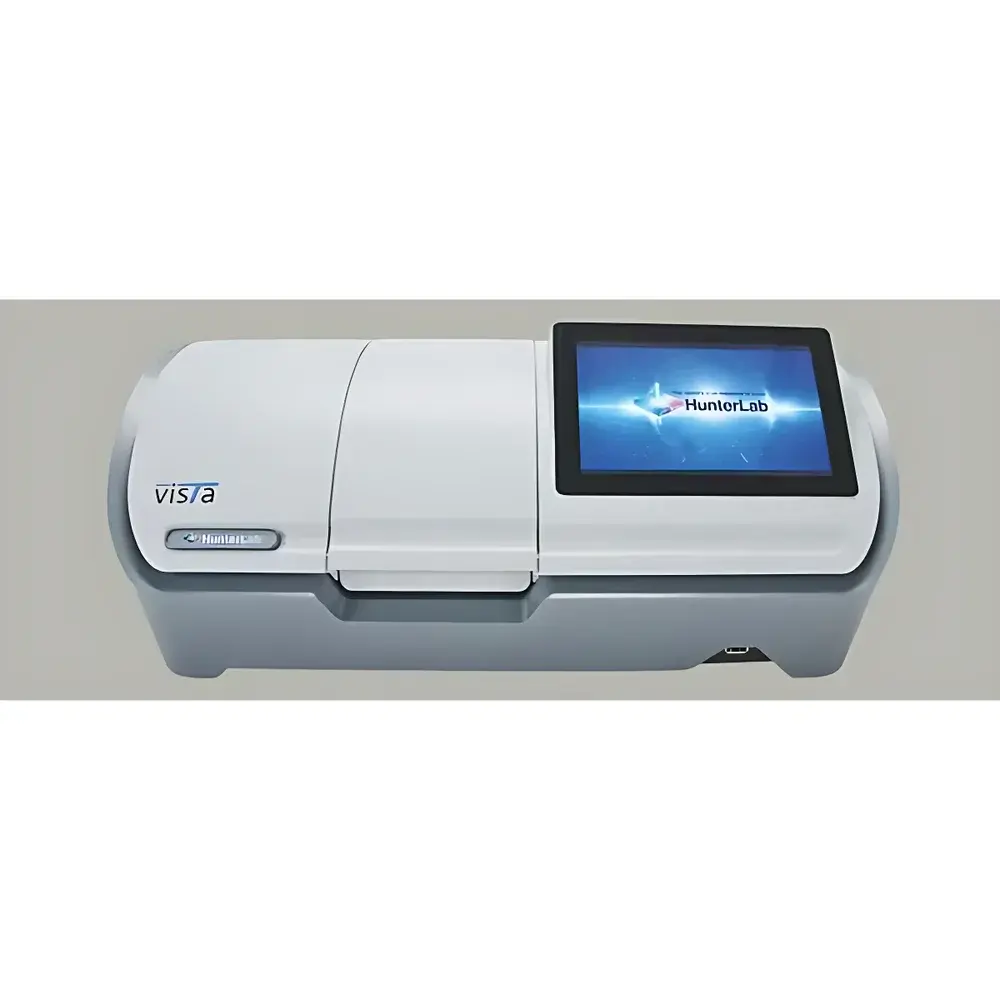
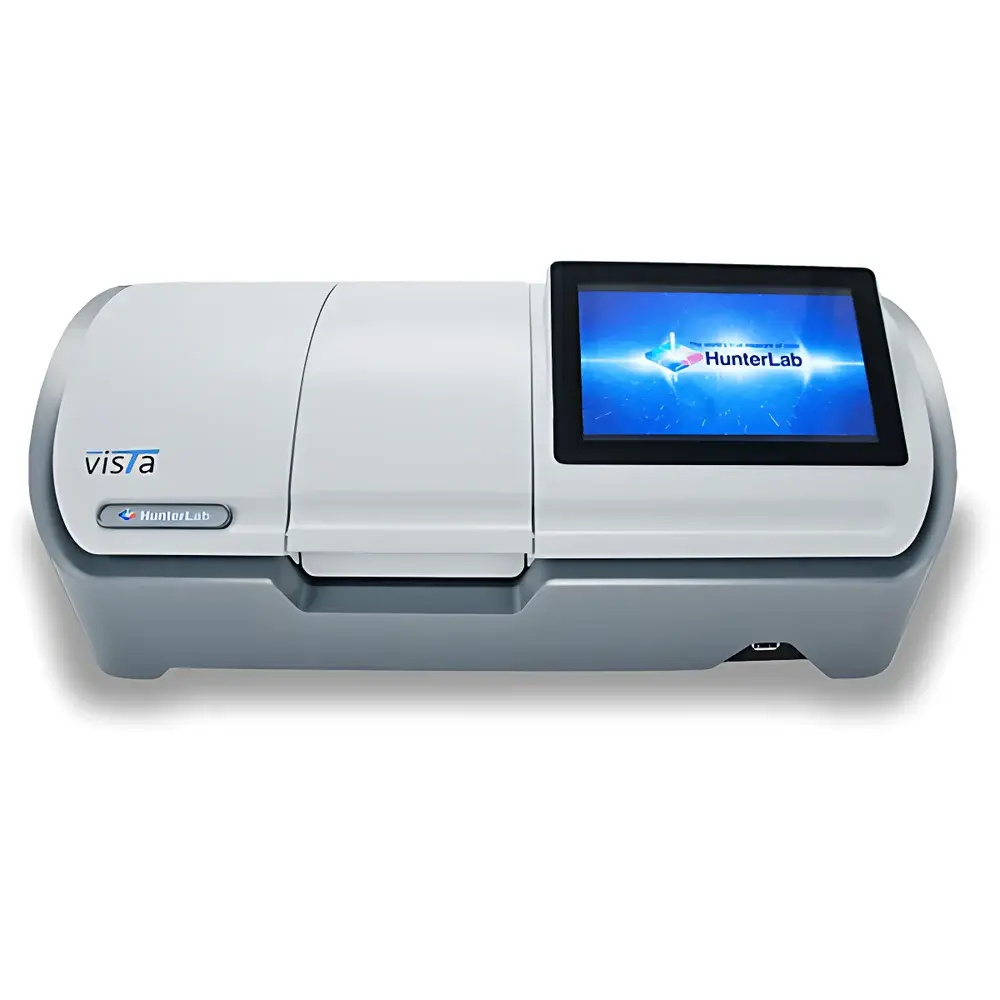
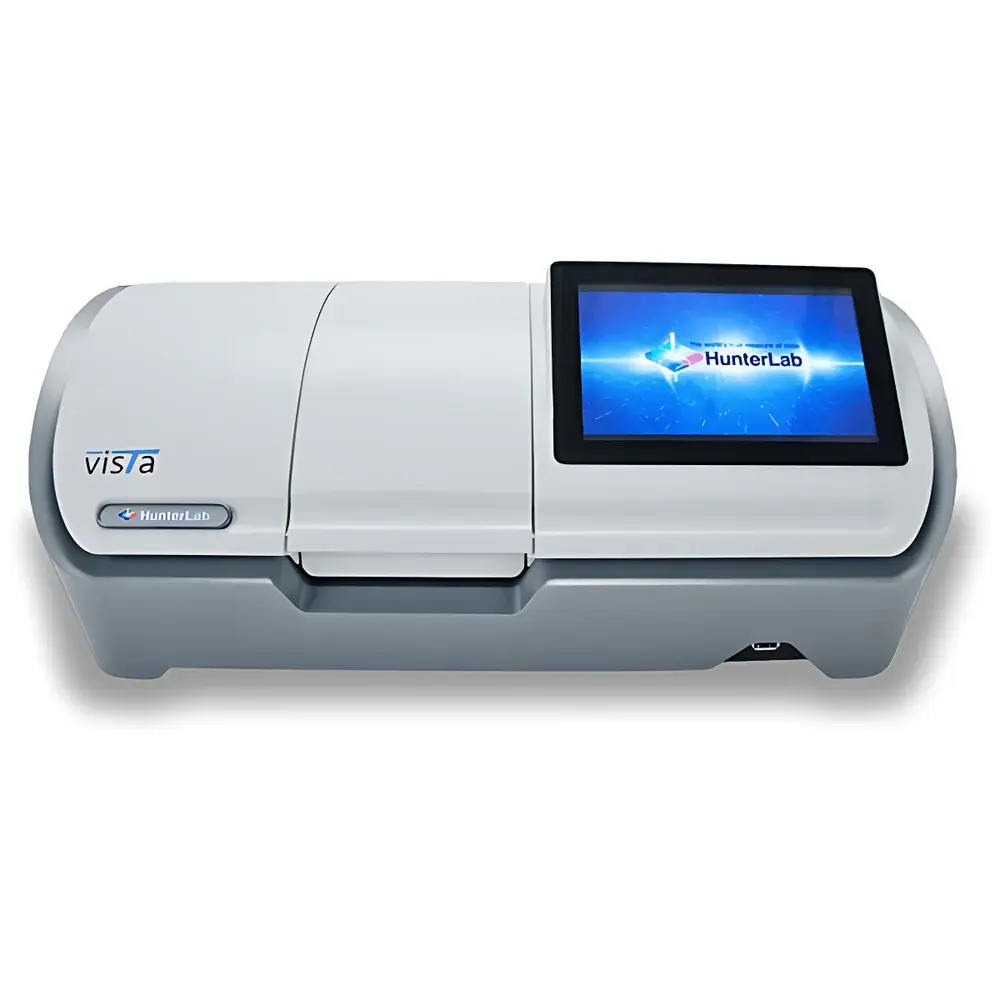
HunterLab Vista Spectrophotometer for Photoresist Resins
| Brand | HunterLab |
|---|---|
| Origin | USA |
| Model | Vista for Photoresist Resins |
| Instrument Type | Benchtop |
| Optical Geometry | d/8° integrating sphere |
| Light Source | Full-spectrum LED array |
| Spectral Range | 400–700 nm |
| Repeatability | < 0.02 ΔE* |
| Compliance | ASTM E1164, CIE 15:2004, ASTM D1003, ISO/CIE standards |
| Color Scales | CIE L*a*b*, Hunter Lab, CIE LCh, Yxy, XYZ |
| Color Difference Metrics | ΔE*, ΔE₀₀, ΔE CMC (l:c) |
| Haze Measurement | Yes, per ASTM D1003 |
| Measurement Time | < 2.5 s (color), < 5 s (haze) |
| Aperture | 18.5 mm (illumination) / 9.1 mm (measurement) |
| Integrating Sphere Diameter | 76 mm |
| Spectral Resolution | < 3 nm |
| Photometric Range | 0–150% |
| Display | 1280×800 color touchscreen |
| Power | 100–240 VAC, 47–63 Hz, 60 W |
Overview
The HunterLab Vista Spectrophotometer for Photoresist Resins is a high-precision benchtop instrument engineered for quantitative color and haze characterization of transparent and semi-transparent polymeric materials used in semiconductor photolithography processes. Designed specifically for the stringent optical requirements of photoresist formulation and quality control, the Vista employs dual-beam spectrophotometric architecture with a 76 mm d/8° integrating sphere to deliver exceptional repeatability and inter-instrument agreement. Its full-spectrum LED illumination (400–700 nm) provides stable, mercury-free, and drift-free spectral output—critical for long-term monitoring of resin batch consistency, solvent content, and aging-related chromatic shifts. Unlike conventional tristimulus meters, the Vista captures complete spectral reflectance and transmittance data at <3 nm resolution, enabling accurate calculation of CIE L*a*b*, Hunter Lab, and specialized yellowness indices (YI E313, YI D1925), APHA/PtCo, Gardner, and Lovibond values—all traceable to NIST-calibrated standards. The system supports both total transmittance (TTRAN) and directional transmittance (RTRAN) modes, allowing precise differentiation between bulk absorption and scattering contributions—a key requirement when evaluating resin clarity, monomer purity, and particulate contamination.
Key Features
- Dual-beam optical design with 256-element diode array detector and high-resolution concave holographic grating ensures minimal thermal and mechanical drift during extended QC runs.
- Integrated haze measurement compliant with ASTM D1003, enabling simultaneous acquisition of color and turbidity metrics in a single sample placement—eliminating repositioning error and throughput bottlenecks.
- Auto-calibration routine with built-in white and black references reduces operator dependency and maintains traceability across shifts and instruments.
- Compact footprint (W × D × H: 33 × 33 × 28 cm) and spill-resistant sample chamber accommodate vials, cuvettes (10 mm and 100 mm pathlength), and custom resin molds without modification.
- Full-spectrum LED source rated for >5 years of continuous operation, eliminating lamp replacement cycles and associated recalibration downtime.
- High-resolution 1280×800 capacitive touchscreen interface with intuitive workflow navigation—no external PC required for basic operation or pass/fail judgment.
Sample Compatibility & Compliance
The Vista is validated for use with liquid photoresist formulations (including novolac, DNQ, and chemically amplified resists), spin-coated films on quartz or silicon wafers (via transmission mode), and cured resin pellets. Sample holders support standard 10 mm and 100 mm pathlength cuvettes, as well as custom cell fixtures for high-viscosity or volatile solvents. All photometric calculations adhere to CIE 15:2004, ASTM E1164 (for color), and ASTM D1003 (for haze), ensuring regulatory alignment with semiconductor manufacturing quality systems. Instrument performance meets GLP/GMP documentation requirements, including audit-trail-enabled software (via optional EasyMatch QC), electronic signatures, and 21 CFR Part 11-compliant user access controls. Inter-instrument agreement is certified at ΔE* (D65/10°) < 0.15 avg. and < 0.25 max. using NIST-traceable transmission filters—critical for multi-site process harmonization.
Software & Data Management
Standard firmware includes embedded data logging with timestamped spectral scans, color coordinates, haze %, and derived indices (e.g., YI, APHA, ΔE₀₀). Export options include CSV, XML, and PDF reports compatible with LIMS and MES platforms. Optional EasyMatch QC software extends functionality with statistical process control (SPC) charts, tolerance band mapping, batch trend analysis, and automated report generation. All raw spectral data are stored in vendor-neutral .qtx format, supporting third-party spectral modeling and machine learning pipelines for predictive resin aging analysis. Audit trails record every measurement event—including operator ID, calibration status, environmental metadata (ambient temperature/humidity if sensor-equipped), and parameter modifications—ensuring full compliance with FDA 21 CFR Part 11 and ISO 17025 requirements.
Applications
- Quantitative assessment of photoresist resin yellowness index (YI E313/D1925) to detect oxidation or thermal degradation during synthesis and storage.
- Batch-to-batch color consistency verification against master standards under D65/10° illuminant—essential for lithographic process window stability.
- Haze profiling of filtered resin solutions to validate filtration efficiency and identify microgel formation prior to wafer coating.
- Transmittance spectral analysis (400–700 nm) to quantify UV absorber concentration and monitor photoinitiator depletion kinetics.
- APHA/PtCo and Gardner scale quantification for solvent-based resin diluents, aligning with ICH Q5C and USP polymer characterization guidelines.
- Supporting DOE studies on resin formulation variables (e.g., monomer ratio, inhibitor level) via multivariate spectral correlation with lithographic performance metrics.
FAQ
Is the Vista suitable for measuring colored photoresist films on silicon wafers?
Yes—the instrument supports transmission-mode measurements through thin-film samples using optional 100 mm pathlength cells or custom wafer-stage fixtures. Calibration accounts for substrate reflectance and thickness-dependent interference effects.
Does the Vista comply with FDA 21 CFR Part 11 for electronic records?
When configured with EasyMatch QC software and appropriate IT infrastructure (user authentication, audit trail, electronic signatures), the system meets all technical and procedural requirements of 21 CFR Part 11.
Can haze and color be measured simultaneously in one scan?
Yes—Vista acquires full spectral transmittance data in <2.5 seconds, from which both CIE colorimetric values and ASTM D1003 haze are computed concurrently without hardware reconfiguration.
What is the recommended calibration frequency for GMP environments?
Daily verification with supplied ceramic tile and air-zero reference is recommended; full recalibration using NIST-traceable standards is advised every 3 months or after instrument relocation or maintenance.
Does the system support custom color difference tolerances for internal QC specifications?
Yes—EasyMatch QC allows definition of multi-parameter pass/fail limits (e.g., ΔL* ±0.3, Δb* ±0.2, haze ±0.1%) with visual alerts and automated rejection tagging.




